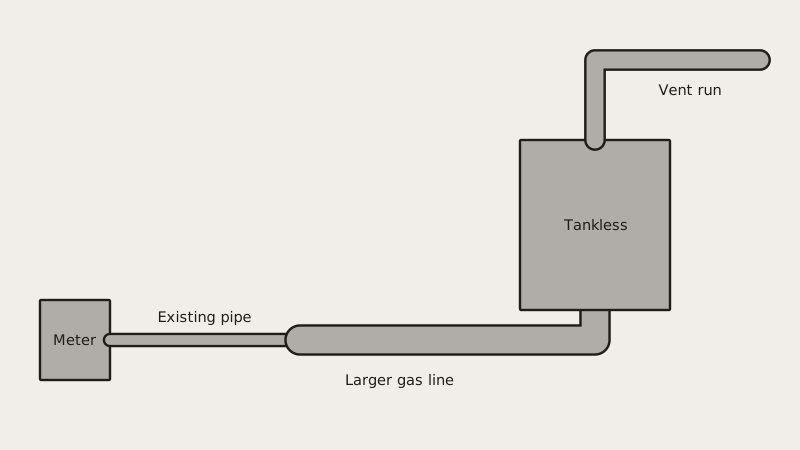
For a gas tankless water heater, budget $3,500 to $5,500 installed when the old tank sits where the new unit will hang, and $6,500 to $8,500 when the gas pipe must be upsized and a new vent run built. Those are published guide figures for Southern California, not Pasadena quotes. The wider picture sits under water heater replacement.
How much should a gas tankless install cost near Pasadena?
Cost guides and Southern California plumbing companies put a straightforward gas tankless swap at about $3,500 to $5,500 including the unit, labor, permit and inspection. Homes that call for bigger gas pipe, fresh venting or wall repair land between $6,500 and $8,500. Wider spreads exist, from roughly $1,800 to over $7,000, mostly from budget units or unusually easy jobs.
What you are paying for, line by line, using the same published guides:
| Item | Typical range (guide) |
|---|---|
| Tankless unit, gas | roughly $1,000 to $2,500 and up for larger condensing models |
| Labor, tank to tankless conversion | $900 to $2,500, often 6 to 8 hours |
| New venting | $300 to $1,200 depending on route |
| Gas line upsize, half to three-quarter inch | $200 to $1,100, more in older houses |
| New gas run from the meter | $300 to $1,200 |
| Permit and inspection | tens to a few hundred dollars by city |
| Seismic straps, valves, flex connectors | usually small, often rolled into the quote |
Source sites disagree, and many are plumbing company marketing pages, so use the table to compare quotes, not to predict one. The plumber who inspects the house gives you the number you can rely on.
Why do tankless quotes in Southern California vary so much?
Because most of the cost is not the heater. Gas line size, vent route, wall access and local permit fees swing the total by thousands. A unit that replaces a tank in an open garage is a short job. One moved to an exterior wall of a finished kitchen is not.
Four drivers matter most in Pasadena houses:
- Gas capacity. At full fire a tankless unit may burn 150,000 to 200,000 BTU an hour, a good deal more than a tank does. Old houses often feed the heater from a half-inch branch that cannot keep up. The price of upsizing depends on distance from the meter and what has to be opened. Who may do that work, and at what price, is covered under gas line work.
- Venting. Condensing models use plastic pipe and a sidewall exit. Non-condensing models need stainless steel flue pipe. Where the pipe can run, and how far, changes the price. Navien's published limits for its NPE-A2 series, for example, are 2 inch PVC up to 75 feet of vent and 1/2 inch gas up to 24 feet, and every brand has its own table.
- Location and finish. A garage, a closet, a crawlspace and an exterior wall all cost different amounts. Stucco and plaster add patching.
- Electrical and drainage. Gas units need power for the fan and controller and a drain for condensate if they condense. Electric tankless heaters have their own issue: they can demand a very large electrical service, which may mean a panel upgrade. We would raise that with an electrician before anything else.
Pasadena's older housing adds its own wrinkles. A 1920s Craftsman with plaster walls and a basement or crawl space, a 1950s ranch with a hall-closet heater, and a hillside house with a detached garage all vent and pipe differently. A plumber can tell in one visit whether your exact layout lands near the low or high end.
How does hard water affect a tankless heater's cost?
Pasadena Water and Power describes its supply as very hard, averaging about 13 grains per gallon in its 2025 data. Scale builds inside a tankless heat exchanger, so owners here should plan on periodic descaling flushes, and some add scale prevention or a softener. That is a running cost, not an install cost, but it belongs in your comparison.
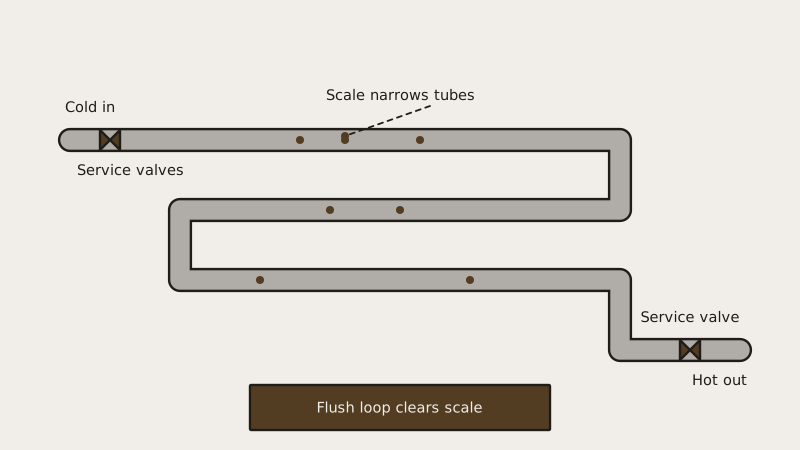
Published sources credit tankless units with a long life, about 20 years according to an ENERGY STAR technical bulletin, compared with a decade or so for a tank. Some sources shave a few years in hard-water areas without maintenance, which is why a flush schedule matters. For comparison with a tank, see tank versus tankless in Pasadena. Softeners carry their own price tag, laid out in water softener installation cost. Swapping one tank for another is priced in gas water heater replacement cost.
Are there rebates, and is a permit needed?
California requires a permit for water heater replacement, and a tankless swap includes gas, venting and sometimes electrical changes, so expect one. Utility and manufacturer rebates have been offered for efficient units. Amounts and eligibility change, so check the gas utility's current offers before signing, and have the plumber say what the quote includes.
Replacement water heaters also fall under the bracing rule in Health and Safety Code 19211, and wall-hung tankless units are generally anchored to the wall. The C-36 plumbing classification at CSLB takes in water heating equipment and gas piping. Permits and $1,000-plus jobs both call for a contractor license: find that number on the quote and look it up.
For federal tax credits, rules have shifted over the last few years, and we cannot confirm current eligibility. Ask a tax professional rather than relying on a contractor's claim.
Is a tankless heater worth the extra money?
It depends on how you use hot water and the number of years you expect to stay put. Tankless saves standby heat loss and supplies endless hot water at a steady flow rate, but upfront cost is higher and payback estimates range from under a decade to well beyond, depending on gas prices and use. Households with big simultaneous demand may need a larger unit or two.
An honest answer needs your numbers: size of household, showers per morning, the existing heater's age and your gas bill. A plumber can size a unit properly, because an undersized one gives lukewarm water when two showers run. For brand-specific installs, see the guides on Navien tankless installation, Rinnai tankless installation and Rheem tankless installation.
To compare real numbers, use the quote page to describe the house, and one of the local plumbers we work with can inspect the space, the gas pipe and the likely vent route. The rest of our plumbing list starts at Pasadena Pipe Works.
Common questions
Will my current gas pipe feed a tankless unit?
Sometimes. Many tank heaters sit on a 1/2 inch branch, and a tankless unit often needs 3/4 inch or larger because it burns a lot more gas at once. The plumber checks the meter capacity, the pipe length and the other gas appliances. Upsizing is a common line item in the guides.
How long does the installation take?
Tank to tankless conversions are commonly described as 6 to 8 hours of labor, so most are done in one day. A job with a new gas run, a long vent or wall repair takes longer. Expect the water and gas to be off for stretches, and ask for a firmer estimate once the space has been seen.
Do I still need seismic straps with a tankless heater?
Earthquake bracing rules cover water heaters, and wall-hung tankless units are typically anchored to the wall instead of strapped like a tank, and the plumber and inspector decide what satisfies the rule at your address. Ask that it appears on the quote.
Can I install a tankless heater myself?
We would not. It combines gas piping, venting, combustion air and sometimes high-amp electrical work, and a permit and inspection apply. One slip can mean carbon monoxide or a gas leak. The permit also brings in a contractor license requirement, so choose someone holding the matching classification and check the record at CSLB.
What should the quote list?
The unit model and size, venting material and run, gas line work, permit, drain or condensate handling, any electrical work, wall patching and taking the old tank away. Also ask about warranty terms from the manufacturer and the installer's own workmanship terms, in writing.
Sources
- Installation cost guides and Southern California plumbing company price pages for gas tankless heaters, checked November 2026
- ENERGY STAR, technical bulletin on demand water heaters (life expectancy)
- Navien, NPE-A2 series (venting and gas line limits, models)
- Pasadena Water and Power, 2026 Annual Drinking Water Quality Report
- California Health and Safety Code section 19211 (water heater bracing)
- California Contractors State License Board, C-36 plumbing classification
Page updated