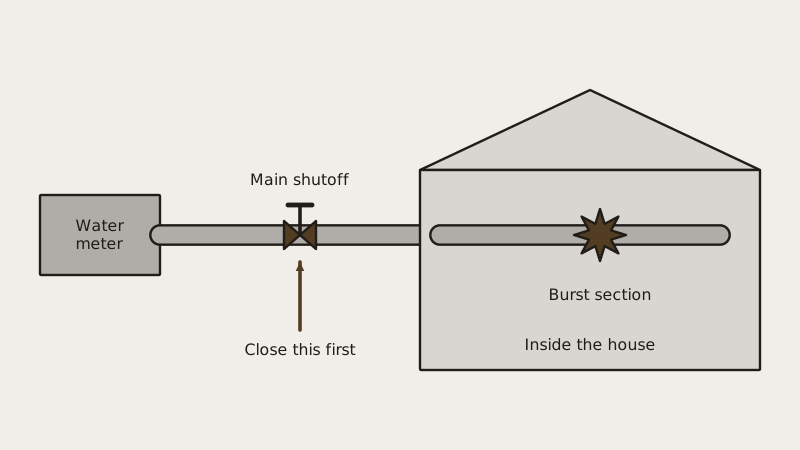
Unwanted water in the house comes down to two steps. The first is yours: close the shut-off valve. The second we arrange. Ring the line shown above, or use the quote form. A local plumber then drives out to your Pasadena or San Gabriel Valley address, locates the break, mends it and puts the price on paper before a single pipe is cut. Below you will find stopgaps, the hunt for hidden leaks and the money side.
Where do I shut the water off when a pipe lets go?
Hunt down the main valve, which sits wherever the line first enters the building: commonly on the front wall by a hose bib, inside the garage, or in the meter box near the curb. A round handle needs several clockwise turns, while a lever shuts in a quarter turn. Next, let the lowest faucet run until flow stops, and set the water heater to pilot or off.
If the floor under you is wet, leave the breaker panel alone. Photograph everything before cleanup, since an insurer will ask. Where a ceiling sags with trapped water, one small puncture at the sagging low point, bucket below, lets it out in a controlled way instead of letting it collapse. The step-by-step version lives in what to do when water leaks through a ceiling. If you need someone at the door fast, the emergency burst pipe plumber page shows how that gets arranged.
Can I find a hidden leak without tearing into walls?
Often yes. The meter is the best tool you own. Shut every fixture and appliance, record the dial, then stay off the taps for two hours and read it again. EPA WaterSense describes the same check. Any movement means water is leaving the system, even when the pipe lies hidden behind drywall, inside concrete or beneath the lawn.
Then shrink the search:
- Toilet tanks. Stir a little food coloring into the toilet tank, then leave the flush handle alone for ten minutes. A tinted bowl points to a worn flapper, the most frequent culprit.
- Main valve test. Close the house valve. If the meter still spins, the leak is outside, in the buried line from meter to foundation.
- Your senses. A warm spot on a floor, a faint hiss at night, bubbling paint, a damp smell or low pressure all suggest a pipe behind a surface.
- The water heater, especially its relief valve discharge pipe and the floor around the tank.
Leaks that survive this checklist need electronic detection with acoustic listening gear and a thermal camera. Published prices for a detection visit fall between $150 and $500, and some plumbers credit the fee toward the repair. Leaks under concrete floors get their own treatment in slab leak repair or repipe.
Which leak shows up in houses more than any other?
The toilet flapper wins. A flapper is a rubber disc that wears, warps and lets tank water trickle into the bowl for months with no sound at all. Next come dripping faucets and the braided supply connectors beneath sinks. EPA puts the typical home at over 9,300 gallons of leaked water a year, and one drip per second at more than 3,000 gallons.
Real pipe failures are the second tier. In a Craftsman bungalow or a 1950s ranch, expect corroded galvanized steel, pinholes in old copper and tired joints. Water here is hard, with Pasadena Water and Power reporting 202 to 256 parts per million for 2025 data, a blend of local groundwater and imported supply. Scale is not the only factor in pinholes, but it does not help. A green crust on a copper joint is the early warning, covered in repairing a leaking copper pipe.
Do repair clamps and tape actually stop a leak?
A stainless sleeve clamp with a rubber liner, matched to the pipe's outside diameter, can hold a pinhole or short split for a few days. A push-fit coupling can bridge a section that has been cut out. Both buy time. Neither is a finished repair, and any clamp on a supply line should be swapped for a proper section soon.
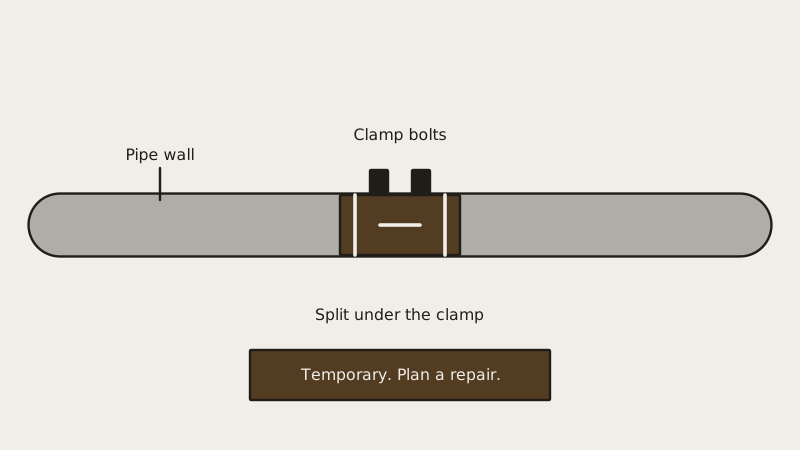
Skip the tape. Gorilla tape is a duct-tape cousin and will not hold a pressurized pipe. Plumber's tape, the thin white roll, seals threads only. Epoxy putty can close a small weep on a dry, depressurized pipe but fails when the line is live. Pressure keeps leaning on the weak spot next to a patch, so a clamped line is on borrowed time.
What will a burst pipe repair set me back?
For an accessible burst, plan on roughly $500 to $2,000 for the plumber, according to published prices. Pipe material, wall access and an after-hours call push the figure around. Drying out and rebuilding wet drywall or flooring is a separate trade and a separate invoice, frequently the larger one. Treat the figures as a guide only. What counts is the figure the plumber writes down for you.
| Job | Published range |
|---|---|
| Swap out an accessible length of pipe | $500 up to $2,000 |
| Pinpoint a hidden leak with equipment | $150 up to $500 |
| Leak under the slab, repair or reroute | roughly $500 through $4,000 |
| Repipe the whole house | $4,000 through $15,000 |
A pipe in the garage costs less than the same break inside a hallway wall. Copper runs above PEX. Nights, weekends and holidays carry a premium. We go deeper in what fixing a burst pipe costs. Ask for pipe repair and surface repair to be listed on separate lines, so you can compare them fairly.
How cold does it need to get before pipes split?
Think 20 degrees Fahrenheit, held for hours, around pipes that sit in unheated attics, crawlspaces or outdoors. Water swells about 9 percent as ice forms, and the pressure cracks the pipe. In Pasadena that kind of cold is rare, so freezing explains few of the bursts here.
Age, pressure and movement explain more. Galvanized lines rust through from the inside. Street pressure and water hammer wear on joints. Soil creeps on hillside lots, tugging at buried fittings. Foothill homes near the Arroyo can still see a hard frost, and exposed hose bibs and sprinkler risers are the first casualties, so wrap them when a cold night is forecast. See preventing a pipe burst and the early signs of a burst pipe.
Will a burst pipe always cost a lot?
No. A split in exposed copper or PEX under a sink is a short visit. The bill grows once the pipe sits behind plaster, above a ceiling or under concrete, since opening and closing finished surfaces eats the hours. Water damage usually outweighs the plumbing line item, so how quickly you close the valve counts for more than who holds the wrench.
Two habits keep costs sane. Request the quote in writing before anyone starts. And if a house with older pipe produces its third pinhole, ask whether a repipe makes more sense than another patch. A plumber should be able to explain both paths in plain words.
Common questions
Who foots the bill when a water pipe bursts?
You cover the plumber and the broken pipe. A standard homeowners policy often covers the water damage that follows when the discharge was sudden and accidental, while slow leaks are commonly excluded. Tenants report to the landlord, who arranges the fix. Phone your insurer before cleanup starts, and keep photos. Read how burst pipe insurance claims usually work.
Is it realistic to repair a burst pipe myself?
Closing the valve and clamping a pipe for the night is realistic. The lasting repair is another matter. State law sets a threshold of $1,000 for labor combined with materials. Past it, the work goes to a contractor that holds a California license. That person also deals with any permit and the pressure test. Owners may work on their own home, but a pipe inside a wall is a poor first project.
Does a plumber handle leaks, or is that someone else?
Plumbers handle leaks: tracing the source, replacing pipe, repairing fixtures and water heater connections, and judging whether a repipe is due. Drying the building and rebuilding drywall is restoration, a separate trade, and a plumber can usually point you to one. Our plumbing services page lists the rest.
What does the "135 rule" mean in plumbing?
No official definition exists. Plumbers mostly use it for drain lines: total horizontal turn between cleanouts stays under 135 degrees, and a bend is built from two 45-degree fittings instead of one sharp 90. It concerns drains, not leaking supply pipe. The local plumbing code has the final say on cleanout spacing.
Which trade repairs water pipes?
A plumber. The state's plumbing classification is C-36, handed out by the Contractors State License Board. Its website shows a contractor's license status, bond and complaint history with the number printed on a written quote. Pipefitters and steamfitters mostly work on industrial and process piping.
Browse every service we arrange on the Pasadena Pipe Works home page.
More in this guide
- Burst water pipe
Water pouring from a burst pipe? The first five minutes matter: find the main, kill the water, protect electrics, then decide what a…
- Ceiling water leak repair
Water coming through a ceiling in a Pasadena home: stop the flow, stay safe, find the source, dry it and repair the drywall.
- Leaks and burst pipes
Homeowners insurance often pays for sudden water damage from a burst pipe but not slow leaks or the pipe itself.
- Leaking copper pipe
Pinhole or joint leak in copper pipe? Stop the water, choose a temporary patch or a proper repair, and learn why Pasadena copper pinholes…
- Ceiling water leak
Water leaking from a ceiling? Immediate steps, how to trace the source, burst pipe repair time, and the 24 to 48 hour window before mold…
- Water spots on ceiling
A ceiling stain with no visible drip can be condensation, an AC drain, a slow pipe leak or an old roof problem.
- Leaks and burst pipes
Why pipes burst in Pasadena homes, in winter and in summer, and the early signs of a leak or burst pipe to watch for before water damage…
- Burst pipe repair cost
Burst pipe, wall leak and slab leak repair costs around Pasadena: price ranges by repair type, what changes the bill, and stopgap fixes…
- Leaks and burst pipes
Burst pipe in your Pasadena home? Shut the water off, make the safe calls, and ask for a plumber.
- Leaks and burst pipes
Signs a pipe has burst in your Pasadena home, how to check under the house and inside walls, plus how to stop a leaking plastic joint…
- Burst pipe prevention
Burst pipe prevention for Pasadena homes: high pressure, old pipe, hoses left on, and the rare freeze.
- Leaks and burst pipes
Slab leak in a Pasadena home: how to spot one, how spot repair, rerouting and a full repipe compare, what each costs and how to request a…
Sources
- California Contractors State License Board, handyperson exemption raised to $1,000
- U.S. EPA WaterSense, Fix a Leak Week
- Pasadena Water and Power, 2026 annual drinking water quality report
- City of Pasadena Permit Center, apply for a permit
- Plumbing Price Guide, pipe repair cost (burst pipe and slab leak ranges)
- Breasy, water pipe leak repair cost (hidden leak detection)
- Estimator Suite, cost to repipe a house
Page updated