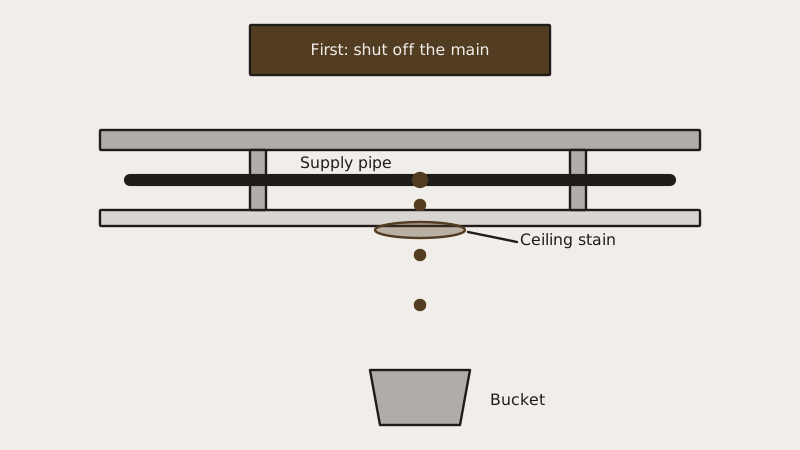
A ceiling that is dripping gives you a short list of jobs, in this order: cut the supply, clear the space underneath, avoid anything electrical that is wet, and then find the source. Turning the main valve clockwise comes first because a pressurized pipe overhead keeps pouring until the supply stops. Power to the room goes off only when the panel can be reached from dry floor.
Below you will find the opening moves, a way to trace the water, realistic repair times and the mold deadline. Wider coverage of split pipes sits on our burst pipe plumber page.
What comes first when the ceiling starts to drip?
Turn off the main, run the lowest tap until the lines are empty, and get people and belongings from beneath the stain. Set a bucket, photograph the damage, trip the room's breaker if the panel is dry to reach, and phone a plumber. If anything smells of gas, leave the building before doing any of that.
A few awkward situations need more care:
- A sagging bulge. Water trapped over drywall can pull a whole panel down, and wet board weighs a lot. Some homeowners poke the lowest point of the bulge to steer water into a bucket. Do that only with power off to the area and while standing well clear of what could fall; when in doubt, leave it for the plumber.
- A wet light fixture. Water in a fixture is a shock risk. Leave the switch alone and trip the circuit breaker instead.
- Furniture and valuables. Slide them aside or cover them with plastic sheeting.
- Evidence. Date-stamped photos of the source, the ceiling and the floor will matter to an insurer.
Rotten-egg odor means gas. Get outside, then call SoCalGas, 1-800-427-2200; someone in danger means 911. The utility explains its steps at socalgas.com.
How can I trace the source of the water?
Close the main and watch. If the drip fades within minutes, a pressurized supply pipe was feeding it. If the drip goes on, look at drain lines, the roof, or an appliance such as an air conditioner or a water heater in the attic. Timing tells a lot: after rain points up, after a flush points to a drain line.
| Observation | Probable source |
|---|---|
| Only after rain | Roof or flashing |
| Ends when the main is closed | Supply line |
| Starts when someone upstairs uses a tub or toilet | Drain line, tub or toilet seal overhead |
| Near an attic air handler | Condensate line or pan |
| Brown ring, nothing dripping now | An old or on-and-off leak; see water spots on a ceiling |
| Wet light fixture | Water tracking along a pipe or wire above |
Two-story houses, condos and apartments often trace to the unit overhead. A leak under a second-floor bathroom commonly means a toilet flange, shower pan or tub drain, and the fix involves either the upstairs unit or an opened ceiling. Notify whoever lives above and the building manager.
To see what a failed pipe looks like, our guide on how to spot a burst pipe helps.
Which leak turns up most often in homes?
Small ones: a toilet that runs on, a drip at a faucet, a weeping supply connection or heater fitting. EPA credits the typical household with more than 9,300 gallons of leakage a year. Ceiling leaks specifically usually come from an overhead drain or supply line, or the roof, and they are noticed after damage is already under way.
Most start gently, with a faint stain, a musty smell or a bubble in the paint. A mark that expands after upstairs fixtures run is a drain; one that grows in a storm is the roof. Resist painting over it. Paint hides dampness and can seal moisture in.
Older Pasadena homes have particular weak points: galvanized supply pipe that has nearly run its course, cast iron drains with corroded joints, and original shower pans. If one gives way, others may be close behind. Drain-side details are in our page on cast iron pipes.
How long does fixing a ceiling pipe burst take?
A reachable pipe may take a few hours: locate it, cut out the damaged stretch, splice in new pipe, pressure-test. Once a wall or ceiling must be opened, add time, and drywall work waits until everything has dried. A firm duration can't be given before a plumber sees it, so request a schedule alongside the quote.
Treat it as five stages. The water is stopped, the leak is located (sometimes with a thermal camera or moisture meter), the pipe is repaired, the structure is dried, and drywall, texture and paint come last. A plumber handles the first three; drying and finishing tend to go to other trades, and the ceiling stays open until it is dry.
Price ranges for these stages sit in the burst pipe repair cost guide, and ceiling water leak repair walks through the repair itself.
How soon does mold appear on a wet ceiling?
Potentially within days. The U.S. Environmental Protection Agency wants wet areas and belongings dried within a day or two (24 to 48 hours) to stop mold. After that window, drywall, insulation and framing become candidates. EPA recommends professional help when the affected area exceeds roughly 10 square feet or the water was contaminated.
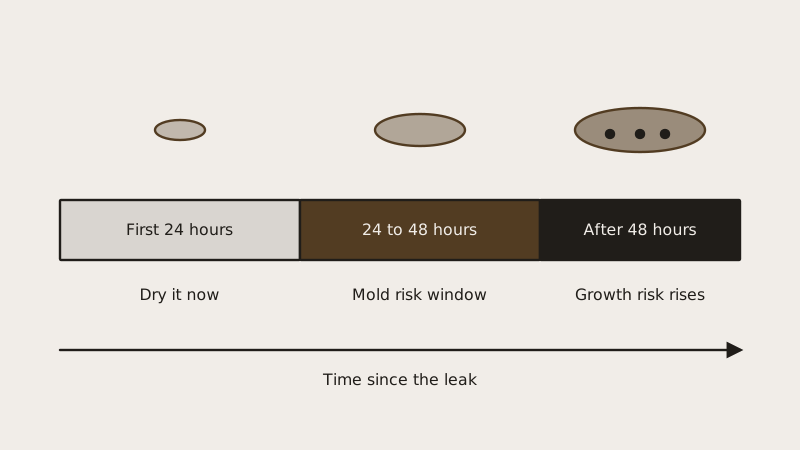
The first two days matter most: stop the leak, open a saturated ceiling, set up fans and a dehumidifier, and strip out soaked insulation. Absorbent materials like ceiling tile and wet drywall may need to go in the trash. Never paint or caulk over mold. For small cleanups, wear gloves and a mask.
Health is part of the picture. Asthma and allergies can flare around mold, and a musty smell with no visible source hints at hidden moisture. Ask a health professional about symptoms, and consider a specialist to assess hidden growth. Water from a sewer or drain line is a different problem and shouldn't be handled casually.
What differs for basements, apartments and tiny leaks?
Even a small leak means water is escaping right now. Lower-level ceilings often carry drain and supply lines, so a drip may come from the kitchen overhead. Renters should report in writing to the landlord and photograph their own unit. In each case, find the source before covering anything up.
How each case differs:
- Small leak. Act early. Small leaks rarely stay small, and slow ones feed mold.
- Basement ceiling. Work out which room sits above. A bathroom, laundry or kitchen usually points to the line.
- Apartment ceiling. The building's owner or manager normally controls shared plumbing, and your lease and local rules determine who pays. Keep records. A tenants' group or an attorney can explain where you stand.
- Whole house flooded. Close the main, ring a plumber and your insurer, and begin drying. Emergency burst pipe help covers it.
Expect your water bill to jump. Pasadena Water and Power runs a leak assistance program that can credit part of the excess charge, up to a cap, for a leak you could not reasonably have noticed, once it is repaired and documented. The utility's page has the rules. To test your meter, use the steps in our piece on a jumping water bill.
Whether insurance helps depends on the policy; burst pipe coverage lists what to ask.
How do I arrange a plumber for the ceiling?
Requests go through the quote page. Say where the leak is, whether it halted after the main was closed, and whether it only happens in rain, and attach photos. A local plumber we arrange examines the house, locates the source and writes the price down before repairs begin.
Look up whoever bids on the state board's license search. California expects a contractor license once labor and materials hit $1,000, or when a permit is needed. If the roof is the culprit, you need a roofer instead of a plumber.
The home page shows the other jobs we arrange across Pasadena and the San Gabriel Valley.
Common questions
Is water leaking from a ceiling always urgent?
Treat it as urgent when water is flowing, the ceiling droops, or wet wiring is involved: shut the main, keep clear and call. A dry, stable stain can be left for a scheduled appointment, though it still needs diagnosis, because the source may keep seeping and feed mold.
Can a homeowner repair a ceiling leak?
Stopping the water and drying the space is yours to do, and a handy person might snug a loose accessible fitting. Tracing and repairing the pipe, working on a roof, or opening a ceiling that hides wiring is better left to a professional. Gas and electrical faults are never DIY. Fresh paint won't cure a leak.
Who pays when the leak starts in the apartment above?
Usually the owner or manager arranges the repair, and who pays for damage turns on the cause and the lease. Put your report in writing, take photos, keep receipts, and check whether renters insurance covers your belongings. A lawyer or tenants' resource can explain your rights.
Should the power be off for a ceiling leak?
Yes, in any area where water touches fixtures, outlets or wiring, but only if you can get to the breaker panel without wading. If not, keep back and bring in the utility or an electrician. Never touch a wet switch, outlet or fixture.
How can I tell a burst pipe from a roof leak?
A burst pipe drips steadily in dry weather and stops when the main closes. A roof leak appears with rain and fades afterward. A drain leak shows when fixtures above are used. If the main-valve test doesn't settle it, a moisture meter in a plumber's hands can trace the source.
Sources
- U.S. Environmental Protection Agency, a brief guide to mold, moisture and your home
- U.S. EPA WaterSense, Fix a Leak Week
- Pasadena Water and Power, water leak assistance program
- SoCalGas, natural gas safety
- Published repair-cost guides for burst pipes and water damage, checked November 2026
Page updated