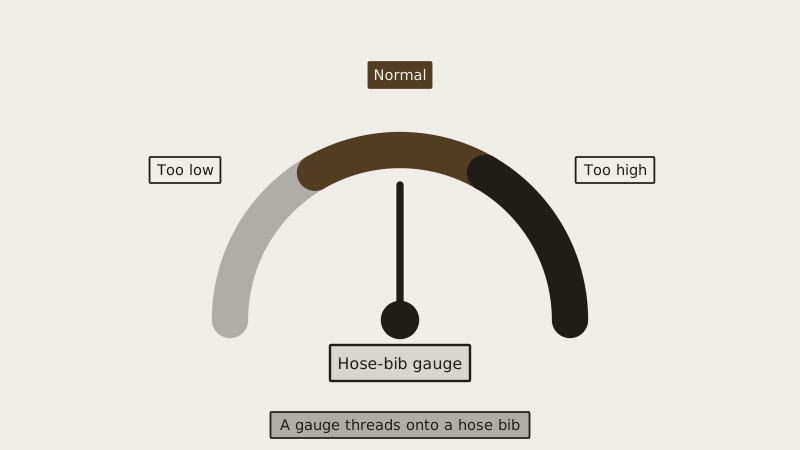
A weak flow through the pipes of a home traces back to a short list: a gummed-up aerator, a tired pressure regulator, supply pipe that is half shut or rusted narrow, or a fault upstream, on the water utility's own line. Tell us which fixtures run weak. A local plumber, booked through us, arrives with a gauge, finds the cause and names a price for the cure. For other jobs, begin at the home page.
Ahead: the quick checks, the role of the regulator, what repairs cost around Pasadena, and the point where pressure turns from annoyance into danger.
Where do I start when pressure drops?
First, map the problem. A single sluggish faucet normally needs its aerator cleaned. A handful of weak outlets implicates the pipes inside the walls. If everything runs weak, hot and cold, look at the regulator near the front hose bib, and where none exists, phone Pasadena Water and Power, whose troubleshooting page lists its own checks.
Try this order, ten minutes in total:
- Twist off the faucet aerator and flush the screen under the tap. Mineral flakes plug it fast.
- Compare hot and cold. Only hot weak? Look at the water heater valves, a topic covered in low hot water pressure.
- Open the front hose bib. Weak there too, and the regulator or street supply is suspect.
- Make sure the main shutoff and the valve at the meter are wide open. If it sits half closed, the entire house is starved.
- Ask a neighbor. Heavy lawn irrigation, firefighting and main breaks dip pressure on a block for a while, as the utility notes.
If the drop survives those checks, bring in a plumber. A permanent loss of pressure at the street is something Pasadena Water and Power's emergency line (626-744-4138) wants to hear about.
Why would pressure collapse on a cold morning?
A deep freeze is unusual on the valley floor in Pasadena, so a slump on a chilly day usually has some other cause: a regulator that quit overnight, a shutoff knocked partly closed, or a new leak bleeding pressure away. With all taps closed, watch the meter dial. Any creeping or spinning points to a leak.
The EPA suggests a simple test: write the meter reading on a scrap of paper, leave every tap closed for about two hours, then compare. A changed number means water is escaping. Foothill streets in Altadena and Sierra Madre sit above the flats, and pressure varies from house to house on a slope. A home near the top of a rise may simply have always run softer.
Old pipe matters too. Plenty of Pasadena homes dating to the Craftsman era and the postwar years kept galvanized steel supply pipe, and that corrodes shut from inside. Flow narrows year after year until the shower dribbles, and swapping a regulator cannot help. A repipe can, as why homes get repiped explains.
How many years will a regulator keep working?
Rule of thumb among plumbers: a home regulator lasts a decade or more, often 10 to 15 years, depending on water quality and pressure swings. The makers we checked print no official service life, so treat that as a field rule, not a promise. Pasadena water is hard, 202 to 256 ppm in 2025 readings, and scale can age a valve early.
Signs a regulator is tiring:
- Creep. Pressure rises overnight with no one using water.
- Hammering. Pipes thump when a valve snaps shut.
- Spitting taps or a hiss when a faucet opens.
- A heater relief valve that drips, or toilets that refill on their own.
- Low pressure that never recovers, which means the valve is failing closed.
A gauge screwed on a hose bib shows the truth in half a minute. Many plumbers want to see static pressure in the range of 50 to 70 psi, and 80 psi is the usual ceiling in plumbing codes. If you read above that, the fix is a regulator, not a tweak.
Where does the regulator hide?
Look for a brass, bell-shaped valve on the main line where water enters the house. Often that is close to the front hose bib, though it can sit in a garage or crawlspace beside the shutoff. Pasadena Water and Power gives the same pointer, front hose bib first. Some homes have none.
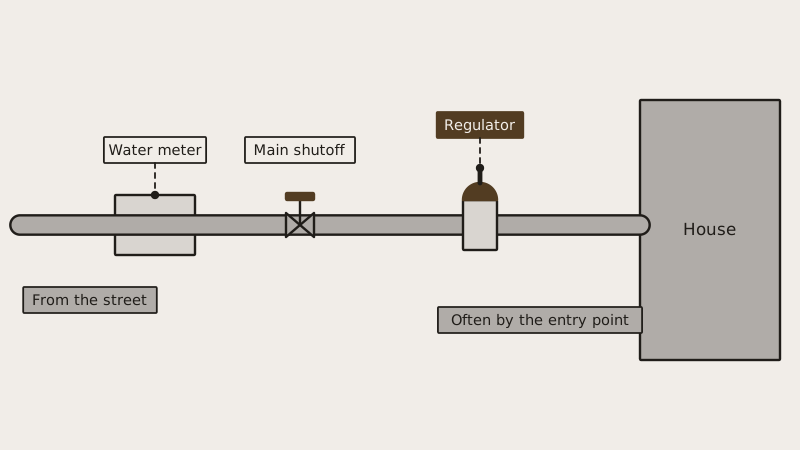
Stuck? Follow the pipe from the curb meter box toward the house and look for a chunky fitting with an adjusting screw and locknut on top. Our guide on where a regulator is located shows what to look for, and the one on whole-house regulators explains sizing.
Slab homes, townhomes and condos tend to tuck it behind a wall panel, above a garage ceiling or in a shared utility room. Where several units share a building, the owner or association may control it, so ask them first.
Is adjusting the regulator a DIY job?
A working regulator can be nudged. Slacken the locknut, then rotate the screw in quarter turns, checking a gauge after each one. Turning right usually raises the setting and turning left lowers it. Quit if the valve spurts, sticks or cannot hold a setting, since that points to worn internals.
Step-by-step detail lives in adjusting a water pressure regulator valve. Two limits apply. Never wind the screw to its stop. And swapping a regulator is plumbing work that cuts into the main line and may need a permit. Under California law, a job needing a permit, or totaling $1,000 across parts and labor, goes to a contractor who holds a state license. Turning the screw on a healthy valve is not a repair.
One caution: if the valve was set low to quiet the pipes, raising it can push a weak joint past its limit, so look for drips afterward.
What will a new regulator cost?
Published 2026 cost guides put a professional replacement near $250 to $900, with most jobs between $300 and $700. The valve alone runs roughly $50 to $350, and labor swings with access and with whether new shutoffs, unions or an expansion tank are needed. Think of those numbers as signposts, because only the written estimate fixes a price.
What moves the number:
- Valve size and type. Three-quarter inch is common. Larger service lines cost more.
- Access. A valve beside the hose bib is cheaper to reach than one wedged in a crawlspace.
- Extras. An expansion tank, new ball valves or corroded unions add to the bill.
- Permit. Some jobs need one, so ask the quote to list it.
Our regulator installation cost page breaks the numbers out line by line.
Is low pressure ever a danger?
Mostly it is only annoying, though two risks are real. A slowing shower can signal a clogged or leaking line that is soaking a wall unseen. And some tankless heaters require a minimum flow before they fire, so weak supply may trigger lockouts or cold streaks. The truly hazardous end is too much pressure, which strains joints and appliances.
Go past 80 psi and a washing machine hose can burst, fittings fail early and toilet fill valves wear out. Sudden swings may mean a failing regulator, and hammering often means pressure is high. The goal is steady pressure inside a safe window, not the strongest possible stream.
Irrigation shows weak pressure as lazy pop-up heads and dry patches. A bigger pump is rarely the answer. Check the backflow assembly and the regulator, then have a plumber measure at the hose bib. For single-fixture trouble, see the kitchen sink guide and weak showers; the wider diagnosis is in Pasadena low-pressure causes.
Common questions
Do plumbers fix leaks too?
Yes, leaks are bread-and-butter plumbing, from a weeping trap under a sink to a failed supply line below a slab. First the source gets located, using a pressure test, a meter check or listening gear. Then the pipe is mended or replaced. Our part is booking the visit and securing a written price before work begins.
What does fixing a water leak usually cost?
If you can see the leak, for example a loose fitting or a worn flexible hose, expect a few hundred dollars. If the pipe is buried behind drywall or under concrete, the bill can climb into the thousands once the surface is opened and patched. Published cost guides vary a lot by location, so these are only a guide. Our burst pipe cost page lists more.
How many years does a hot water heater typically last?
Department of Energy figures: ten to 15 years for most storage heaters, 20 or more for tankless. Hard water, skipped flushing and a spent anode rod cut that short, and Pasadena's mineral-rich supply makes yearly care worthwhile. Past ten years and leaking, start planning a replacement.
What is the typical bill to swap out a water heater?
Standard tanks mostly run $900 to $1,800 installed in 2026 guides, while tankless starts near $1,400 and climbs well past $3,900. Permit, strapping, venting and haul-away move the total. This is a guide only; the water heater replacement price page has the breakdown.
How can I tell the heater's pressure relief valve has gone bad?
Suspect it when the valve drips constantly or sprays while the heater is not overheating, although high household pressure or a dead expansion tank can cause the same symptom. Many makers advise briefly lifting the lever once a year: no flow, or no reseal afterward, means replacement. That is plumber work, because the discharge pipe must meet code.
What is the price of fitting a new pressure regulator?
Most guides quote $250 to $900 all in, with the valve itself roughly $50 to $350 of that. An easy swap in a reachable spot lands at the low end. Tight access or added parts, an expansion tank for instance, push toward the top.
Does drinking water help with low blood pressure?
That is a health question for a doctor or pharmacist, not a plumbing page, and household water pressure has nothing to do with blood pressure. If you feel faint or unwell, contact a medical professional, and call 911 in an emergency.
More in this guide
- Where the regulator sits
Where to find the water pressure regulator in a Pasadena home: near the front hose bib, the garage or a crawlspace.
- Whole house water pressure
A whole house pressure regulator caps street pressure before it reaches your pipes.
- Water pressure and valves
Adjust a home water pressure regulator with a gauge and a wrench: where the valve sits, how far to turn it, how long it lasts, and when to…
- Costs
A pressure regulator usually costs $250 to $650 installed.
- Low water pressure
Low water pressure in a Pasadena home: test it with a gauge, then sort the causes by symptom, from a failing regulator to rusted…
Sources
- Pasadena Water and Power, water troubleshooting (low pressure, regulators, emergency line)
- U.S. Department of Energy, Energy Saver guide (water heater lifespans)
- U.S. EPA WaterSense, Fix a Leak Week (leak and meter test)
- Pasadena Water and Power, 2026 water quality report (2025 data)
- Published prices of regulator replacement from several 2026 U.S. cost guides, checked November 2026
Page updated