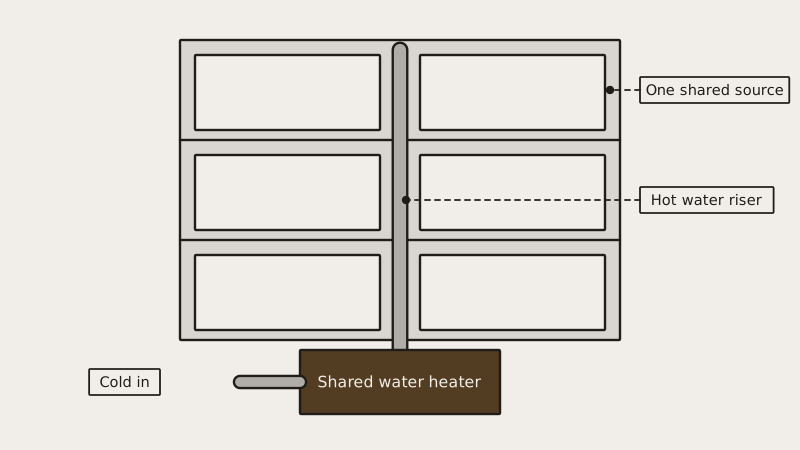
Hot water vanishing from several apartments together points at the building's shared plant: a central heater or boiler that tripped off, a recirculation pump that quit, a mixing valve jammed open, or a closed valve on one riser. Tenants should write to the landlord and keep a copy. Owners and managers need a plumber used to bigger equipment, and water heater repair at building scale is a different trade from a single-family tank swap. What a worn-out unit looks like is covered in water heater replacement.
At Pasadena Pipe Works we wrote this for both sides of the lease: how apartment hot water plants are laid out, the safe checks open to a tenant, what California's habitability law says, where Pasadena tenants report a failure, and what the plumber does in the boiler room.
Why would every unit in the building go cold together?
Because most apartment buildings make hot water in one place. A pair of large heaters or a boiler feeds a pipe loop that serves every unit, so a single failed part leaves all the taps lukewarm. Usual suspects: the central heater shut itself down, the recirculation pump stopped pushing hot water around the loop, a mixing valve is jammed open, or a valve on one riser is closed.
How the system works shapes the symptoms:
- Ice cold across the board. Think central heater: an ignition or pilot fault on gas, a tripped breaker on electric, or a lockout that needs a technician.
- Warm, never hot. A mixing valve stuck open keeps feeding cold water into every tap.
- Hot low in the building, cold high up. Frequently the recirculation pump has stopped, or one riser valve is shut.
- Fine at dusk, gone at dawn. Peak demand, or a pump cycling badly.
- Only your unit. Buildings with a heater per apartment put the fault in that heater or a fixture valve. Our page on what causes no hot water lists the possibilities.
Pasadena has plenty of apartment buildings that go back to the 1920s and beyond, with long pipe runs and equipment patched over generations, and such loops are hard to balance. All the more reason to describe the problem in detail when you report it.
What can a tenant safely check?
Find out whether neighbors are affected, which taps are cold, and whether your unit has its own heater. If it does, look at its power or gas control. Leave the building's boiler, gas valves and mixing valves alone: they belong to the owner's plumber, and a gas fault is a safety matter.
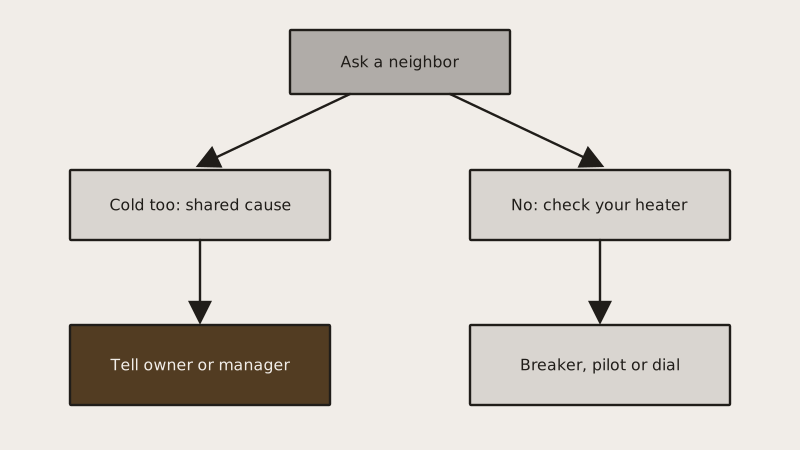
A short, safe checklist:
- Knock on a door or two. A cold building means a shared cause.
- Run every hot tap, kitchen and bath. If just one runs hot, suspect a local mixing or shower valve.
- Find any heater inside your unit, often tucked in a cupboard or out on a balcony. If it is yours, check its breaker, or on gas its pilot and dial.
- Gas odor? Walk out before anything else. Once you are clear of the building, ring SoCalGas (1-800-427-2200), and treat anyone in danger as a 911 matter.
- Leave other people's thermostats alone, and do not relight a gas heater you are unsure about.
- Make notes: the hour the hot water stopped, the units affected, and each person you contacted.
What does the law say about hot water in a rental?
In California, hot and cold running water is one of the things that make a rental habitable. Civil Code section 1941.1 names a water supply able to produce both, delivered to the fixtures, and the City of Pasadena's Rent Stabilization Department repeats the point on its habitability page. A unit that substantially lacks it can count as untenantable.
What tenants can do, according to the City of Pasadena:
- Tell the landlord or manager first, by letter or email if you can, and save a copy.
- Then a Code Compliance complaint, if nothing is fixed or you suspect a code violation: use the city's online form, or phone the City Service Center on (626) 744-7311 on weekdays in office hours. Code Compliance itself answers at (626) 744-8633.
- Rent Stabilization answers questions on rent increases, eviction protections and petitions, but it does not inspect buildings.
State law has another remedy, called repair and deduct (Civil Code section 1942), but the city calls it limited and risky and suggests talking to a housing counselor or an attorney first. Rights questions are outside our field, so use the city's contacts or a legal aid office.
What should owners and managers do first?
Pin down the scope, then phone a plumber who handles multi-unit systems. Look for a gas smell, a tripped breaker, a lockout message on the boiler or a closed valve, and tell tenants what is happening. With habitability at stake, act the same day and keep written notes of the fault, the calls and the repair.
Before the plumber arrives, note:
- Which units and floors are affected, and when it began.
- Whether the heater is gas or electric, and its make and model from the rating plate.
- Any display codes, alarms, tripped breakers or unusual noises at the boiler.
- Whether anything was changed recently: a repair, a shutoff, a new valve.
To choose who to call, read about commercial plumbing services and the difference between commercial and residential plumbers. Night and weekend failures are covered on the emergency commercial plumber page.
How does a plumber get a building's hot water back?
By locating where the heat disappears: heater, pump, mixing valve or somewhere in the loop. The plumber checks the energy supply and controls, tests the pump and valves, takes temperatures along the loop, then repairs or swaps the failed part. If the heater has run its course, the visit turns into a replacement quote.
Typical steps:
- Check supply and controls: gas pressure, ignition, thermostat settings, breakers and safety devices.
- Test the pump and look for closed or stuck valves on risers.
- Check the mixing valve, which blends hot and cold to a safe delivery temperature.
- Flush or descale if hard water scale has built up. Pasadena Water and Power measured about 13 grains of hardness in 2025.
- Repair or replace, with a written price for each.
Pasadena's Building and Safety people say any water heater replacement in Pasadena needs a plumbing permit, and larger gas equipment can bring mechanical permits as well. Its handout also sets rules on strapping and the relief valve drain, which the contractor deals with. Leave that permit to a plumber who has a California contractor license.
How do we set up a plumber visit?
Use the quote form to describe the system, the symptoms and how urgent it is, and a local plumber comes by and states the price in writing. Tenants feel an outage daily, so state when it began and how many units are cold.
Common questions
How quickly is a repair done?
A shut valve or tripped control may be sorted soon after the plumber walks in. A dead pump, mixing valve or heater part can wait on delivery. Replacing a central heater runs over several days once permits and inspection are counted. Expect a timeline only after diagnosis.
What should a manager ask when choosing a plumber?
Obtain the contractor's California license number, ask about multi-unit experience, and confirm whether diagnosis, parts and permit are in the price and when work can begin. Ask for scope and price in writing, plus a note of the cause, which supports your records if tenants ask.
Can a tenant hold back rent over this?
That is a legal matter beyond our answer. State law and the City of Pasadena describe particular remedies, and the city warns that repair-and-deduct is limited and risky. Talk to the Rent Stabilization Department, a housing counselor or legal aid before withholding anything, and keep written records.
What if the landlord stays silent?
Send a written request and hold on to a copy. If nothing changes, file a Code Compliance complaint through the city's online form or the City Service Center, (626) 744-7311. The complaint is logged and sent to the right department for investigation. A gas odor goes straight to SoCalGas.
Sources
- City of Pasadena Rent Stabilization Department, habitability and repairs
- City of Pasadena, resources for reporting rental housing maintenance and habitability concerns
- California Civil Code section 1941.1, untenantable dwellings
- City of Pasadena Building and Safety Division, typical residential gas-fired water heater requirements
- SoCalGas, natural gas leaks
Page updated