South Pasadena is a small city of about 3.4 square miles with roughly 11,100 housing units, and plumbing here behaves differently from the rest of the valley for three reasons: the houses are old, the tap water comes from more than one source, and the city runs its own permit desk. We arrange plumbers for the whole city. This page covers what is particular to it, and the areas page shows the neighbouring cities we also serve.
Why does the water in South Pasadena change from street to street?
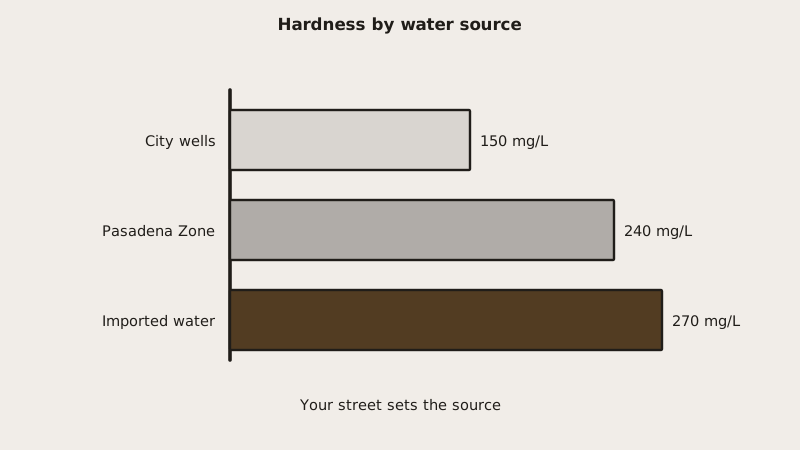
The city's own 2024 water quality report says the supply comes from three sources: wells in the Main San Gabriel Basin, imported Metropolitan Water District water, and groundwater bought from the City of Pasadena, which reaches only the Pasadena Zone. Which source feeds your street sets the hardness of your water, and hardness sets the pace at which scale coats fixtures and tank bottoms.
The same report lists hardness as calcium carbonate. South Pasadena's own groundwater measured 150 mg/L (range 140 to 150, tested 2021). The Pasadena groundwater supplied to the Pasadena Zone measured 240 mg/L in 2024 (range 210 to 270), and the Metropolitan imported water measured 270 mg/L (range 240 to 300). Convert at 17.1 mg/L per grain: roughly 9 grains for the city's wells, about 14 for the Pasadena Zone water, and about 16 for imported water.
In practice, two neighbours can see different scale on a showerhead. If your heater wears out early, or a faucet cartridge keeps clogging, hardness is a suspect. A plumber we arrange can inspect the heater and talk through a softener. Our guide to water hardness by zip code explains how to read the numbers. For the install side, see softener system installation. Ask the city's Public Works office which zone your address sits in before you decide.
What kind of houses and pipes does South Pasadena have?
South Pasadena is mostly early twentieth century housing. The city's Inventory of Historic Resources lists many Craftsman homes built from about 1903 to 1924, and its design guidelines call Craftsman the most common style in the historic neighbourhoods, followed by Mission and Spanish Colonial Revival, with Tudor and Colonial Revival added in the 1920s and 1930s.
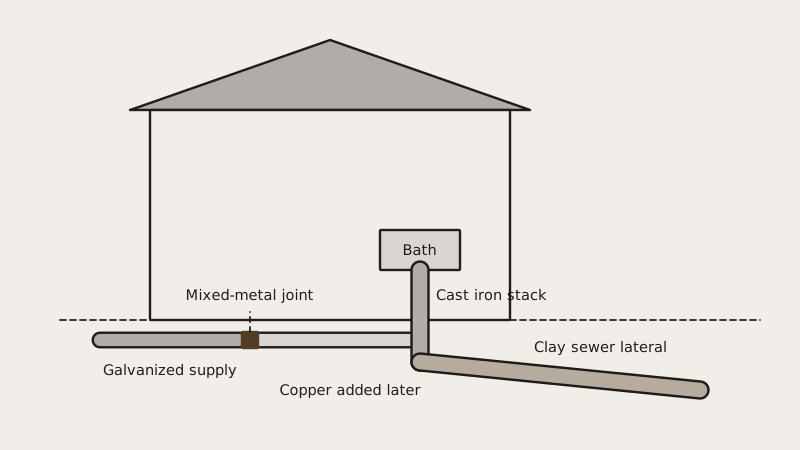
Pipes follow the era. A house from that stretch can still carry rust-narrowed galvanized steel supply lines, waste stacks of cast iron, and clay sewer laterals invaded by roots. Houses that were partly remodelled usually mix materials: copper added in later decades, newer PEX or plastic where a bathroom was redone. Joints between different metals are where leaks tend to show up first.
Hillside streets near the Arroyo Seco add a practical wrinkle. On sloping lots the water main, the sewer and the house can sit at quite different heights, which affects water pressure and how a drain line is routed. Many houses of this era also sit on raised foundations, which helps a plumber reach pipes from below, though a tight crawl space adds labour time to a quote.
Renters occupy a bit over half of the city's occupied homes according to census figures, so many calls come from landlords as well as owners. If you manage a rental, mention it when you book: tenant access and notice matter for the visit.
If a house has failing galvanized or old copper lines, a repipe may be cheaper than repeated repairs. Weigh why people repipe against the repipe cost guide first, and see how cast iron pipes age.
What should a plumbing job in South Pasadena run me?
The city has no price list of its own, and published plumbing guides disagree widely on hourly rates, call fees and job totals, so no single figure would be honest for your house. Most work is priced flat after the plumber has looked at it, and the written quote sets the price before any tools come out.
A whole-house repipe is quoted far higher than a repair, with published guides running roughly $4,000 to $15,000, driven by house size, access and plaster repair. Tank water heater swaps and toilet replacements land well below that. Treat all of this as ballpark. Plan around the written quote that comes after the visit.
What pushes South Pasadena quotes up is the housing: tight crawl spaces, plaster walls that must be patched, historic features an owner wants kept, and the permit step. The water heater price guide breaks that job down.
Which city rules touch a plumbing job in South Pasadena?
South Pasadena's Building Division lists a new or replacement water heater as a job that needs a permit, with no design approval needed. Applications go by email to the city's permit technician. State law also requires the heater to be strapped to the wall. Anything above $1,000 in labor and materials is work where state law demands a contractor license, so ask whoever quotes to confirm theirs.
Heater swaps, gas piping and main line work belong to a contractor, because a permit and inspection come with them. With a gas odor, get everyone outside before doing anything else. The utility line is 1-800-427-2200 (SoCalGas), to be dialed from outdoors. Anyone in danger means 911 instead.
Historic houses add a second layer. The city has a Cultural Heritage Commission that reviews changes to designated historic properties. Plumbing that stays inside the walls rarely raises an issue, but anything that alters the outside of a listed house, such as a new vent, deserves a call to the city before you book.
The city also keeps a Lead Service Line Inventory, and its report says Public Works will arrange an appointment to view it (626-403-7240). If your house is old, ask whether your service line is galvanized or lead before a repipe, and read water heater replacement if the heater is the reason you called.
What happens when I book a visit in South Pasadena?
Send the quote form or phone the number shown above. Give us your street, the symptom and the rough age of the house, and say whether water is escaping now. Someone local comes out to inspect the problem, and a price in writing reaches you while the tools are still in the truck. Phones are answered weekdays, 9am to 5pm.
Gather before the call:
- Any earlier plumbing work you can recall, and the year the house went up.
- Photos of the leak, the heater label or the fixture.
- The location of your main water shutoff.
- Rent or own, and whether a landlord must sign off first.
If a pipe is pouring, shut the main valve and then ring us. Old valves seize, so exercise yours gently on a calm day and ask about replacing it if it sticks. For gas, the earthquake shut-off valve guide is the one to read.
Common questions
What will a South Pasadena plumber charge?
Published guides vary too widely to quote one hourly rate for this city, and many repairs are flat-priced after an inspection. Heater swaps, toilet replacements and repipes each depend on access, the age of the house and the permit step. The binding figure is the quote in writing, and it only exists after someone has stood in your house.
Does a heater swap in South Pasadena need a city permit?
Yes. The Building Division's list marks new and replacement water heaters as permit jobs, with no design approval needed, and the contractor normally files the paperwork. A faucet or flapper rarely needs one, yet gas lines or moved pipes are worth a question to the division.
Is South Pasadena water hard?
Yes, moderately to very hard. The 2024 report shows 150 mg/L for the city's own wells, 240 mg/L for Pasadena groundwater in the Pasadena Zone and 270 mg/L for imported water. That is roughly 9 to 16 grains per gallon. Scale on fixtures and a shorter heater life are the usual signs.
Are there lead pipes in South Pasadena?
The city says it has prepared a Lead Service Line Inventory, open to the public by appointment with Public Works. Its 2024 sampling found lead in three of 32 homes, one above the action level. Older houses can also hold lead solder or galvanized pipe indoors, so have the visiting plumber note the service line material.
For the bigger picture, start from the plumber guide for Pasadena.
Sources
Page updated