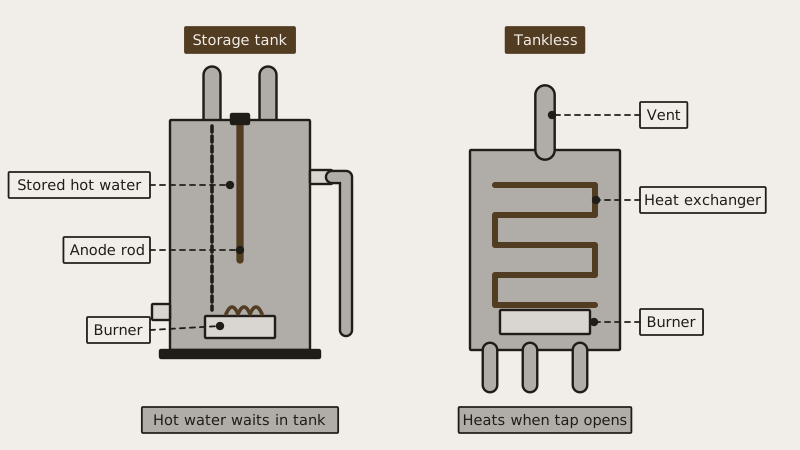
One design stores somewhere from 30 to 80 gallons, heated, in a steel vessel all day; the other fires only when a tap opens. Tankless costs more up front and often needs a bigger gas line and new venting, but it takes up little space and can last longer. A tank costs less to put in and is simpler to swap. For many Pasadena homes the right pick comes down to hot water use and what the existing gas line, vent and wall can carry.
This guide supports our broader page on water heater replacement. It covers money, energy, installation, and the repairs each type tends to need.
How does a storage tank differ from a tankless unit?
A storage unit warms a reservoir and keeps it there until someone needs it. A tankless unit, also called demand-type, pushes cold water through a heat exchanger the moment a faucet opens and shuts off when it closes. No standby heat loss results, though the burner can raise only so many gallons per minute at one time.
Day to day, the two feel different. A tank hands you a big batch, then empties, then makes you wait for recovery. Tankless keeps the hot water coming, within a flow ceiling. Run a shower, the dishwasher and a washing machine at once and a single small unit can fall behind, with water turning lukewarm.
Plenty of "no hot water or pressure" complaints trace back to this kind of mismatch. A heater sized for two bathrooms can't carry four. If your hot water fades only when several fixtures run, sizing is the first suspect. If it vanishes completely, start with the reasons hot water stops.
How do tank and tankless water heater costs compare?
Installed, a tank heater generally costs $600 to $3,100 depending on fuel and capacity. A tankless unit typically lands between $1,400 and $5,600 and moves higher whenever the gas pipe, vent or electrical service has to change. Those are national price-guide ranges and only a rough yardstick; what counts is the figure printed on your written quote.
| Setup | Typical installed range (guide) | What pushes it up |
|---|---|---|
| Gas tank, like-for-like swap | within the tank range above | Bigger tank, relocation, code upgrades |
| Electric tank | about $600 to $3,100 | New circuit, heat pump models |
| Gas tankless, vent and line reusable | about $2,100 to $4,500 | Condensate drain, controls |
| Gas tankless, first-time conversion | often $3,000 or more | Larger gas pipe, new venting, wall work |
| Electric tankless | $1,400 up to $3,000 | Panel or wiring upgrade, priced on top |
Across sources the biggest bill belongs to a tank-to-tankless conversion, since the work around the heater outweighs the heater itself. For the model-specific angle, see our pages on tankless installation cost and the price of water heater replacement.
Does a tankless water heater really save money?
It saves energy, but the amount tracks your hot water habits. According to the federal Energy Department, demand-type heaters beat storage tanks by 24% to 34% in homes using roughly 41 gallons a day of hot water, and by 8% to 14% in homes near 86 gallons a day. The more a household uses, the less tankless gains.
Now the arithmetic. Take the extra install cost on your own quote and divide it by the yearly energy savings you can expect from your hot water use. Where the extra cost is large and the savings modest, payback can stretch close to the unit's whole working life, which the Energy Department puts above 20 years for tankless against 10 to 15 for storage models.
So the honest summary: tankless pays off for small to mid-size households that stay power-conscious and plan to stay a long time, and for anyone who wants the floor space back. For a rental or a house you plan to sell within a few years, a tank often makes more sense. People searching for a "tankless vs tank water heater calculator" can plug the figures from a written quote into any simple spreadsheet: extra install cost divided by yearly savings.
What does a Pasadena house need before tankless will fit?
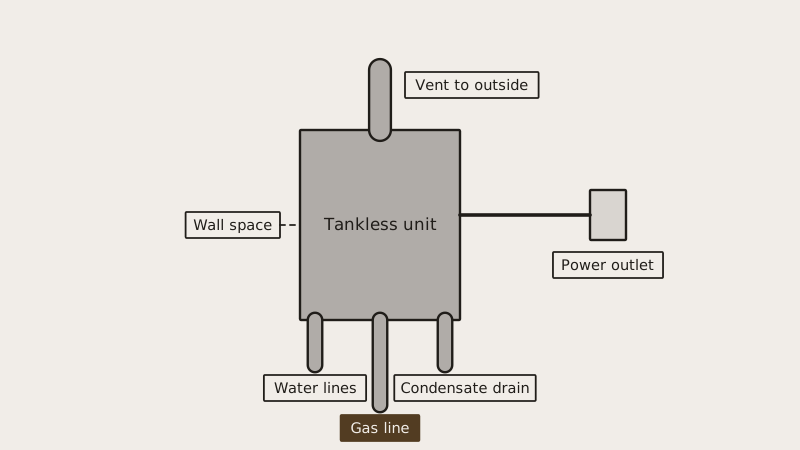
Three things: a gas line big enough, a vent path, and room on a suitable wall. A big tankless unit can pull as much as 199,000 BTU, a lot more than the burner on a typical tank, so someone has to check the gas pipe against every appliance on the run. The city also wants a plumbing permit for any replacement.
Checks the plumber walks through:
- Gas supply. Rinnai's RU199iN, a popular condensing model, ranges from 15,000 to 199,000 BTU with a 3/4 inch gas connection. Whether your run is large enough depends on its length and everything else it feeds. Gas pipe changes fall to contractors under state rules.
- Venting. Condensing units can vent through PVC or CPVC, and their condensate must drain somewhere. Older tank flues are rarely reusable.
- Air quality rules. Pasadena falls inside the regional air district (the South Coast AQMD), which caps nitrogen oxide output from new gas appliances. Rinnai lists its condensing models as meeting that district's low-NOx limit. Confirm any model you pick is approved for sale here.
- Hard water. Pasadena Water and Power describes its water as very hard, averaging about 12.9 grains per gallon. Scale builds on a tankless heat exchanger, so plan on descaling, and ask whether a softener belongs in the plan. Our softener installation page explains how that works.
- Location and bracing. The city's water heater standard requires prior approval of the location, and a California statute, section 19211 of the Health and Safety Code, wants tank heaters strapped against quake movement.
Older houses can surprise you. A 1930s home may have a water heater closet sized for a 40-gallon tank and nothing else, with galvanized supply pipe that already limits flow. If that sounds like your house, read about repiping before spending on a premium heater.
How do gas, electric and propane versions compare?
Gas is the common choice around Pasadena because many homes already have natural gas service from SoCalGas, and gas heats water fast and cheaply. Electric costs less to install but often runs higher per month, and an electric tankless heater can demand a heavy circuit, so a panel upgrade may follow. Propane suits properties with no gas main, which is rare in the valley.
Cost comparisons shift with utility rates, so a quote should show both install price and likely running cost. An electric tankless may look inexpensive at $1,400 to $3,000 installed until the electrician says the panel can't take it. A propane tankless needs a unit set up for propane and a tank on site.
Heat pump tank heaters, which are electric, are a third path and can cut electric use sharply. Whether one fits depends on garage or closet space, since it pulls heat from surrounding air. A written side-by-side from the plumber beats any rule of thumb.
Is a mini tank better than a tankless heater for one fixture?
A mini tank, usually a small electric unit of a few gallons, suits a single distant sink or a small bathroom where running a long hot line would waste water. It is cheap and plugs into a circuit. It will not run a shower for long, and it is no replacement for a whole-house heater.
For point-of-use needs, the real choice is mini tank, small tankless, or doing nothing and living with the wait. A recirculating setup can also help in a big house. Whatever you pick, a plumber should confirm the circuit and the water connection first.
Can a tankless water heater be repaired, and what goes wrong?
Yes, most faults can be fixed. The common ones are mineral scale on the heat exchanger, a clogged inlet filter, ignition or flame sensor faults, and error codes tied to venting. Many manufacturers call for periodic flushing, and with Pasadena's hard water that matters. A tank fails differently: sediment, a worn anode rod, a leaking tank, or a failed thermostat.
A leaking tank usually means replacement, because the steel has given out. Our water heater leak guide separates a fitting drip from a failed tank. For brand-specific pages, see Rinnai tankless repair and Rheem tankless repair. Hot water that sputters, runs cold, or swings in temperature is a service call, not a mystery.
For water heater service, a local plumber we arrange begins with a diagnosis and a price on paper. Use the quote page and ask for a tank option and a tankless option together. Our other services around Pasadena sit on the home page.
Common questions
How does gas tankless compare with a gas tank?
A gas tank keeps a reservoir warm and fires in brief bursts to hold the set temperature. A gas tankless unit burns only on demand but at a far higher rate, so it often wants a bigger gas line and different venting. Either swap needs a Pasadena permit and a contractor who has the state license.
Is an electric tankless heater cheaper than an electric tank?
Not usually at the start. Guides show electric tankless installs between $1,400 and $3,000, and an electric tank frequently comes in lower. Because tankless draws a heavy load, a panel or wiring upgrade may follow. Running cost depends on your electricity rate. Compare both options in a written quote.
How long does a tank or tankless water heater last?
Energy Department figures: storage tanks 10 to 15 years, most tankless units past 20 with replaceable parts. Hard water shortens both unless the unit is flushed or the water is softened. Tank life also depends on the anode rod, so a tank that is ten years old and flaking rust is already a replacement candidate.
Do tankless water heaters need maintenance?
Yes. Manufacturers generally call for periodic flushing to clear mineral scale, and cleaning of the inlet filter. In Pasadena, where the water is very hard, that matters more than in soft-water cities. A plumber can flush the unit and read any stored error codes. Check your manual for the interval, because it varies by model and water quality.
Can I put in a tankless heater myself?
Plan on hiring it out. A replacement needs a Pasadena plumbing permit, and the job involves gas piping, venting and sometimes electrical service, which California reserves for contractors who hold the right license. Doing it yourself can also create gas and carbon monoxide hazards, plus trouble with an inspector or an insurer later.
Sources
- U.S. Department of Energy, tankless or demand-type water heaters
- City of Pasadena Building and Safety Division, water heater standard
- Pasadena Water and Power, water quality FAQs
- Rinnai, RU199iN product page and installation manuals
- California Health and Safety Code section 19211, water heater bracing
- HomeGuide, water heater installation cost
- HomeGuide, tankless water heater cost
- TidyBoss, tankless water heater cost
Page updated