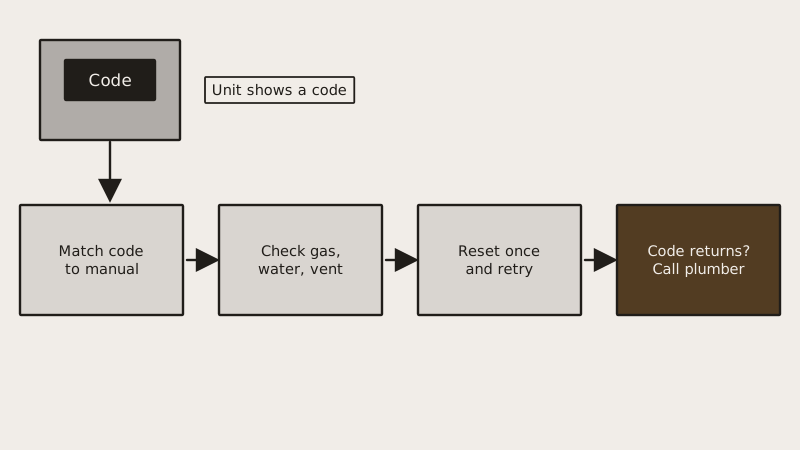
When a Rheem tankless unit goes cold, the cause is typically mineral scale inside the unit, a gas or power interruption, a vent or condensate blockage, or a failed part announced by an error code. Owners can look at the gas valve, the power and the display. Gas work, venting and internal parts belong to a plumber, so water heater repair beyond the basics is not a homeowner job. The bigger picture is in our water heater replacement guide.
Pasadena Pipe Works books local plumbers throughout Pasadena and the San Gabriel Valley. Below: what each symptom suggests, why hard water is hard on a tankless unit, and what the city expects once work reaches the gas line or the vent.
What is my Rheem trying to tell me with an error code?
That its self-diagnostic found a fault and stopped something. Rheem advertises a digital thermostat with a self-diagnostic program on its tankless line, yet codes differ between models, so only your manual gives the real meaning. Record the code, the model number and what the unit was doing, since a plumber can use all three.
Rheem says the model and serial number sit on a label at the front or the right side of the unit. For gas tankless units, plumbing publishers (not Rheem itself) report these common patterns:
- No ignition (often 11): the burner failed to light, with a shut gas valve, low gas pressure, a dirty igniter or a vent fault among the causes.
- Flame loss (often 12): it lit, then went out, which can mean the gas supply was interrupted.
- Overheat (often 14): scale or weak water flow let the heat exchanger run too hot.
- Vent or combustion (often 99 or 90): a blocked vent or a fan fault, with a meaning that shifts between model families.
Take those only as a pointer. A code that returns after one reset signals a real fault underneath, and anything touching gas or combustion needs a plumber.
What do I check when nothing comes out hot?
Work through the basics in order: power, gas valve, water supply, then the display. A tripped breaker, a closed gas valve, a shut inlet or a trickle of flow can each stop the unit. When all of those are fine and the display shows a code or stays dark, the trouble is inside the unit or its vent, and it is time for a plumber.
A safe owner checklist:
- Power. Gas-fired tankless units may need a 120-volt receptacle for their controls, according to Pasadena's handout. Check the plug and the breaker.
- Gas. Make sure the shutoff at the heater is open. If your range still works, the meter is delivering.
- Water. Open one hot tap wide. A tiny flow may not wake the unit, and a half-closed inlet or clogged filter can starve it.
- Display. Jot down any code and try a single reset the way the manual describes.
- Gas odor? Reset nothing. Walk out, then dial 1-800-427-2200 to reach SoCalGas.
Leave the cabinet closed, the gas pressure alone and the safety devices in place. Gas appliance work is contractor work.
Why does the water swing between hot and cold?
Scale, low flow or a mixing fault is the usual story. A heat exchanger crusted with minerals passes heat poorly, so water leaves lukewarm, or the unit overheats and cuts out. Tiny flows can stop it firing steadily, and water that turns cold when a second fixture opens may mean demand has outgrown the unit's capacity.
Common symptoms and what they suggest:
| Symptom | Possible cause |
|---|---|
| Lukewarm everywhere | Scale, a half-shut valve, a clogged inlet filter |
| Hot, cold, hot again | Flow too low to hold ignition, or a sensor fault |
| Fades when a second tap opens | Demand beyond the unit's capacity |
| Cold at one fixture | A local mixing or cartridge valve |
| Cycling on and off | Scale, venting or flow trouble |
Rule out the house side as well: a clogged aerator, a tired shower valve or a crossover inside a mixing faucet can pass for a heater fault. The household side is covered in what causes no hot water.
How does hard water in Pasadena affect a tankless heater?
The minerals coat the heat exchanger with scale, which cuts efficiency and can set off overheat faults. Pasadena Water and Power recorded hardness from 202 to 256 ppm in 2025, close to 13 grains per gallon, and notes the buildup it causes in water heaters. Rheem says tankless units need descaling, not a tank flush, so descaling is your maintenance job.
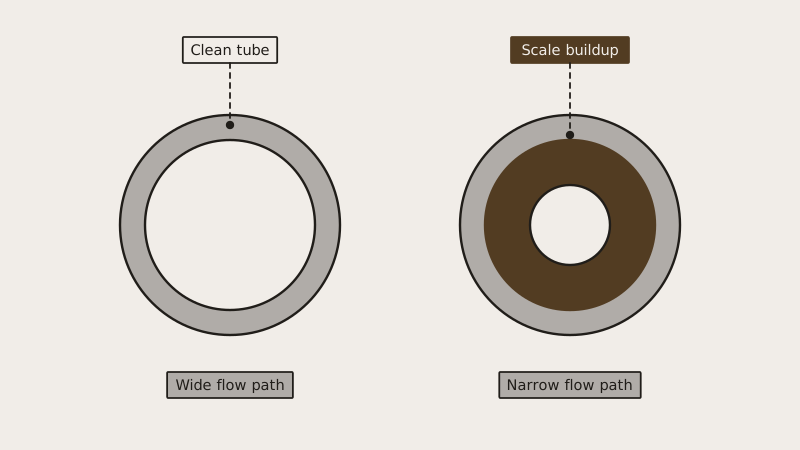
How owners and plumbers descale, in outline:
- A descaling flush pumps a mild acid, usually white vinegar, through the heat exchanger via the unit's isolation valves. Published accounts run 45 to 60 minutes with a small pump.
- How often depends on your water and model. Plumbing publishers suggest yearly where water is hard, and your manual governs.
- No isolation valves? Then flushing means cutting pipe, so a plumber adds them first.
- A softener lowers scale buildup, and softener installation explains the options.
Which Pasadena permit rules touch tankless work?
Pasadena's Building and Safety Division requires tankless installs to meet the California Plumbing and Mechanical Codes, with the maker's instructions and the listed vent system on site at inspection. Gas line sizing calculations are required, and simple plumbing, mechanical and electrical permits can often be issued over the counter.
Points from the city's tankless handout that matter for repairs and replacements:
- Gas supply. A tankless unit usually draws far more gas than a tank heater, and the city notes that a dedicated line of at least 200,000 BTU per hour is typical, sometimes with a larger meter. New or altered gas piping gets pressure tested.
- Venting. Most manufacturers use forced vents, commonly stainless steel, and Type B vent is not acceptable for those. Condensate drains must end where code says.
- Location. Gas appliances are restricted in bedrooms, bathrooms and some closets unless listed for direct venting. Where an undetected leak could damage the structure, a watertight pan with a drain is required.
- Electrical. Some gas units need a 120-volt receptacle, and any new electrical work needs an electrical permit.
A replacement or any change to the gas line needs a permit, pulled by whoever does the work under a California contractor license. Each neighboring city has a separate building department, which where we work points to.
When does a Rheem tankless heater need a plumber?
When a code comes back after a reset, when gas or exhaust can be smelled, when the unit leaks or never ignites, when the vent or condensate drain looks blocked, or when descaling is overdue and there are no isolation valves. Rheem also directs owners to its Find a Pro tool. To start a visit, use the quote form.
Check whether the price includes diagnosis, descaling and any permit. An old unit that keeps faulting may be better replaced than repaired again: the comparison is in tank against tankless water heaters and what tankless installation costs.
Common questions
How long is the visit for a tankless fault?
A reset, gas valve check or filter clean is quick, and a descaling flush runs an hour or two. A failed igniter, sensor, fan or board stretches things if the part has to be ordered. Expect an estimate once the code is read and the unit inspected.
What do I verify before booking a tankless repair?
Pull up the contractor's record on the state licensing website. Confirm they work on Rheem tankless units, whether diagnosis and descaling are included, how parts and warranty are handled and whether a permit applies. Have the price in writing first.
Should I descale a Rheem every year?
Rheem says tankless units need descaling in place of a tank flush, and hard water raises the stakes. Plumbing publishers commonly suggest a yearly descale where water is hard, with a clean inlet filter and a vent check. Follow your manual, and keep service records for any warranty claim.
Is repair or replacement the better choice?
Age, the fault and the price decide it. A scaled or blocked unit is usually worth repairing, while a failed heat exchanger or repeated board faults on an older unit can tip toward replacement. A plumber can set the repair price beside a new unit's and explain the trade.
Sources
- Rheem, frequently asked questions (model label, self-diagnostics, Find a Pro)
- Rheem, how often to flush your water heater (tankless units need descaling)
- City of Pasadena Building and Safety Division, tankless water heaters handout
- Pasadena Water and Power, 2026 Annual Drinking Water Quality Report (2025 hardness)
- SoCalGas, natural gas leaks
Page updated