Few cities in the valley are as residential as San Marino. It covers about 3.8 square miles with just under 4,500 housing units, and most of its houses were built between 1920 and 1950 on lots from about 4,500 square feet to well over 30,000, under strict design review. That mix of age, space and rules shapes every plumbing job here. We arrange plumbers across the whole valley, and this page is about San Marino alone.
Why do big lots change a plumbing job?
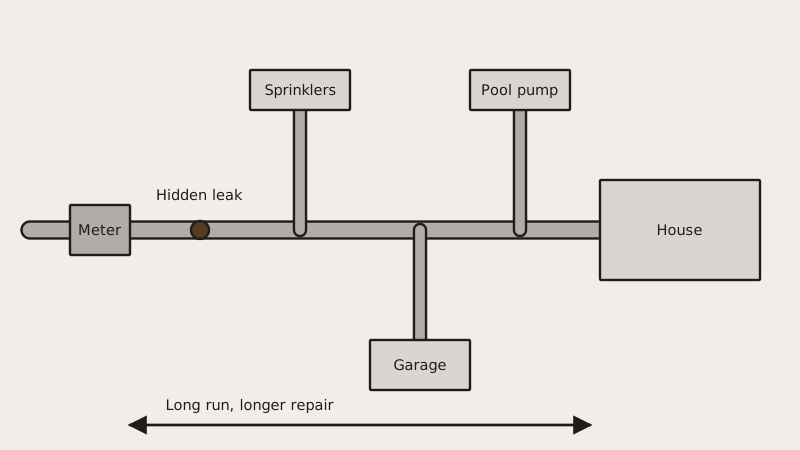
A large lot means long pipe. On 30,000 square feet the stretch between meter and front door, the gas run to a detached garage or pool equipment and the sprinkler supply can each be a long buried distance, and any of them can leak where nobody walks. Finding the leak takes longer, and so does replacing the section.
Long runs also affect hot water. A kitchen that sits far from the heater waits longer for heat, which is why some owners add a recirculation pump or a second heater. Meter-to-house distance matters for pressure too: see how a pressure regulator protects the fixtures when the street supply runs high.
Large grounds mean outdoor plumbing in bulk: hose bibs, irrigation zones, a guesthouse or pool house. Our guide to leaky outdoor faucets covers the small repairs. For anything buried, ask the plumber who quotes whether the price assumes digging, trenching or boring, and who restores the landscaping.
What is inside a San Marino house built between 1920 and 1950?
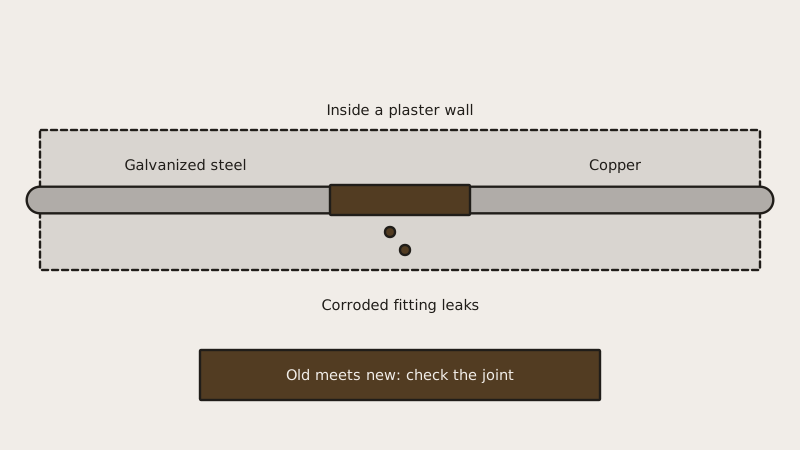
The original plumbing of a 1920s to 1950s house is typically galvanized steel supply, cast iron drains and, after the war, copper. By now many have been replaced in part. The danger is the join between old and new: a copper line spliced to rusted galvanized steel can corrode at the fitting and leak inside a plaster wall that the owner would rather not open.
Design review is a real factor in the city, and houses of this age often carry original plaster, tile and hardwood, so a plumber should expect to protect finishes and say how wall repair is priced. Cast iron drains in older houses are a typical trouble spot; our cast iron pipes guide explains the signs, and the repiping page explains when replacing the supply makes more sense than patching.
Because most homes here are owner-occupied (91 percent in the 2010 census), a lot of work is planned rather than urgent: a repipe before a remodel, new water heaters ahead of a sale, bathroom upgrades. Planned work gives time for permits, and it is cheaper than an emergency call to the same address.
Which company bills me for water in San Marino, and what is in it?
The city lists two suppliers, California American Water and Sunnyslope Water Company, depending on where you live. California American Water's 2017 report said its San Marino supply came from 90 percent local wells and 10 percent purchased Metropolitan Water District water. Hardness in that report ranged from 58 to 152 mg/L, roughly 3 to 9 grains per gallon.
That is moderately hard, softer than most of the valley. Sunnyslope's figures are different and we did not read its report, so check it if your bill comes from Sunnyslope. Our hardness by zip code guide shows how to read the numbers. The 2017 report is the latest we could open, so use the supplier's current report for today's values, and call the water company for main breaks or meter leaks, not a plumber.
What do San Marino plumbing jobs typically run?
Hourly rates and toilet work vary by job, and many jobs get a flat price, so the written quote sets the figure. Published guides put tank heater swaps around $900 to $1,800 and a full repipe anywhere from $4,000 to $15,000. Consider these rough markers, not an offer.
For San Marino homes, expect the upper half of those ranges when the house is large, the pipes are far from the heater, or finishes need protecting. Several fixtures per bathroom and multiple heaters also scale the bill. Line items are in the water heater price guide and the page on replacing a toilet.
What city rules should a San Marino plumbing job follow?
The city's Planning and Building Department handles permits, while the state asks for a contractor license on plumbing work beyond $1,000 in labor and materials. A water heater replacement normally needs a permit and inspection, as it does in most California cities. No San Marino rule turned up in our search, so the city's main line, (626) 300-0700, is the place to confirm.
One local quirk is worth planning around. According to the community's Wikipedia entry, San Marino is one of the few cities that require commercial vehicles to hold a permit to work inside city limits. The city's own pages did not confirm the current rule, so ask the city before a job is scheduled, and ask whoever quotes whether the permit is included in the price.
Gas lines are contractor-only. On detecting gas, everyone exits, and SoCalGas (1-800-427-2200) gets the call from outside. Real danger goes to 911.
What helps a visit go smoothly in San Marino?
Send the quote form with your street, the trouble, the house's approximate age, and whether the issue is indoors or in the yard. Someone local visits, with the price set out on paper before any pipe is touched. Our phones are staffed from 9am to 5pm on weekdays.
Have photos of the damage, the heater's label and the location of your shutoff valve. Mention if a design review approval, an architect or a historic feature is involved, and whether you want finishes protected. If you are comparing a patch with a repipe, our repipe cost guide shows the numbers.
Common questions
Will a big San Marino property cost more to plumb?
Often, yes. Rates are set by each plumber, and long pipe runs, trenching and the care taken with finished interiors push a quote toward the top of any range. Only the written figure delivered after a visit commits anyone.
Is San Marino water hard?
Moderately. California American Water's 2017 report, the latest we could open, listed hardness from 58 to 152 mg/L, about 3 to 9 grains per gallon. Sunnyslope Water Company serves part of the city and its numbers may differ. Check the current report from your own supplier before choosing a softener.
Where do I report a water main break here?
Your water company, not a plumber. The city lists California American Water at (888) 422-5269 and Sunnyslope Water Company at (626) 287-5238, depending on your address. A leak on your own side of the meter, inside the property, is a plumber's job. Closing the shutoff at the house is a safe first move.
Does San Marino require a permit for a plumber to work there?
Possibly. San Marino is described as one of the few cities requiring commercial vehicles to hold a permit to work within city limits, but the current rule is unconfirmed. Ask the city on (626) 300-0700, and ask whoever quotes whether any permit fee is part of the price.
Every area we cover is listed on plumber pasadena.
Sources
- San Marino, California (housing era, lot sizes, design review, commercial vehicle permits)
- City of San Marino, Water providers
- Angi, water heater replacement cost (2026)
- HomeGuide, cost of replacing polybutylene pipe (2026), used as a price guide
- California American Water, San Marino Water System 2017 Annual Water Quality Report
Page updated