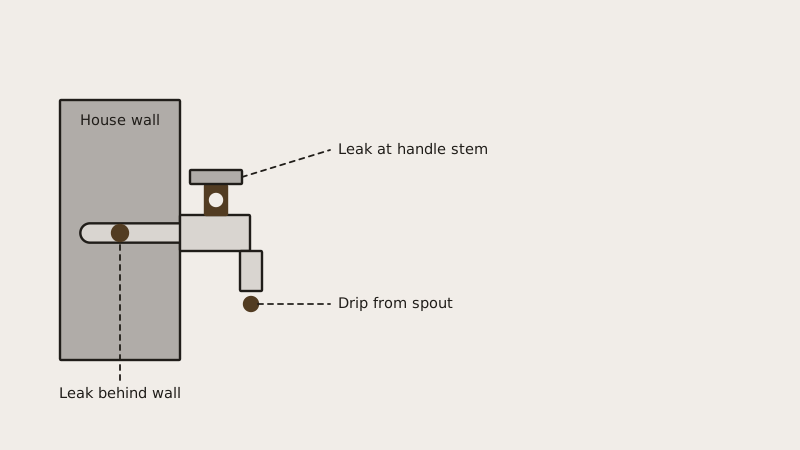
Pin down the source first. A drip at the spout points to a worn washer or seat, and moisture around the handle stem to loose or tired packing. Seepage where the pipe enters the wall is a supply-pipe fault, and that one is plumber's work. Our page on faucets and fixtures covers the indoor side of the same repairs.
Where is my outdoor faucet leaking from?
Run the faucet with a hose attached, then with it off, and watch three spots: the spout, the base of the handle, and the wall where the pipe enters. A drip from the nozzle when the handle is shut is the washer or seat. Water from the handle stem is the packing. Water at the wall is a pipe or joint.
A few more clues:
- Leak only when the hose is on: often the handle packing, or a hose fitting, since pressure pushes water past a worn seal.
- Leak even when closed: washer, seat or a failing valve.
- Water spitting from a cap at the top of the spout when the water starts: that is the vacuum breaker, a backflow device, and a brief burst of water when it opens can be normal. A steady stream from it is not.
- Soaked siding, a damp interior wall or a stain on the interior wall right below the faucet: the fault is hidden in the wall.
Water waste adds up. The EPA puts a once-a-second drip at upward of three thousand gallons annually, which makes even a small hose bib leak worth fixing. A rising water bill is another prompt, and a leaky faucet and a high water bill examines.
What stops water seeping around the handle?
Snug the packing nut beneath the handle by a quarter turn and test again. Still wet? Shut off the supply, remove the handle and nut, change the packing washer or string packing, and rebuild it. It is the easiest of the three fixes, often a ten-minute task.
Cranking the nut too hard makes the handle stiff and wears the stem. A scored or corroded stem means a new stem or a new faucet. Local water is a factor: Pasadena Water and Power describes its supply as very hard, and mineral scale on a stem can chew up packing and washers faster than in soft-water towns.
What fixes a drip from the spout?
Cut the water to the faucet or the house, let the faucet drain, then take off the handle and packing nut, withdraw the stem, swap the rubber washer on its tip and clean the seat. Put it together and test. If it still drips, the seat is probably damaged and the faucet itself should go.
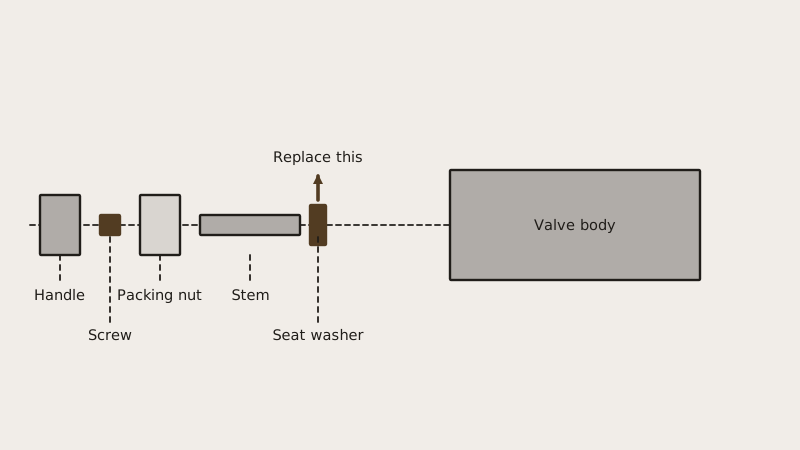
Details that help:
- Water off first. Look for an interior shutoff on the line feeding the faucet, often in a garage, crawlspace or under the house. If you cannot find one, shut the main. Pasadena Water and Power advises knowing where your main valve is and marking it.
- Take a photo of the parts as you remove them.
- Match the washer. Bring the old washer and stem to the hardware store so you can get the right size and thread.
- Clean the seat with a cloth or a seat-dressing tool so the new washer seals.
- Reassemble without over-tightening, and open the shutoff slowly.
For the indoor version of this job, read the indoor leaky faucet guide.
At what point is a new outdoor faucet the better answer?
When the stem or seat is damaged, the body has cracked, the vacuum breaker leaks steadily, or no parts exist for an old model. A threaded-on faucet swaps out quickly. One soldered to copper, or sitting on damaged pipe inside the wall, needs a plumber.
A modern replacement is often a frost-free sillcock, a long-stem faucet that shuts the water off inside the heated part of the house so the exposed section cannot freeze. Freezing is not a daily concern in Pasadena, but foothill areas see cold nights, and a frost-free model is a reasonable choice. Remove hoses from outdoor faucets in cold weather, because a hose left attached can trap water.
Most U.S. jurisdictions require hose bibs to have a vacuum breaker or backflow preventer, according to the reference article on taps, and it stops dirty water being drawn back into the house supply when pressure drops while a hose sits in a bucket, pool or chemical sprayer. Keep it on a new faucet. If a hose-end sprayer or irrigation system is attached, ask a plumber about the right backflow device, and see backflow testing for devices that need yearly testing.
Who handles a leak behind the wall?
A plumber does. Wetness at the wall or a stain below the faucet suggests a failed joint or cracked pipe behind the siding, and waiting lets the framing rot and mold feed on it. Close the supply to that faucet or the whole house, and leave the wall unopened.
Many Pasadena houses date from the Craftsman era through the 1950s, and old galvanized or copper lines to outdoor faucets can corrode where the pipe meets the wall. The usual repair removes the failed length, puts in new pipe and tests it. If water is spraying or the leak is large, treat it as a burst pipe and follow the steps in a burst water pipe in Pasadena.
Want the faucet or the pipe behind it inspected? Put the problem into the quote page, and a local plumber, arranged by us, does the work. New faucet pricing is covered under faucet installation cost. More of our work starts at Pasadena Pipe Works.
Common questions
Can I fix an outdoor faucet myself?
Usually, for washers, packing and a threaded replacement. You need a wrench, replacement parts and the water shut off. Soldered pipe, a leak inside the wall, a shutoff stuck open or a corroded line all point to a plumber. A permit is rarely needed for a simple repair, though a larger replacement might.
Why does water drip from the vacuum breaker?
A little water from the vacuum breaker as the faucet opens or closes can be normal, but a steady drip or spray while running suggests a worn breaker or a hose or sprayer left attached. Replace the breaker or the faucet, and keep it in place because it protects your drinking water.
How much time should I plan for the repair?
Snugging packing is a matter of minutes. A washer or stem swap usually stays under an hour. A plumber replacing the whole faucet needs an hour or two, with more for damaged or soldered pipe, and repairs inside the wall add patching.
Will a dripping hose bib push up my bill?
It can. A slow drip accumulates, and a once-a-second drip is the EPA's example of thousands of gallons lost each year. A leak that appears only with the hose on may waste less, while one inside the wall may waste more because nobody sees it.
What should the quote cover for a faucet replacement?
A frost-free faucet if you want one, the vacuum breaker or backflow device, repair of any damaged pipe, and wall patching. Find out how the water gets shut off and how the work is tested, and jot down the contractor license number to look up with the state.
Sources
Page updated