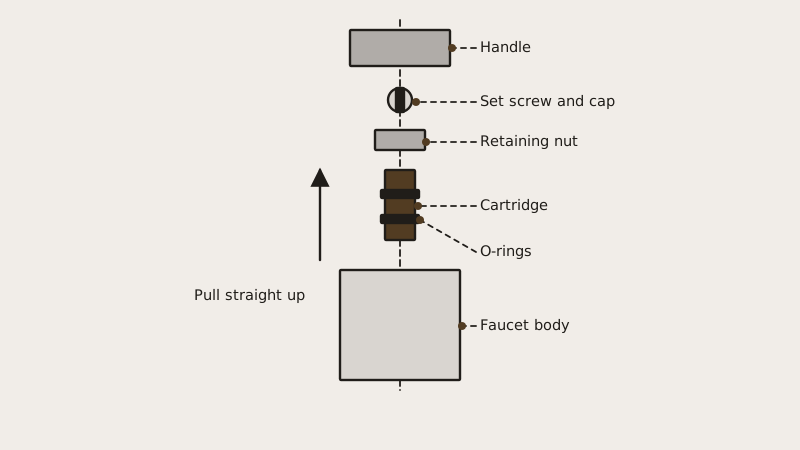
The spot where water escapes names the failed part. Drops from the spout while the handle is shut mean a tired cartridge, seal or valve seat inside. Seepage near the handle or the spout's collar means O-rings. Both are fixable with a handful of cheap parts, a screwdriver and an hour, and the same logic covers kitchen, bathroom and many shower valves. A faucet corroded past saving, or water escaping inside a wall, belongs with a plumber; our shower and faucet repair plumber page covers that side. Use the quote form to line one up.
What kind of single-handle faucet do I have?
Most single-handle faucets are one of three designs: cartridge, ball or ceramic disc. A handle that lifts and pivots over a short body is usually a cartridge. A handle that swings in a wide arc over a rounded cap often hides a ball. A smooth quarter-turn handle on a wide base usually means ceramic discs.
The surest check is to look inside once the handle is off. A cartridge comes out as one piece. A ball faucet has a metal or plastic ball with small springs and rubber seats beneath it. A ceramic disc faucet has a cylinder with flat discs at the bottom. Brand gives a hint: Moen and Price Pfister single-handles are normally cartridge types, and Delta made many ball faucets, though newer Delta models use cartridges. Take photos as you disassemble.
What should be on the counter before I begin?
Close the two shut-off valves under the sink, or the shower's stop, then open the faucet to let the pressure out. Gather a hex key set, a screwdriver, adjustable pliers, a small flat pry tool, plumber's grease and a towel. Plug the drain so no screw falls in, and lay out parts in order as you remove them.
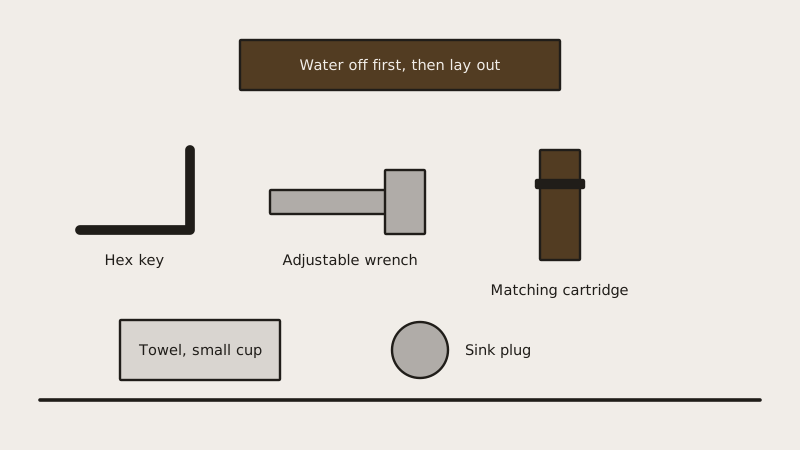
Buy parts after you open it, not before. Look for a number stamped on the cartridge or the faucet body, and carry the old part into the shop to compare. Ball faucets use a kit with seats and springs, and the seats and springs should be replaced together. Replace every O-ring while the faucet is open, since they age even when the cartridge is fine.
If the shut-off valves under the sink will not close or drip when turned, stop. Close the home's main valve instead, and consider having a plumber replace those valves.
How do I replace the cartridge or the parts inside?
Pry off the cap, undo the set screw (usually a hex screw) and lift off the handle. Unscrew the retaining ring or nut, pull the cartridge straight out, note how it faces, and push the new one in the same way. For a ball faucet, lift out the ball, replace seats, springs and O-rings, and refit with the ball tab aligned.
Rinse any grit out of the body before reassembly, and smear plumber's grease on new O-rings so they seat without tearing. Tighten the retaining nut snugly, not crushingly. Reattach the handle, open both shut-off valves slowly, and let it run for about a minute with the aerator removed so loose debris washes out. Then check for drips at the spout, the base and under the sink.
A cartridge that will not budge may call for a puller made for that brand. If the faucet body is pitted or the threads are chewed up, replacement is more sensible than repair, and the faucet installation cost guide shows what that runs.
Why is the faucet still dripping after the repair?
Typically the part is a near-miss, an O-ring got pinched, or the valve seat in the body is worn or crusted. A seat that is rough no longer seals against a new cartridge. Re-seating the cartridge fully, or cleaning the seat, fixes some cases. A pitted seat means replacing the faucet body.
Mineral deposits are a Pasadena problem. Pasadena Water and Power's latest report puts hardness around 12 to 15 grains per gallon, so scale collects on cartridges, aerators and valve seats, so a faucet that sealed for years can start to drip. Soaking removable metal parts in vinegar loosens deposits. Our guide on hard water scale removal goes further, and a softener is the lasting fix.
Does a dripping faucet matter?
Yes, mostly for water and the bill. EPA's WaterSense program estimates a faucet that drips once each second loses more than 3,000 gallons yearly, and its figure for the average home's leaks is above 9,300. A drip also stains the sink, and leaks at the base can rot the cabinet beneath. Our page on whether a leaky faucet raises the water bill explains the numbers.
Do not ignore dampness under the sink. Look over the supply hoses and stop valves too, which weep in much the same ways. A cabinet floor that feels soft or looks stained needs the source fixed and the area dried before mold sets in.
Which faucet or shower-valve jobs go to a plumber?
Once the stop valves refuse to close, once parts will not come out, once the leak is behind a shower wall, or when the faucet is old enough that parts are no longer made. Shower valves behind tile are a bigger job, because the wall may need opening.
In Pasadena's older houses, faucets may be decades old and fitted to galvanized or corroded supply lines, where turning a stiff valve can break something that was holding. A plumber replaces valves, supply lines and the faucet in one visit and can check for hidden leaks. A major repair that opens a wall can pass the point where California requires a contractor license, at $1,000 in labor and parts. Related repairs: two-handle faucets, tub faucets and outdoor spigots.
Common questions
Is it possible to work on the faucet with the water on?
No. Close the shut-off valves under the sink or the main valve first, because a live faucet with the cartridge pulled sprays water everywhere. If you have no working shut-offs, shut the main and make replacing the old valves part of the job.
How do I find the right replacement cartridge?
Find a model number on the faucet or cartridge, check the maker's site, or bring the old cartridge to a plumbing supply counter. Sizes differ between brands, and a near match leaks. Photograph the faucet and its markings first for comparison.
Why does my faucet drip only when the water is hot?
Hot water wears O-rings and seals faster, and the hot side of a cartridge can fail first. In a single-handle faucet both sides share a cartridge, so replacement covers both. Heat can also expand scale deposits. If only the hot side drips, the cartridge or its seal is the usual suspect.
Is it cheaper to replace the faucet than repair it?
A repair kit or cartridge is often the cheaper route, since the parts are small. An old, pitted or discontinued faucet is a better candidate for replacement, which may cost about what repeat repairs would. A plumber can judge from the body itself; have parts and labor itemized.
Is water around the handle base a plumber's job?
Usually not. A worn O-ring around the cartridge or spout collar is the typical cause, and a homeowner can swap it. Water seeping from beneath the faucet body or through the countertop may come from a supply connection or the mounting, and that deserves a plumber's look.
Our other plumbing services are on the Pasadena Pipe Works home page.
Sources
- U.S. EPA WaterSense, Fix a Leak Week
- Pasadena Water and Power, water quality FAQs
- Faucet repair and valve identification guides from several home repair publishers, checked November 2026
Page updated