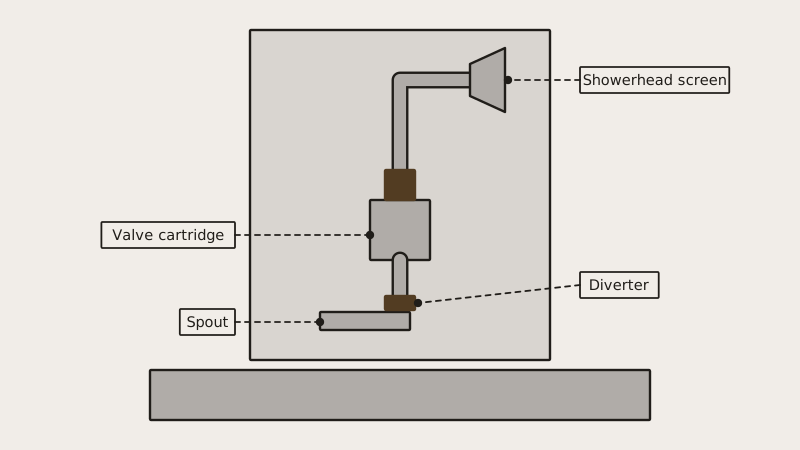
When the kitchen sink and the washer run strong but the tub dribbles, the house supply is healthy and the trouble is local. Likely culprits: a clogged shower head, a stuck diverter, scale inside the valve cartridge, or a stop valve left half shut. Hot, cold or both being weak narrows it further. Below are those causes, plus two leak scenarios that often turn up alongside.
General shower work lives on our shower repair hub. A weak whole house is another matter, handled in the causes of low water pressure.
What explains a feeble tub in an otherwise normal house?
Something is restricting flow between the shutoff and the tub itself. Mineral scale in the valve, a worn cartridge, a diverter that never fully switches, a clogged shower head, or a part-closed stop valve are the common reasons. In Pasadena's very hard water, scale gets first suspicion.
Pasadena Water and Power describes the city's water as very hard, averaging about 12.9 grains per gallon on its FAQ page. Over years, that hardness leaves white deposits in shower heads, cartridges and diverters, narrowing the passages a little at a time. The decline is gradual, so people often notice it only when it gets bad.
Run this pattern test first:
- Tub weak but shower strong, or the reverse. Look at the diverter, spout or shower head, not the valve.
- Tub and shower both weak, everything else fine. The cartridge or their shared branch is restricted.
- Only hot weak, or only cold weak. A partly clogged hot or cold side of the cartridge or a stop valve, or in the water heater lines if hot is the problem.
- Overnight loss. Something shifted: a valve closed, debris broke loose, or a pipe failed.
How do I inspect the shower head, spout and diverter?
Remove the shower head and look for grit and white crust. A scaled head can soak in vinegar, then get rinsed and retested. Next try the tub spout: lift the diverter and see whether water favors the shower or still leaks from the spout. A stuck, worn or scaled diverter sends little water where you want it.
Take the steps in order:
- Fill the tub alone with the diverter down. Strong flow puts the problem on the shower side; weak flow points at the valve.
- Take the head off and run the shower bare. Strong flow means the head is clogged. Heads and flow restrictors are covered in our shower pressure guide.
- Look at the tub spout. Some spouts have a built-in diverter that wears out, and spouts are inexpensive to replace.
- Soak removable parts in vinegar for an hour or so, brushing off scale. For stubborn deposits, see removing hard water scale.
Water still trickling from the spout with the shower running means the diverter isn't sealing, which wastes water. Dripping tub hardware is dealt with in a leaky tub faucet.
What if the valve cartridge is the problem?
Behind the handle sits a cartridge or valve body that mixes hot and cold. When scale or debris clogs it, or the cartridge wears out, flow drops even though the pipes are fine. Replacing a cartridge is a repair many homeowners attempt, but it needs the right cartridge for the brand, and the water shut off first.
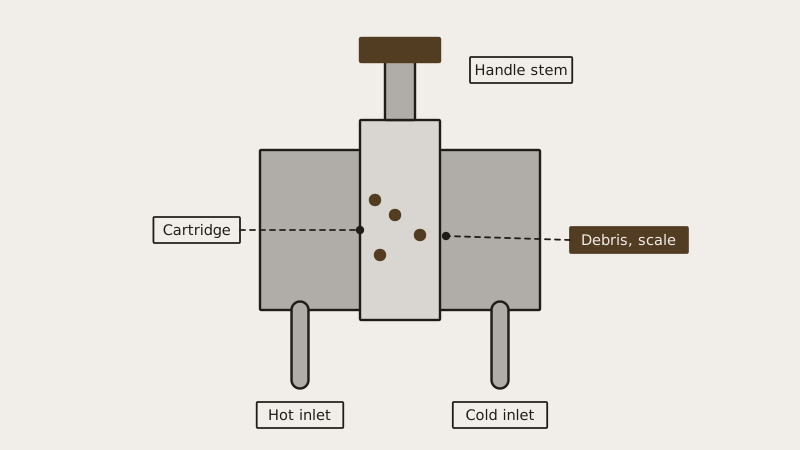
Locate a shutoff before opening the handle. Some houses have stop valves in an access panel behind the tub; others rely on the main. Unable to isolate the water? Stop and call, because forcing a valve can snap a corroded stem and flood the bathroom.
A professional will also check what you can't see: a stop valve inside the wall that is partly shut, a corroded or scaled branch pipe, or debris that lodged in the valve after street work. After a shutoff or flush, particles can clog cartridges. What a cartridge looks like and why it fails is shown in our leaky faucet guide.
What if the bathroom sink flow fell all at once?
A sharp drop at one sink usually points to a clogged aerator, a stop valve below that is only partly open, or a kinked or debris-filled supply line. Twist off the aerator and wash out the grit; if flow comes back, that was it. If not, look at both shutoffs under the sink and the flexible lines.
Grit often shows up after plumbing work or a main shutdown, and aerators catch it first. In hard water, white scale does the same slowly. Hot side only? Check that stop valve and the one at the water heater. For the kitchen, see the kitchen sink pressure article.
A weak sink and a weak tub with a fine kitchen may share a branch line, which a plumber with a gauge can sort out.
What if there is a shower pipe leak or burst behind the wall?
A leak behind a shower wall shows up as a damp or stained wall, a mark on the ceiling beneath, falling pressure, a climbing bill, or a meter creeping with every tap shut. A burst pipe moves water fast, so shut the main immediately and ring a plumber instead of waiting it out.
Some signs that a shower supply line may be leaking:
- Soft or discolored drywall or tile around the tub or shower.
- Reduced pressure at the shower that worsens over days.
- Water sound in the wall when nothing is running.
- A turning meter with every fixture off, which our high water bill guide tests.
Close the main, drain the line through a low tap, photograph the wall and request a plumber, who may find the leak with a moisture reader or thermal camera and open the wall only where needed. Burst pipe warning signs have their own page, and a plumber on the shower repair side can look behind the tile.
What about a ceiling leak around a light fixture below a bathroom?
A wet ceiling light usually means a leak from the bathroom overhead: shower pan, tub drain, toilet or supply line. Treat it as dangerous, since water and wiring are a shock risk. Leave the switch alone, trip the breaker if the panel is reachable dry, and call a plumber.
The fixture is only where the water finds a way out. The source could be several feet away, since water follows joists and wiring. Closing the main is the first test: a drip that stops was a supply line. The full sequence is in our ceiling water leak guide. EPA says drying within one to two days heads off most mold.
Never reuse a fixture that has been soaked until an electrician checks it.
When is the plumber the right call?
Make the call if the basic checks fail, the problem sits in the wall, a valve is stuck, or there is any leak, stain or burst. The plumber gauges pressure at the fixture, inspects the cartridge and branch, tries the stop valves, and writes a price before repairs. California wants a contractor license once work reaches $1,000.
To start a visit, use the quote page. List the weak fixtures, whether hot, cold or both, when it began, and anything that changed first, such as plumbing work or a shutoff. Photos of the spout, valve and stains help. A local plumber we arrange then diagnoses the fault and quotes before starting.
The home page covers our other services around Pasadena and the San Gabriel Valley.
Common questions
How can the shower work while the tub spout barely runs?
The diverter, the tub spout or the line feeding the tub is restricted. Test by running the tub with the shower diverter down, and check whether the spout is clogged or worn. A scaled diverter often sends most of the water to one outlet. Cleaning or replacing the spout or diverter often fixes it.
Why is just my bathroom sink weak?
Most likely the aerator is clogged with grit or scale, or a shutoff valve beneath the sink that isn't fully open. Unscrew the aerator, rinse it and test. Check both stop valves and the flexible supply lines for kinks. If only hot is weak, look at the hot side first.
Can a clogged shower head cause low pressure in the tub?
Only in the shower mode. A clogged head reduces shower flow, while the tub spout runs separately. If the tub is weak too, look at the valve cartridge, the diverter or the branch. A soak in vinegar can clear scale from a shower head, and a quick test without the head tells you if it was the cause.
Is low pressure at one fixture a sign of a leak?
Sometimes. A leak on that branch can drop pressure, but a clogged part is more common. Look for stains, damp walls, a meter that creeps with all water off, and a rising bill. Any of those means a plumber should inspect, because hidden water damage grows quickly.
Is hard water behind a weak shower?
Often, over the long run. Scale narrows shower heads, cartridges and diverters, and Pasadena's water is very hard. Cleaning helps, and a softener prevents fresh buildup without reopening pipe that is already narrowed. How that works is explained on our softener installation page, so you can weigh it.
Sources
- Pasadena Water and Power, water quality FAQs
- U.S. Environmental Protection Agency, a brief guide to mold, moisture and your home
- Published diagnostic guides on low water pressure at a single fixture, checked November 2026
- California Contractors State License Board, hire a contractor
Page updated