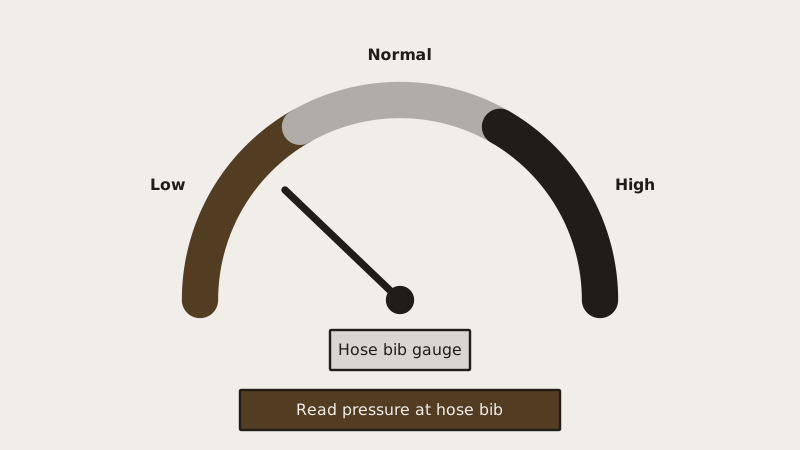
Most homes feel right with a static pressure around 40 to 60 psi, and anything under about 30 psi feels weak. The cause is either at the supply (a failing pressure regulator, a half-closed valve, the street), in the pipes (rusted galvanized lines, a leak), or at one fixture (a clogged aerator or a bent supply hose). A cheap gauge and ten minutes at an outdoor spigot separate them.
A house with a pressure regulator should start with that valve, so our hub page on pressure reducing valves makes a good companion. What follows runs from the quickest check to the likeliest repair.
How do I find out what my water pressure actually is?
Thread a pressure gauge, a hardware-store item, onto the outdoor hose bib or laundry connection closest to the point of entry. Every fixture inside stays off. Open the bib all the way and read the needle. Normal runs roughly 40 to 60 psi, under 30 is low, and above 80 is more than California code allows without a regulator.
Next, repeat the reading while a shower and a kitchen tap run. Healthy at rest but sagging under flow suggests a restriction in the pipes. Low even at rest suggests the regulator, the service line or the street. That comparison tells you whether to chase the pipes or the supply.
What makes pressure low across the entire house?
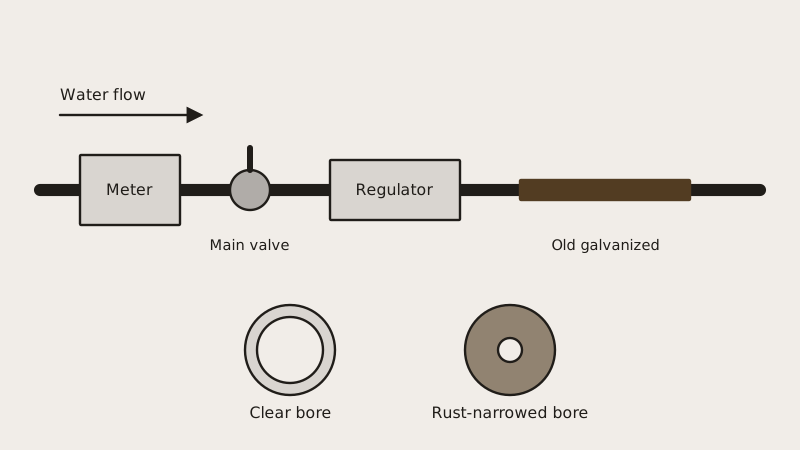
If each fixture is weak, suspects include a worn-out regulator, a main or meter valve not fully open, rust-narrowed galvanized pipe, a leak ahead of the house, or lower pressure from the utility. Pasadena's older housing adds one more: original galvanized lines that slowly scale shut from within.
Take them in turn:
- Failing regulator. The bell-shaped valve near the main can wear out and pass less than it should. Our walkthrough on adjusting a pressure regulator shows the adjustment screw, and a regulator that won't hold a setting needs replacing. Hunting for it? Try where the regulator is located.
- A valve not fully open. Plumbing or meter work can leave the main only part way open, and a gate valve should be turned to its stop.
- Galvanized pipe. Plenty of houses built between the 1920s and 1950s still carry it. Rust and mineral scale choke the pipe's inside, and pressure declines slowly over years. If that describes your house, see why homeowners repipe.
- A hidden leak. Water escaping before it reaches your fixtures costs pressure and money. Our high water bill guide describes a two-hour meter test that exposes one.
- The service line. The buried pipe from meter to house can be corroded or partly blocked.
Pasadena's own water is very hard, around 13 grains per gallon in recent reports, and hard water drops scale inside pipes and fixtures. Over many years that narrowing contributes to the pressure loss, particularly on hot lines.
Is the problem my street or the utility?
Possibly, and the utility says so itself. Pasadena Water and Power lists temporary low pressure from heavy lawn watering, a water main break, a nearby fire or clogged fixtures, and notes that hillside homes, homes far from a booster pump plant, and homes near a pressure-reducing station can see lower pressure as a normal condition.
A quick test: ask a neighbor whether pressure is down on their side too. If several houses are affected at the same time, it is probably the system, not your pipes. Report a permanent drop in pressure to Pasadena Water and Power's water emergency line, 626-744-4138. Customer service takes general calls at 626-744-4005 on weekdays.
If your street pressure is steady but your house reads low, the problem is on your property.
What if only one tap, the shower or the hot side is weak?
A single weak fixture with healthy neighbors means a local fault: a clogged aerator, a half-shut angle stop, a kinked supply hose or a worn cartridge. Weak hot water only points toward the water heater, its shutoff valve or scale in the hot lines. Check these before blaming the whole system.
Each pattern has a likely cause:
| Pattern | Likely cause | Where to read |
|---|---|---|
| Weak at one tap | Clogged aerator, half-shut stop valve | Weak kitchen sink flow |
| Weak in the shower | Clogged shower head, failing cartridge or valve | Low shower pressure |
| Tub weak, others fine | Tub valve or spout diverter | Tub with no pressure |
| Weak hot water only | Heater valve, scale, sediment | Low hot water pressure |
| Weak everywhere | Regulator, main valve, pipes, supply | This page |
Unscrew the aerator at a weak faucet and rinse out grit. If pressure jumps, you found it. In hard water areas, white crust in the aerator is the usual reason.
Can low water pressure be dangerous?
Mostly it shows up as poor performance, yet there are real risks. Pasadena Water and Power notes that low pressure in a system raises the chance of contamination entering the pipes. Inside a house, a sudden drop can mean a break, and thin flow can keep a tankless unit from firing, since many need a minimum flow.
Read it as a warning sign. A pressure drop that arrives suddenly, together with a wet spot or a higher bill, can mean a pipe has failed. Sudden loss of pressure and cloudy or discolored water are both worth a call to the utility. Fire sprinkler systems and some appliances depend on adequate pressure, so ask a plumber whether yours need a minimum.
The opposite also matters. Pressure above 80 psi stresses fixtures and hoses, and the plumbing code wants a regulator once static pressure climbs past it. Never tested yours? Only a gauge tells you. For the cost of fitting or replacing one, see regulator installation cost.
What can I try myself, and what needs a plumber?
Reading the gauge, cleaning aerators and shower heads, confirming the main is fully open, and looking for leaks or kinked hoses are yours to do. Leave to a plumber the regulator on the main line, galvanized repiping, buried service line work and anything that opens walls. California expects a contractor with a license once a job's labor and materials pass $1,000.
If a plumber finds galvanized pipe that is badly narrowed, the options are replacing sections or repiping the house, often with PEX or copper. PEX versus copper explains how they compare.
A thorough plumber tests pressure before and after, and shares both numbers. Ask for both readings and a written price before any pipe is cut; the quote page is the place to begin. Our other services appear on the home page.
Common questions
What reading counts as normal for a house?
Published guides place normal static pressure near 40 to 60 psi, with 50 to 60 the comfortable middle. Below 30 feels weak, and above 80 the plumbing code wants a regulator. Take the reading at an outdoor bib, indoor fixtures off.
What would make pressure fall overnight?
Look for a recent event: a main break or maintenance nearby, a valve left part-closed after work, or a failed pipe. Ask neighbors and the utility first. When only your house is affected, and you see soggy ground or a meter turning with everything off, shut off the main, then call.
Is a booster pump the answer?
When supply pressure is truly low, a booster can lift it at the house. It won't cure rusted pipe or a leak, and it can load old fittings with extra stress. Diagnose first; a plumber can take pressure and flow readings, then judge whether a pump, a new regulator or new pipe fits.
Can hard water reduce water pressure?
Over years, yes. Mineral scale from hard water collects inside pipes, aerators, shower heads and water heaters, and narrows the passage. Pasadena's water is very hard, so clogged aerators and slowly weakening flow are common. A softener prevents new buildup, but it doesn't clear pipe that is already narrowed. Our softener installation page explains how that works.
Is low pressure covered by the water utility?
The utility is responsible for pressure in its mains and will respond to reports of a permanent change. Everything past the meter, regulator included, is yours. Pasadena Water and Power can tell you whether the street supply is behaving normally, which tells you which side to investigate.
Sources
- Pasadena Water and Power, water quality FAQs (water pressure)
- California Plumbing Code, pressure regulator requirement above 80 psi, as summarized by Southern California plumbing contractors, checked November 2026
- Published diagnostic guides on household water pressure from plumbing and home-improvement sources (normal static range 40 to 60 psi), checked November 2026
Page updated