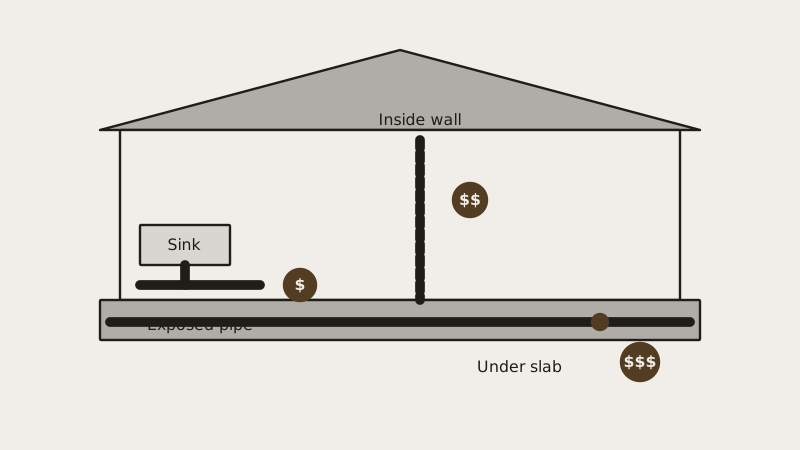
Angi's published figures show burst pipe work spanning $200 to $3,000 and averaging $500 for an open, reachable pipe, and a slab leak at $630 to $4,400, averaging $2,280 once detection is counted. Drying out and rebuilding after the water is frequently billed separately. Read all of it as a rough yardstick. Your actual figure appears only on paper once someone has seen the pipe.
Everything below applies those national ranges to a Pasadena house. Water still running? Go to the burst pipe plumber page first, shut off the supply, and come back. To price your own pipe, begin with the quote form.
What does a typical water leak repair cost?
For a split pipe or failed fitting you can see and reach, expect somewhere between $200 and $800. The national spread for burst pipes is $200 to $3,000, and the number rises when the damaged length hides in a wall, ceiling or floor, because those jobs add opening and closing finished surfaces.
Where does the money go? Mostly labor, plus the pipe itself. A break below ground, behind plaster or under a slab can pass $5,000 when access and patching enter the picture.
| Situation | Guide range | What swings it |
|---|---|---|
| Exposed pipe or fitting | $200 to $800 | Pipe size and material, valve condition |
| Inside drywall or over a ceiling | $500 to $3,000, at times beyond | Cutting, patching, paint, texture matching |
| Finding a hidden leak | $150 to $400, some quotes to $600 | Listening gear, number of lines to test |
| Slab leak, spot fix | $500 to $4,000 | Depth, concrete to remove |
| Slab leak, new line overhead | $1,500 to $5,000 | Length of new run, wall access |
| Replacing every supply line | $4,000 to $15,000, sometimes higher | Square footage, pipe type, wall repair |
| Drying and water damage work | $1,000 to $5,000, sometimes higher | Hours the water ran, materials soaked |
These come from national cost sites, not from Pasadena invoices, so a local quote can land outside them. The biggest line in the table has its own page: what repiping costs.
Why does a slab leak cost more than other pipe repairs?
Because the pipe is buried. National guides show slab leak repair averaging about $2,280 with detection included, in a band of $630 to $4,400. Somebody has to pinpoint the leak electronically, then break through concrete or abandon the buried line, then rebuild the floor on top. Each step adds labor.
Plumbers choose among three routes, and you should ask which one they propose and why:
- Spot repair: open the slab over the leak, swap the damaged stretch, patch the concrete. Cheapest when a single point has failed.
- Reroute: abandon the pipe in the concrete and feed a fresh line overhead. Costs more than a spot fix, but the floor stays intact next time.
- Repipe: replace the whole supply system. Worth considering when pinholes keep opening up in new spots.
House type matters in the San Gabriel Valley. Many 1920s Craftsman homes in Pasadena and Altadena sit on raised foundations with crawlspaces, where plumbing is reachable from below. Slab-on-grade floors are generally more common in later mid-century tracts, and copper lines buried in that concrete are a regular source of pinhole leaks, with soil, water chemistry and rubbing against the slab all suspected. Pasadena's very hard water, near 13 grains per gallon in recent reports, scales fixtures but isn't the same thing as corrosion.
Our comparison of slab leak repair against repiping walks through that decision. Cutting a slab is not DIY territory. Plan on a state-credentialed contractor, and often a permit.
What does a burst water main cost to fix?
It hinges on which pipe broke. The pipe under the street is the utility's, and Pasadena Water and Power takes those reports on its water emergency line. From the meter to your front door, the line is usually yours, and the utility can confirm that for your address. Replacing a buried service line can reach into the thousands.
Water surfacing in the street or parkway is a call to Pasadena Water and Power's emergency number, 626-744-4138, and ask where utility responsibility stops. If the failure is past the meter, a contractor's quote covering trenching, pipe, any permit, and restoring landscaping or paving. National guides publish no dependable single price here, because trench length and depth vary so widely. Only a site visit gives an honest number.
Your water bill takes a hit too. Pasadena's leak assistance program can credit up to half of the excess water charge, capped at $3,000, but only after the leak is repaired and documented, and with eligibility rules plus a yearly funding limit. Check the program page before paying a contractor, and hold on to the invoice.
What type of clamp stops a pipe leak?
A repair clamp, meaning a rubber sleeve inside a metal band, can hold a pinhole or short split on sound pipe long enough to get a plumber out. Pick one sized to the pipe, tighten it evenly over the leak, and think of it as temporary. On corroded galvanized steel or thin old copper, the pipe next to the clamp may fail next.
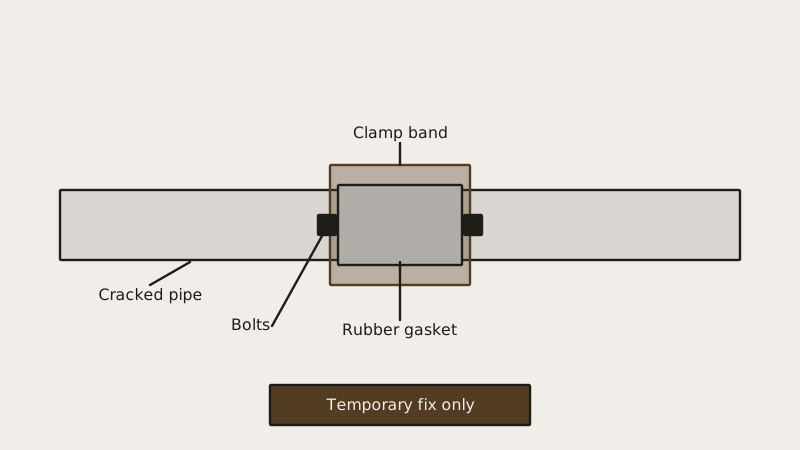
They're inexpensive hardware-store items, but they don't suit leaks at elbows, fittings or threads, where a new fitting or a replacement section is the real fix. Never put one on gas piping.
Do the work with the supply off and the line drained. Seating a clamp on a spraying pipe is a fight you rarely win. How long it lasts depends on the pipe, and nobody can promise a number. Plastic pipe behaves differently, as our guide to leaks in plastic pipe explains.
Is there a tape that seals a leaking pipe?
Self-fusing silicone tape. It stretches, bonds to itself and closes a small leak on dry, clean pipe for a brief time. The white thread-seal tape in the plumbing aisle is meant for threaded joints, so it won't stop a leak on a pipe wall. Epoxy putty is another stopgap, and it also sets best on a dry surface.
Wrap or putty only helps with minor drips on low-pressure sections, and only after the supply is off and the surface is dry. A burst is beyond it. If the leak returns through a wrap, the pipe itself is giving up, and a plumber should cut out the weak stretch and splice in new pipe.
What will fixing a pipe leaking inside a wall run?
Generally $500 to $3,000, sometimes more, because the plumber must locate the leak, open drywall, replace the section, and then someone patches and paints. Drying is separate. Close the main at once; a concealed leak soaks insulation and framing fast.
Related searches land in the same place. A leaking connection at a fitting is often a quick job when it is reachable. A leaking radiator pipe belongs to a hydronic heating system, a different set of parts, and a plumber who services heating should look at it. Ceilings get their own treatment in the ceiling water leak guide.
Speed with drying pays off. The U.S. Environmental Protection Agency says wet areas dried inside 24 to 48 hours usually avoid mold, while saturated ceiling tile or carpet can end up in the trash. Insurer payment follows the wording of the policy and the failure's cause; our piece on burst pipe coverage lists what to ask.
How can I limit the damage and the bill after a pipe lets go?
Spin the main supply valve clockwise to its stop, open the lowest tap to empty the lines, and photograph the wet areas. Lift belongings off the floor. Kill power to a soaked room only if the panel is reachable from dry ground. Then call. Cutting short the time water spreads saves the most, since the damage often outweighs the pipe.
Other habits that cut costs:
- Learn where the main shutoff is today, and confirm it turns.
- Pay for leak location before anyone opens a wall. Electronic detection costs less than guessing.
- Request a quote that spells out scope, parts, permit and patching so bids line up side by side.
- Look up each bidder's license; the state expects one at a $1,000 job total, or for any permitted job.
Our guide on preventing a pipe burst covers pressure and age. See the home page for the rest of our plumbing work.
Common questions
How long is a slab leak job?
A spot repair can fit in a day or two when things go smoothly: locating the leak, cutting concrete, fixing the pipe, pressure testing, then floor patching later. Rerouting or repiping takes longer. We can't give a firm time unseen; ask for the schedule in writing.
Which questions come first when hiring for a burst pipe repair?
Check the license status and what the quote includes. Ask about permits, wall and floor restoration, leak detection, and who handles drying. Keep the scope in writing, and file the receipt where your insurer or the city's leak program can see it later.
Is leak detection billed extra?
Usually, and it tends to earn its keep. National figures put electronic detection near $150 to $400, with a few regional quotes reaching $600. Knowing the exact spot before a wall or slab is cut can save more than the test. Some plumbers fold detection into the repair price, so read the quote.
Does home insurance pay for burst pipe damage?
Often the policy responds to sudden, accidental water damage but skips the failed pipe and slow leaks, and wording varies. Read yours, tell the insurer quickly, and keep photos and receipts. A plumber's written report helps. More on that in insurance and burst pipes.
Is every burst pipe an emergency?
Water you can't stop qualifies, so close the main and call. A contained pinhole drip on a line you've isolated can be left for a booked visit. Sewage, water near electrical equipment or any gas smell changes the picture, and emergency burst pipe help covers that.
Sources
- Pasadena Water and Power, water leak assistance program
- Pasadena Water and Power, water quality FAQs and emergency line
- U.S. Environmental Protection Agency, a brief guide to mold, moisture and your home
- Angi, burst pipe repair cost guide
- Angi, slab leak repair cost guide
- HomeGuide, burst pipe repair cost
Page updated