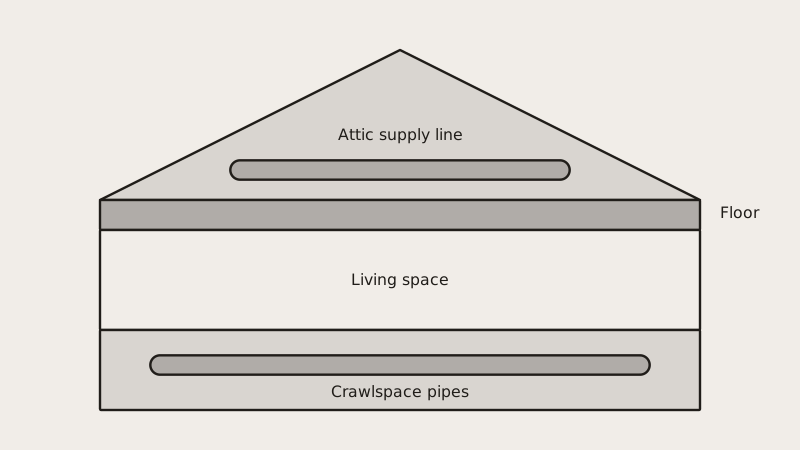
This kind of work covers supply lines, drains, vents, a water heater or a gas line sitting in the cramped, dark space overhead or under the floorboards. Most Pasadena homes have one or both. Leaks up there stay hidden until a stain shows up on a ceiling, so the work is mostly about finding the problem, reaching it safely and fixing it without wrecking finished rooms. Once we arrange it, a valley plumber drives over. Prices start from the quote page. Everything else we handle sits on the Pasadena Pipe Works home page.
What kind of plumbing sits in a Pasadena attic or crawlspace?
Expect water supply lines, drain and vent pipes, and sometimes a gas line or a whole water heater. Raised-foundation houses from the Craftsman era through the 1950s keep their pipes in a crawlspace under the floor. Houses with a second story or a flat roof tend to run lines through the attic and the walls.
Typical pipe materials follow the age of the house. Galvanized steel and cast iron show up in the oldest homes, copper in many from midcentury, and plastic such as PEX or ABS in recent work and additions. Inside the crawlspace you may also see the gas line to the furnace and the earthquake shutoff valve near the meter. The upside of a mild climate is that frozen pipes are rare here, so what ruins these spaces is corrosion, condensation and slow leaks.
Why is plumbing in tight spaces harder to repair?
Because access, safety and visibility all get worse. A plumber may crawl on joists, work under low clearance in summer heat that can climb far above the outdoor temperature, and handle solder or torches near insulation and wood. Pipes are often wrapped in old insulation, so finding a leak takes time before any repair starts.
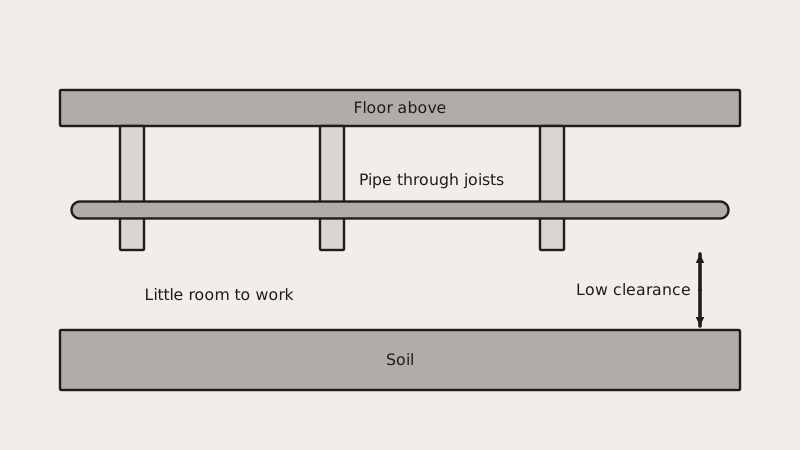
That is why the quote for a job inside an attic or crawlspace can run higher than the same fix under a sink. Expect extra time for access, protection for ceilings and floors, and sometimes a small opening cut into drywall. A heater parked in the attic brings code rules of its own. City handouts summarizing the California Plumbing Code mention a lit path to the unit, a solid floor to stand on and a watertight pan with a drain. Local departments can add their own requirements, so a permit check belongs on the job list. An aging unit may call for water heater replacement instead.
Does a pipefitter out-earn a plumber?
Federal data does not split them. One occupation line in the Bureau of Labor Statistics tables covers plumbers, pipefitters and steamfitters together, with a median near $63,800 a year in May 2025. Pay moves with employer, specialty and city, and that source gives no Pasadena figure.
The roles overlap but point in different directions. Plumbers work mostly on water, gas and drainage in homes and small businesses. Pipefitters and steamfitters work more on pipes carrying chemicals, steam or high-pressure gas in factories and large buildings. A pipefitter who specializes in industrial systems can earn well, but that tells you little about who fixes a leak in your crawlspace. For a house, the plumber is the right call. A building with process piping is a different story, covered under commercial plumbing services.
Who gets paid more, HVAC or plumber?
The two are close. The bureau puts HVAC mechanics and installers at about $61,010 and plumbers at about $63,800, both medians for May 2025, so the gap is small. Training path, overtime, employer and whether a license is required push any one person's pay either way.
For a homeowner the better question is who to call. Heating Air Conditioning technicians handle furnaces, ducts, cooling and refrigerant, which is also what usually lives in an attic. Plumbers handle water, drains and the gas piping that feeds a furnace or heater. The two jobs meet at the water heater and at gas connections, so a single visit sometimes needs both trades, and the gas side of it falls under natural gas pipe rules.
Is HVAC or plumbing the harder trade?
Neither is easier. Both take years to learn. Plumbers typically train through an apprenticeship of four to five years, per the federal labor bureau, and HVAC technicians often start with a six-month to two-year program followed by supervised field work. Which one is harder depends on the task and the person doing it.
What makes plumbing difficult is the risk of hidden water damage, the need to meet building and gas codes, and the tight spaces. HVAC adds electrical work and refrigerant handling. If you are choosing a career, try both. If you are choosing who to book, match the trade to the symptom: water, drain and gas lines call for a plumber, and cooling or heating that will not run calls for HVAC. A shared pro may cover both.
How do I book help for an attic or crawlspace problem?
Tell us what you notice: a brown ceiling stain, a damp crawlspace, a dripping heater, knocking in the walls. Photos speed things up. The visiting plumber should hand over a price in writing before any pipe is touched. If water is running now, shut the main valve and then compare what you see with the signs a pipe has burst.
Gas odor? Exit the house right away. Away from the building, the SoCalGas number is 1-800-427-2200, and 911 covers real danger. Relighting pilots and touching gas piping are off limits for homeowners, since California requires a contractor license for gas piping work and permits apply. Communities from South Pasadena to Diamond Bar are listed under where we work. To keep these hidden lines healthy, see preventing a pipe burst.
Common questions
How long will an overhead or underfloor job run?
One small leak could be a one or two hour repair, with the hunt for it adding more. A heater swap or new lines can fill half a day to a full day or longer, depending on access. Expect a time window on the quote.
What should I check on a plumber before booking?
Ask for the contractor license number and run it through the state board's lookup. Then settle if the quote covers cutting and patching the access point, whether a permit is involved, what protects your floors, and who pays for surprises behind the drywall. Keep those answers in writing.
Should I be around while the plumber works?
Most visits go better with an adult there to open the hatch, point to the stain or describe the noise, and approve any change in price while the water is shut off. Some crawlspaces open from outside and can be unlocked ahead of time. Mention how access works when you book.
Should I go into the crawlspace or attic myself?
Only to look. Watch your footing on joists, never step between them, wear a mask and gloves around old insulation, and avoid any space with a gas smell or standing water near wiring. Old insulation can contain asbestos, so do not disturb it. Leave the fixing to a plumber.
Sources
- Plumbers, Pipefitters, and Steamfitters, US Bureau of Labor Statistics
- Heating, Air Conditioning, and Refrigeration Mechanics and Installers, US Bureau of Labor Statistics
- Residential water heater installations under the California Plumbing Code, City of Escondido handout
- Check a contractor license, California Contractors State License Board
Page updated