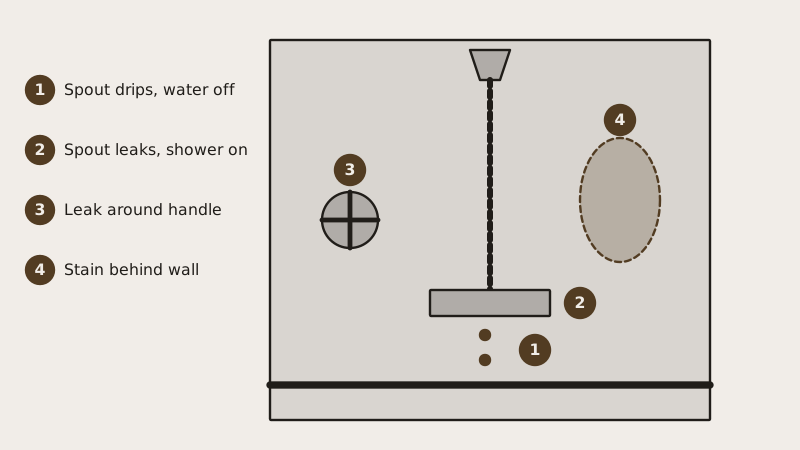
First, notice the timing. A spout that drips while everything is off has a tired washer (two handles) or a tired cartridge (one handle). A spout that drips just when the shower is on has a failing diverter. Dampness around the handle means an O-ring or packing. Water at the wall, or a stain behind it, is plumber territory. The broader set of jobs sits under shower, faucet and sink repair.
We take the patterns one by one, add notes for a popular Moen single-handle bathroom faucet, and finish with the under-the-sink leak that so often gets asked about alongside it.
What does the leak's location say about the cause?
Time and place identify the part. Drips with everything off blame the washer or cartridge. Water coming out of the spout once the shower starts blames the diverter. Moisture at the handle blames worn stem seals. A wet wall, a stained ceiling underneath or a soft spot means a leak inside the wall, and that is beyond a weekend repair.
| Where and when | Likely part | DIY? |
|---|---|---|
| Spout drips with water off, two handles | Seat washer or O-ring in one handle | Yes, with care |
| Spout drips with water off, one handle | Cartridge | Often yes |
| Spout drips only while the shower is on | Diverter in the spout | Usually a spout swap |
| Water around the handle or trim plate | O-ring, packing nut or stem | Often yes |
| Leak at the wall where the spout meets it | Wrong nipple length, failed seal | Sometimes |
| Damp wall, ceiling stain or soft spot | Pipe or valve body behind the wall | No, call a plumber |
One more clue: a leak that shows up only in the spray, never with the faucet running alone, is often a caulk or grout joint, not plumbing.
What is the fix when the spout drips with the water off?
Shut off water to the bathroom and work out your valve type. With two handles, remove the dripping handle and its stem, renew the rubber washer at the base and the O-ring, and rebuild. With one handle, change the cartridge. The parts are cheap, and with a correct match the work often fits inside an hour.
WaterSense, the EPA program, counts a drip a second as over 3,000 gallons yearly and lists worn washers and gaskets as a frequent cause. Full steps for the two-handle type are in the two-handle faucet guide, and single-handle models are covered in fixing a single-handle faucet.
Older Pasadena bathrooms call for caution. A tub valve may be buried behind tile without an access panel, and any stop valve has probably not been turned in decades. If the only way to cut the water is the main, or the stem will not come out, leave it alone and ring a plumber instead of forcing parts.
Why do drips start only once the shower is on?
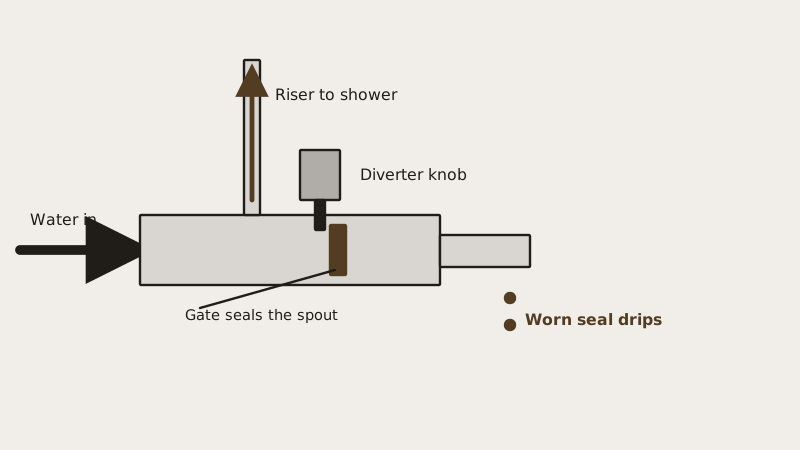
The diverter is to blame: it is the gate that redirects water to the showerhead. When it is a lift knob on the spout, the usual cure is a whole new spout, a modest purchase. A slip-on spout comes off after you cut the caulk at the wall, and a threaded one unscrews once the caulk is cut. Fit the new spout and caulk it.
Hard water makes diverters stick and seep. Pasadena Water and Power logged 202 to 256 ppm in 2025, near 13 grains per gallon, so crust inside a spout is common here. Vinegar can loosen scale on parts that come off, but a diverter that keeps passing water is cheaper replaced than nursed.
A spout that leaks where it meets the wall brings the pipe nipple into play: too long and the spout will not seat, too short and it bottoms on the threads before it seals. Either replace the nipple or buy a spout of matching depth. A leak that survives a new spout may be in the pipe behind the wall.
What about a leaking Moen bathroom faucet?
Identify the cartridge before buying one. Moen says most of its cartridge numbers fall in the 1200 series; the 1225, found in single-handle bathroom faucets made before 2009, is held by a U-shaped copper clip, while newer ones such as the 1255 use a retainer nut. Close the supply, take off the handle, remove the clip or nut, swap the cartridge and reassemble.
Moen's steps for a 1225 in a pre-2009 single-handle bathroom faucet:
- Turn off the water supply shutoff valves.
- Remove the handle, then slide the copper retainer clip out of the valve body with a flathead screwdriver.
- Pull out the old cartridge. Moen recommends cleaning and flushing the valve body before installing the new one.
- Slide in the new cartridge and push it fully home. Its plastic tabs must sit flush and be centered on the cut-outs at the 12 and 6 o'clock positions.
- Reinstall the clip. If you meet resistance, do not force it, because the cartridge may not be aligned.
A faucet that looks like a 1225 type but dates from after 2009 may actually take a 1255, and Moen warns that the retainer nuts are not interchangeable. If you are unsure, remove the handle and look, or use Moen's faucet identifier. Moen also says many of its faucets carry a limited lifetime warranty on leaks and drips for the original purchaser, so read that before buying a part.
How can I stop a leak in the pipes beneath a kitchen sink?
Set a bucket under it, dry everything, and see where fresh water appears: a drain slip-nut joint, a faucet supply line or a shutoff valve. A loose slip or compression nut often needs only a quarter turn by hand. Cracked washers and worn supply lines are replaced, and a trap that is corroded or cracked gets swapped for a new one.
Quick guide:
- Drain joints (the trap). Snug the slip nuts, then swap the washers if it still seeps.
- Faucet supply lines. Replace any braided or soft line that is kinked or cracked.
- Stop valves. A weeping stem may firm up at its packing nut, but a valve that is frozen or leaks from its body gets replaced.
- Pitted steel or copper pipe. That is a plumber's job.
Under Pasadena's exemption list, repairing leaks in pipes, valves or fixtures needs no plumbing permit provided none is replaced or rearranged. Putting in a new valve or a section of pipe is a different matter, so ask the Permit Center. The longer version is repairing leaks beneath the sink.
Which tub faucet problems need a plumber?
Water in the wall or ceiling, a stem or cartridge that will not budge, no shutoff short of the main, a second failed repair, or a cracked or corroded valve body: any of these. Replacing a valve behind tile can bring a permit and wall repair with it. Begin at our quote form. Across Pasadena and the San Gabriel Valley (see the home page), the visiting plumber writes the price down first.
Common questions
How long should I set aside?
A first-timer with an accessible faucet should allow about an hour plus the errand for the part. A plumber is typically faster. Opening a wall, freeing a seized valve or replacing a valve behind tile takes much longer and may involve a permit.
What do I want from a plumber before agreeing?
The license number, checked with the state; whether parts are included; whether walls get opened and who repairs them; whether a permit applies; and the price in writing. If a valve replacement is proposed, ask what exactly is wrong with the old one.
Why is it dripping after I fitted a new washer?
Likely culprits are a pitted valve seat, a washer of the wrong size, or scale keeping a seal open. A damaged seat eats new washers, and it can be smoothed or replaced with a seat wrench. After a second failed repair, a new valve may be the better route.
Is it ever fine to leave the water on?
Not for anything beyond tightening a handle screw. Close the bathroom shutoff first, or the house main if there is none, because pressurized water sprays out of an open stem or cartridge opening. When neither will close, stop and call a plumber.
Sources
Page updated