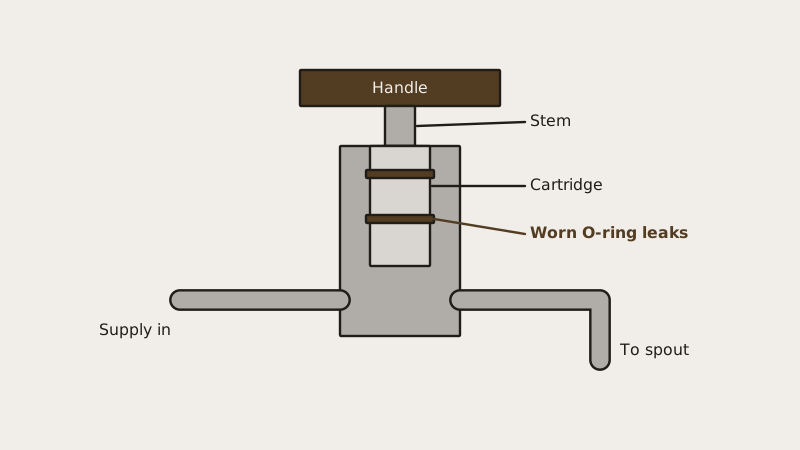
A dripping faucet is a worn washer, O-ring, seat or cartridge, and swapping the part usually ends the drip. Turn off the little valves beneath the sink, dismantle the faucet in an order you can reverse, buy a part that is a twin of the old one, and rebuild. If the faucet is a shower or tub valve inside a wall, see the shower repair plumber page before you cut anything, or send a quote request.
What type of faucet is it, and which part has worn out?
Four designs cover nearly every faucet, and the design points to the part. Two handles that screw down tight are usually compression faucets with rubber washers. A single lever with a ball joint under the cap is a ball faucet. A smooth lever or knob that lifts and turns often hides a cartridge, and a short, wide cylinder under the handle suggests a ceramic disc.
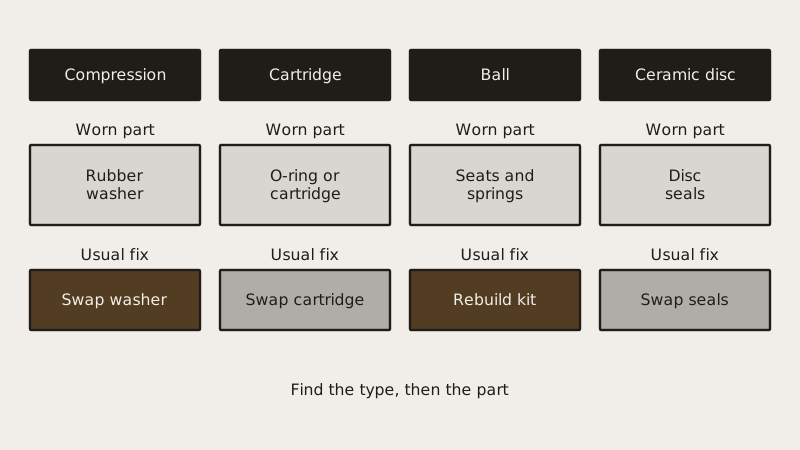
Where the water escapes narrows it further:
- Drips from the spout. Worn washer and seat in a compression faucet, a tired cartridge, or damaged inlet seals in a ball faucet.
- Weeps around the handle. A dried O-ring or loose packing nut.
- Wet at the base. Spout O-rings, a common issue on swivel kitchen spouts.
- Slow trickle that never stops. A pitted valve seat, often scarred by scale.
Older Pasadena houses often carry a mix of old compression valves in bathrooms and newer cartridge faucets in remodeled kitchens, so check each fixture on its own. Water here is hard, 202 to 256 parts per million in Pasadena Water and Power's report for 2025 data, which is why seats pit and cartridges stiffen sooner than owners expect.
What is the repair routine for a kitchen faucet that drips?
Start at the cabinet and turn both small valves to closed. Open the faucet once to release trapped pressure, and lay a rag over the drain. Remove the screw under the handle cap, lift off the handle, then loosen the retaining nut. The cartridge pulls straight out. Note which way its notch pointed before you shop.
Seat the new cartridge with its notch facing the way the old one did, snug the nut, put the handle back and reopen the valves slowly. A dab of plumber's grease on the new O-rings helps. For two-handle versions, compare notes with how to fix a two-handle leaky faucet, and for a lever style try fixing a single-handle faucet. Delta, Moen and other makers sell kits by model number, so photograph the faucet and look for the number before you shop.
What about a bathroom sink faucet that keeps dripping?
The repair matches the kitchen one, with two differences. Bathroom faucets are smaller, so the parts are fiddlier, and the shut-off valves under the vanity are often stiff or crusted. Test them before you begin. If a valve stays slightly open, go to the house main, close that, and work on a dry line.
Bathroom sinks also tend to have a pop-up drain assembly nearby, and moisture in the cabinet may come from a supply connector or the drain instead of the faucet. Wipe the cabinet dry and wait for the first bead to appear, which tells you the source. Cabinet leaks have their own guide, a leak beneath the sink. An old, corroded faucet that is no longer made often costs less to swap out than to rebuild, and the faucet installation cost page shows what a swap runs.
What stops a tub or shower faucet from dripping?
A tub spout that drips after the handle is off has a failed valve cartridge or stem, and the repair means shutting the water, removing the trim and handle, and pulling the valve parts out through the wall opening. Spout drips with a diverter lever, by contrast, point to the diverter inside the spout, which is often a quick swap.
The wall valve is where DIY gets risky. Shut off water to the whole house if no local stop is installed, and be ready to find that the valve body is corroded or soldered in. The page on fixing a leaky tub faucet lists the steps by brand style. Ask a plumber if the handle will not budge, if the cartridge breaks in pieces, or if you reach plaster that crumbles. Opening the wall to reach the valve is plumbing work, and a plumber also repairs the opening afterward.
Can I repair a hose bib that leaks outside?
An outdoor hose bib that drips from behind the handle usually needs its packing nut tightened a quarter turn, or the packing washer replaced. One that drips from the spout has a worn stem washer. One that sprays from the vacuum breaker cap when running has a failed breaker. Close the interior valve that feeds the bib, and if there is none, the main.
On foothill lots and older yards the bib may be rusted onto galvanized pipe, and heavy force on a wrench can wring the pipe inside the wall. Brace the pipe with a second wrench and stop the moment anything shifts. Replace the whole bib when the stem is scored. Details on that repair are in fixing a leaky outdoor water faucet. Pasadena freezes rarely, but cold nights in the hills can crack an exposed bib, so a cover helps.
How much does a faucet repair cost, and does the drip really waste water?
Cost guides from around the country put a plumber's faucet repair at $100 to $400, while the cartridge is only $10 to $40 at most. The waste is real too. EPA WaterSense puts a one-drip-per-second faucet at more than 3,000 gallons lost each year. Treat prices as a rough guide, since a quote comes from the plumber.
Price climbs for hard-to-reach shower valves and for pull-down kitchen faucets. Many plumbers add a trip fee in the $50 to $100 range, sometimes folded into the repair. To see how a drip lands on the bill, go to what a leaky faucet does to your water bill.
Common questions
How much of the afternoon will this eat up?
A first-timer swapping a cartridge or washer on a sink faucet should allow 30 to 60 minutes. A plumber who arrives with the part finishes in about half that. A tub or shower valve takes longer, and a corroded one can turn into a half-day repair if the wall must be opened.
Is it possible to do this with the water still on?
No. Pull a cartridge or stem with the supply live and you get a fountain. The stop valves in the cabinet do the job, and the main valve is the fallback if they are seized or were never installed. Open the faucet afterward to drain it, and plug the sink so small parts do not fall in.
Why does my faucet keep dripping after a new cartridge?
Common causes are a pitted valve seat that no longer seals, a cartridge that is the wrong model or sits crooked, a missed O-ring, or scale on the spout. Hard water makes seats rough over time. Replace the seat if the faucet allows it, or replace the whole faucet once parts and your Saturday add up to a new unit.
Is a permit or a plumber required for a faucet repair?
Changing a cartridge or washer in your own home does not usually need a permit. Under state rules, anything that adds up to $1,000 across labor and materials belongs to a contractor who has a California license. Faucet repairs rarely get near that. Replacing a valve inside a wall is different, so ask a plumber, who handles any permit.
When is replacing the faucet smarter than repairing it?
Replace it when parts are discontinued, when the finish is pitted and the body corroded, or when the parts cost close to what a new fixture would. A fresh faucet may also use less water. See what installing a faucet costs.
Other plumbing jobs we arrange across the valley are on the Pasadena Pipe Works home page.
Sources
- U.S. EPA WaterSense, Fix a Leak Week (drip waste figures)
- Pasadena Water and Power, 2026 annual drinking water quality report
- California Contractors State License Board, handyperson exemption
- Published faucet repair prices from national and Southern California cost guides, checked November 2026
Page updated