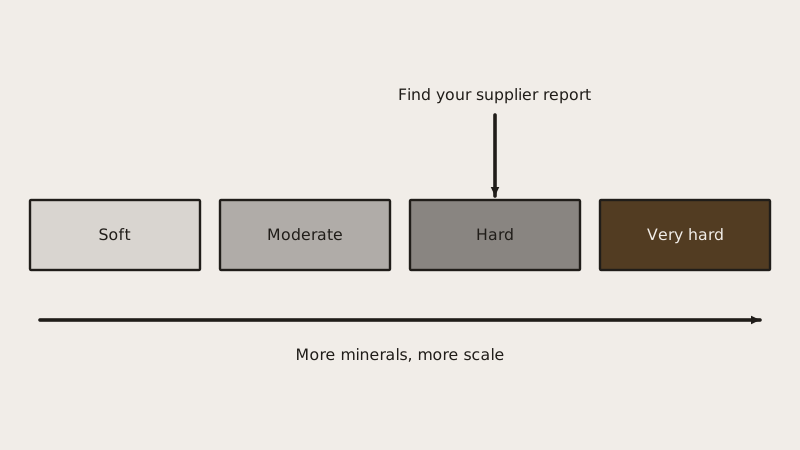
Tap water in Pasadena falls in the hard to very hard range. Pasadena Water and Power measured 202 to 256 milligrams per liter in 2025, an average of 222, which is about 13 grains per gallon. Nearby suppliers report anywhere from the 150s to the 270s. Because hardness depends on who supplies your water and which sources are blended that season, the best answer for any address comes from the supplier's annual report, which this guide tells you how to read. If hard water is already costing you scale and spots, see our guide to water softener installation.
How hard is the water in Pasadena?
Very hard by the usual scale. Pasadena Water and Power reported total hardness between 202 and 256 mg/L for 2025, averaging about 222 mg/L, or roughly 13 grains per gallon. The US Geological Survey calls anything above 180 mg/L very hard.
According to the utility's report, roughly half of Pasadena's supply is local groundwater from the Raymond Basin and the rest is imported water bought through the regional wholesaler, Metropolitan. Both run hard because they travel through limestone and other mineral-bearing ground. The utility adds that hardness varies with the mix of sources through the year, and that it has no known health effect. It does leave white scale on fixtures and appliances, reduces the cleaning power of soap, and shortens water heater life. The utility serves Pasadena and portions of unincorporated Altadena, East Pasadena and San Gabriel.
What do the published numbers say by area?
The table collects the figures we could read in official reports, all in mg/L of calcium carbonate, with 17.1 mg/L equal to one grain per gallon. Each is an average, and the water at your tap moves within the stated range. We left out cities whose official numbers we could not read, instead of guessing.
| Supplier and area | Reported hardness | Year | Class on the USGS scale |
|---|---|---|---|
| Pasadena Water and Power, Pasadena and nearby areas | average 222 (202 to 256) | 2025 | very hard |
| South Pasadena, local groundwater (ZIP 91030) | average 150 (140 to 150) | 2021 test, 2024 report | hard |
| South Pasadena, Pasadena groundwater delivered to its Pasadena zone | average 240 (210 to 270) | 2024 | very hard |
| South Pasadena, Metropolitan imported water | average 270 (240 to 300) | 2024 | very hard |
| Golden State Water, South Arcadia system | average 160 (110 to 200) | 2025 | hard |
On the USGS scale, 0 to 60 mg/L is soft, 61 to 120 is moderately hard, 121 to 180 is hard and above 180 is very hard. The South Arcadia average of 160 is in the hard band, about 9.4 grains per gallon. We could not verify official numbers for every city we cover, so we leave them out instead of guessing.
Which ZIP codes are served by which supplier?
ZIP codes and water systems do not line up. A city may have its own water department, a private company, or several small mutual water companies, and a single street can change suppliers. The reliable way to know is to read the name on your water bill.
Pasadena addresses are mostly served by Pasadena Water and Power. South Pasadena, ZIP 91030, has its own city water department and blends local groundwater with water from Pasadena and Metropolitan. Altadena is split among several providers: the Arroyo Seco watershed directory lists Lincoln Avenue Water Company for the west side, plus Rubio Cañon Land and Water Association and Las Flores Water Company, and Pasadena Water and Power covers part of it. Golden State Water runs the South Arcadia system, which draws groundwater from the Main San Gabriel Basin. Look for your supplier's latest water quality report on its website; every utility is required to publish one each year. If you live in an area we cover, the areas we cover page names them.
What does hard water do to pipes, heaters and fixtures?
When hard water is heated, calcium carbonate drops out as scale. The USGS notes that this can shorten the life of equipment, narrow pipes, lower pressure over time and push up heating costs. In practice you see white crust on faucets, cloudy glasses and stiff laundry, and inside you get a tank that rumbles.
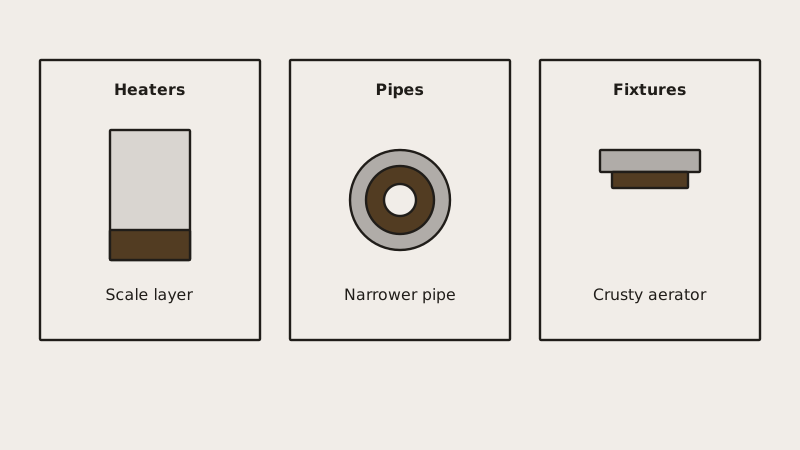
The water heater takes the worst of it. Scale coats the bottom of the tank and burns out elements, which is one reason the lifespan of a water heater can fall short of national averages here. Flushing the tank and replacing the anode rod helps, as described in anode rod replacement. Scale on fixtures and showerheads can be removed with a mild acid like vinegar; see hard water scale removal. Hard water can also leave hair feeling dry; signs of hard water on hair covers that.
How do I find my own water hardness?
Open your supplier's annual water quality report, sometimes titled a Consumer Confidence Report, and find total hardness, listed in mg/L or in grains per gallon. Or phone the number printed on your bill. A home test strip, sold at hardware stores, gives a rough check at your tap in a minute.
Test strips and drop kits are fine for a rough number, and a lab test is more exact. Remember that the water can change by season, because utilities switch between groundwater and imported supplies, so test once in summer and once in winter if you care about precision. Do not rely on third-party websites that list one hardness figure for a whole city; they often mix years and sources, and they sometimes disagree with the utility's own report. If your supplier is a small mutual company, ask for its report in writing.
Do I need a water softener?
Not necessarily. Water above about 180 mg/L, which the USGS calls very hard, is where many owners start thinking about one, because of scale in the water heater, spotting and soap use. A softener swaps calcium and magnesium for sodium or potassium. It costs money, uses salt and needs upkeep, and it is not needed for drinking water.
Options include a whole-house salt softener, a salt-free scale conditioner and a point-of-use fix such as showerhead filters. A softener also affects an anode rod, which wears faster in softened water. Installation is plumbing work, and the price depends on the unit and the house; read water softener installation cost for ranges and the do-it-yourself softener guide for what you can do yourself. A plumber can size a softener from your water report. To arrange one, use the quote page.
Common questions
Is hard water safe to drink?
Yes. The USGS describes hardness as a nuisance, not a health concern, and Pasadena Water and Power reports no known health effect from it. Drinking-water safety is a separate matter, covered by the standards tables in each utility's report, and a softener is a comfort and equipment choice, not a safety device.
Does the 2025 Eaton fire affect these numbers?
Nothing in the published reports says so. Pasadena Water and Power wrote that it issued a do-not-drink notice for parts of its service area after the fire and lifted it once testing, approved by the state's drinking water division, confirmed the water was safe. Hardness is about dissolved minerals and is reported separately.
How long does a softener installation take?
Usually half a day to a day, depending on the unit, the drain and electrical needs, and whether the plumbing needs changes. The water is off for part of the visit, so plan around it and ask about timing at booking.
What should I ask a plumber about a softener?
Get the contractor license number and check it with the state board. Ask what the unit is sized from, which water test was used, what salt and upkeep will cost each year, where the drain line will run and whether a permit applies.
This guide is one of many on Pasadena Pipe Works.
Sources
- 2026 Annual Drinking Water Quality Report (2025 data), Pasadena Water and Power
- Your 2024 South Pasadena Water Quality Report, City of South Pasadena
- South Arcadia Water System, Consumer Confidence Report for 2025, Golden State Water
- Hardness of water, US Geological Survey
- Water agencies in the Arroyo Seco watershed
Page updated