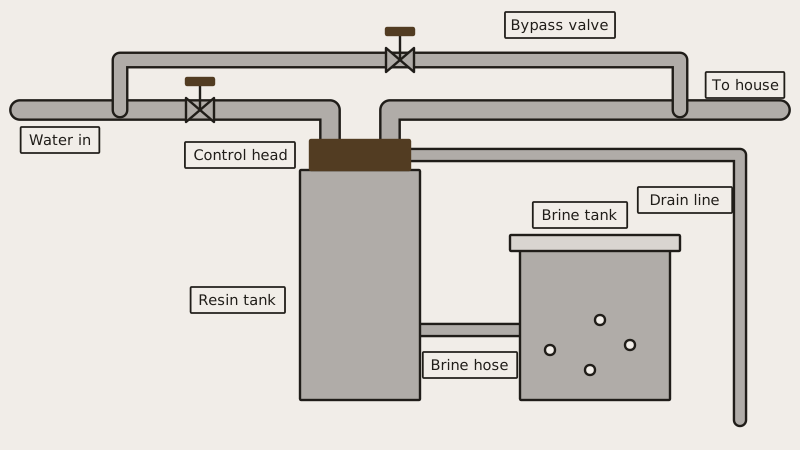
Yes, you can install a salt-based water softener yourself if you are comfortable cutting into the main water line, running a drain hose with an air gap and sorting out a permit first. The unit sits on the pipe just after water enters the house, so every tap beyond it runs treated water. If cutting copper or tying into the main is new to you, hire it out: our softener installation page explains the options.
Pasadena water is hard, so the question comes up often at Pasadena Pipe Works. Below: how to read your own hardness figure, the steps in order, what the permit and sewer rules mean for a DIY job, whether a softener fixes dry skin or hair, and a quick way to deal with scale in the meantime.
How do I find out how hard my water is?
Look up your supplier's annual water quality report, or test a glass of tap water with hardness strips. For Pasadena Water and Power customers, the 2025 data puts hardness anywhere from 202 up to 256 ppm, averaging about 222, or roughly 13 grains per gallon. Pasadena Water and Power calls that very hard, and the number is what you size a softener from.
Hard water is simply water carrying dissolved calcium and magnesium minerals, and softener labels use grains while reports use ppm, and the bridge between them is simple: 17.1 ppm equals one grain per gallon. A busy household on 13-grain supply exhausts a softener faster than a couple living alone, so the capacity you buy matters. The utility draws about 40 percent from the Raymond Basin's local wells and about 60 percent from imported Metropolitan Water District supply, and the blend, plus the season, moves the number. Wells carry more of the load in summer.
Not on Pasadena's system? Each city in the valley has its own supplier and its own report, so check the one on your bill. Our guide to water hardness by zip code lists what we have checked. A private well is outside any utility report, so pay for a lab test.
Is a DIY softener install realistic for a homeowner?
For someone who has soldered copper or used push-fit fittings before, it is a half-day to full-day project. For everyone else, the risk sits in the details: cutting the wrong pipe, forgetting that the softener interrupts the grounding path of the main line, or leaving the drain without an air gap. A leak at a fitting on the main can flood a house before you find the valve.
Honest guide to whether to do it:
- Reasonable to DIY: you have a spare outlet and a standpipe or floor drain nearby, accessible copper or PEX, and your own tools for the pipe type.
- Better with a plumber: galvanized supply pipe that may crumble when cut (common in older Pasadena homes), a tight garage or crawlspace, or no drain within reach.
- Needs a pro regardless: any change to gas piping, which California does not let you do without the right contractor license, and any sign the existing main valve will not close.
Check the cost before you decide. Our softener installation price guide shows what the labor typically adds, and you may find it worth skipping the afternoon of cutting pipe.
What does the installation sequence look like?
Pick a level spot near the incoming pipe, a drain and a 120-volt outlet. Then close the main, empty the lines, splice into the supply, set the bypass valve, route the drain hose through an air gap, and bring the unit online slowly while a tap purges air. Your model's instruction sheet overrides this outline.
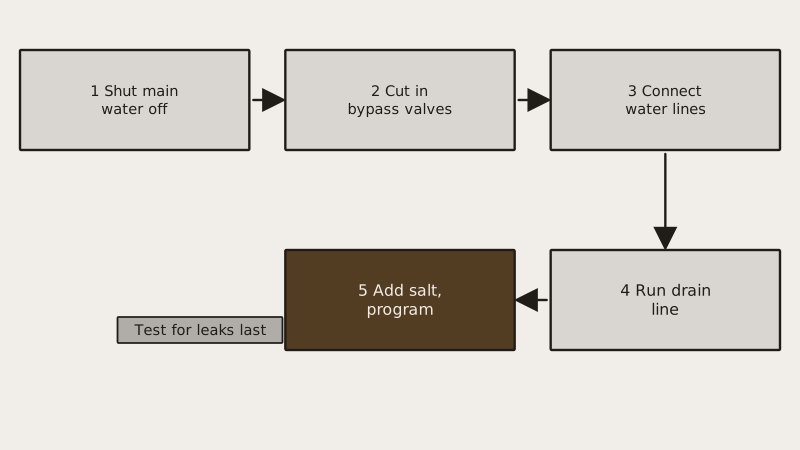
In practice the job goes in this order:
- Pick the spot. Whirlpool's guide wants it level, dry and close to the main, a drain and a power point. The outlet should not be on a switch.
- Close the main and empty the house. One tap upstairs and one at the lowest point will drain the pipes.
- Mount the bypass valve on the softener, with the inlet and outlet the right way round, and leave it in bypass.
- Cut the main and fit the inlet and outlet pipes. Add a jumper wire across the cut if the manufacturer calls for one, since a plastic bypass interrupts the electrical ground that the pipe may provide.
- Run the drain hose short and direct to a standpipe, laundry sink or floor drain, leaving open air between the hose end and the drain. Whirlpool specifies 1-1/2 inches, and the California Plumbing Code also expects an air gap where the discharge meets the sewer.
- Add salt and restart slowly. Open the main, then ease the bypass toward service so resin does not wash out, and run a tap for 15 to 20 minutes until the air is gone.
- Set the hardness and the regeneration schedule on the control head, using your supplier's number.
Is there a permit, and what about the salty discharge?
Phone the City of Pasadena Permit Center before buying anything. The city's exemption list names stopping leaks and clearing stoppages, not new equipment, so expect a plumbing permit and verify by phone. A separate state rule, Water Code section 13148, lets some local sewer agencies limit self-regenerating softeners, so check your city's position too.
Neither rule appears in most box-store instructions. In Pasadena that is Building and Safety, the city division with the phone line (626) 744-4200. Every other valley city has a building department of its own, and our where we work page points to each one. The water code section allows agencies, once a regional water board finds salt a problem, to require permits, certain efficiency ratings or removal of older units. Pasadena Water and Power itself notes that some cities have banned salt-based softeners because of chloride in the discharge. We have not seen a valley ban, but we cannot promise there is none for your street.
If a plumber does the job, they handle the permit as part of the visit. A request through our form starts that conversation.
Does a softener help hard water skin, or hair loss?
A softener cuts soap scum and leaves skin and hair feeling less coated, but evidence that it treats skin conditions is weak. In the SWET trial, published in PLOS Medicine, softeners gave no clear improvement for children with eczema, and the authors advised against recommending them for moderate to severe cases. Pasadena Water and Power also states there is no known health effect from hard water.
For dry skin, switch to a gentle cleanser, shorten hot showers and moisturize while skin is damp. A showerhead filter will not soften water. For hair loss, we found no reliable evidence that hard water causes it. Hard water can leave hair rough and dull, but hair loss has medical causes, so see a doctor or dermatologist. Our short note on signs of hard water on hair separates the cosmetic from the medical.
Can I deal with scale without buying a softener?
Partly. White vinegar loosens crust on faucets and showerheads: tie a bag of it around the head overnight, then rinse. Keep it off marble and other natural stone. Scale inside pipes and heaters is out of reach, though an annual heater flush helps. A softener stops new buildup but will not strip what is already there.
Pasadena's hardness is also why heaters and kettles scale up. The utility says hardness causes buildup in water heaters and shortens their working life. The full routine is in our piece on descaling fixtures and heaters, and water heater replacement covers what happens when scale wins. Also see why your water bill might be high, since scale can reduce the efficiency of heating.
Which jobs belong with a plumber?
Give it away when the cut would land in galvanized pipe, when the main valve is seized, when no drain or outlet is nearby, or when the city's rules are murky. A tradesperson with a California contractor license can obtain the permit and pressure-check the fittings, which pays off in a house with old pipe.
Common questions
How many hours should I set aside?
Plan on a morning if you have done pipe work before and a full day if not, counting the draining, the connections and the purge. A plumber usually moves faster. Brittle old pipe, a far-off drain or a permit inspection can all lengthen the day.
What must I confirm with a plumber beforehand?
Collect the license number and run it through the state contractor board's search. Find out who obtains the permit, and insist on a written price that itemizes unit, labor and parts. Ask how the drain will run, how the air gap is made and how the electrical ground is kept intact. Then ask who pays if a fitting leaks.
Should I stay home on installation day?
A person has to answer the door and show the plumber the main valve, the chosen spot and the outlet. Expect the taps to go dry for a stretch. Be around at the end so the two of you can check the hardness setting, the salt level and each fitting for drips.
Is soft water safe to drink?
Water from a salt-based softener has more sodium, because sodium replaces the calcium and magnesium. Pasadena Water and Power notes this can matter for people on a sodium-restricted diet, and that very soft water can be corrosive to pipes. On a sodium-restricted diet, ask your doctor, and think about leaving one drinking tap untreated.
Sources
- Pasadena Water and Power, 2026 Annual Drinking Water Quality Report (2025 data)
- Pasadena Water and Power, water quality FAQs
- California Water Code section 13148, local control of self-regenerating water softeners
- City of Pasadena Building and Safety Division, work exempt from permit
- Whirlpool, water softener installation instructions
- Thomas et al., ion-exchange water softeners for eczema in children (SWET trial), PLOS Medicine
Page updated