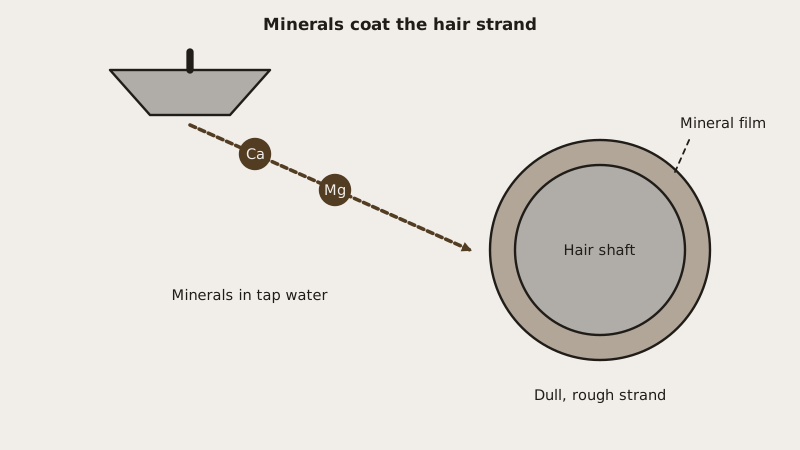
Hair that feels coated and dull, soap that will not lather, skin that feels tight after a shower, and a white crust on faucets are the classic hard water signs. Pasadena Water and Power calls its water very hard, so expect to see some of them. Fixing it at the source starts with a water softener installation.
The sections ahead cover the residue hard water leaves, what research really shows for hair, skin and digestion, ways to test your own supply, and options running from a shower filter to a whole-house softener. Pricing starts on the quote page.
How does hard water show up on hair?
Hair washed in hard water tends to feel rough or coated, look dull, tangle easily, and resist lathering. Shampoo may rinse out poorly, leaving a waxy film. Color can fade faster, and scalp flaking sometimes follows. These are common complaints, though some may be about product build-up rather than water alone.
The mechanism is mineral deposit. Hard water carries dissolved calcium and magnesium, which cling to hair and bind with soap to form a film. A scanning electron microscopy study published in the Indian Journal of Dermatology, Venereology and Leprology found more magnesium on hair washed in hard water, but no significant difference in visible damage to the hair shaft.
So the honest reading is this: deposits are real, and the feel of the hair changes, but the evidence that hard water breaks hair or causes hair loss is weak. Much of the louder claim-making comes from companies that sell filters and softeners.
How do I find out whether my tap water is hard?
Look for white or chalky crust around faucets and on showerheads, spots on glassware, a film on shower doors, soap that barely lathers, and a heater that rumbles from scale. The most reliable check is the hardness figure your water utility publishes; a cheap strip from the hardware aisle is the quick alternative.
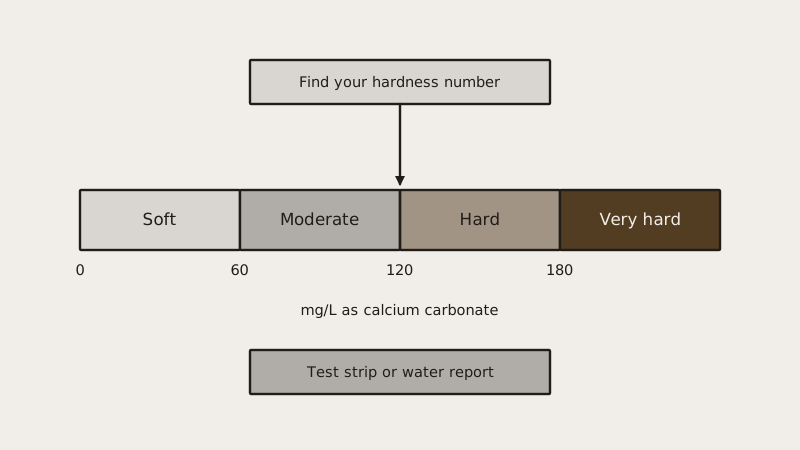
Pasadena Water and Power's FAQ says the city's water averages 12.9 grains per gallon and is considered very hard, with the number shifting by season as local groundwater and imported water trade shares. Using the standard conversion of about 17 mg/L per grain, that is roughly 220 mg/L, above the 180 mg/L line the U.S. Geological Survey uses for very hard water.
Other San Gabriel Valley cities draw from their own utilities, so your number depends on your address. Our page on water hardness by zip code explains how to look yours up.
Can hard water affect your skin?
Common reports are skin that feels dry, tight or itchy after bathing, a filmy feeling that soap seems not to rinse away, and flare-ups on skin that is already sensitive. Pictures online usually show the white crust left on fixtures rather than skin changes, because the skin signs are subtle and vary by person.
Hard water needs more soap to lather, and soap scum can stay on the skin. For most people this is an annoyance. For people with eczema the picture is more complicated: ECARF, a European allergy research foundation, reports that a review of studies found an association between hard water and atopic dermatitis in infants, while softeners had little measured effect on symptoms in two studies.
If skin problems are persistent, a doctor or dermatologist should look at them. Water is one possible factor among many, and hard water is not a diagnosis.
Can hard water cause skin problems or dermatitis?
Possibly in some people, but the evidence is mixed. A review cited by ECARF found children in hard-water areas slightly more likely to have atopic dermatitis, yet the mechanism is unclear, and softeners did not clearly improve symptoms in two studies. Treat hard water as a possible irritant, not a proven cause.
Practical steps that carry little risk: use a gentle, fragrance-free cleanser, keep showers short and lukewarm, rinse thoroughly, and moisturize after bathing. These help irritated skin regardless of water type.
Eczema in the household? Raise water with the doctor before you spend on equipment. A softener is a household decision about scale and soap use first, and only a possible extra benefit for skin.
Is hard water bad for you, or does it cause kidney problems?
Not by the evidence we checked. The World Health Organization has not set a health-based guideline value for hardness, stating it is not of health concern at the levels found in drinking water. Its material also notes calcium and magnesium are essential minerals, and that research on hardness and heart health is still debated.
For kidney stones, we found no verified link between ordinary municipal hard water and stones in the sources we read, and we are not in a position to give medical advice. If you have had stones or kidney problems, a doctor or dietitian can say what applies to you, including how much you should drink.
Hard water mainly costs you in the house: scale in water heaters, pipes and fixtures, more soap, and shorter appliance life. The USGS says scale can shorten equipment life, raise heating costs and clog pipes.
Can drinking hard water cause constipation or stomach problems?
We found no reliable evidence in the official sources we checked that ordinary city hard water causes constipation, stomach upset or other digestive problems. The WHO treats hardness as not of health concern at normal drinking-water levels. If digestive symptoms persist, see a doctor rather than assuming the water is the cause.
A sudden change in water source or taste can bother some people for a few days. That is different from hardness itself. Talk to your doctor about persistent symptoms, and do not treat them with equipment alone.
What are the solutions for hard water on hair and in the home?
Options range from small to whole-house. A clarifying shampoo used occasionally removes build-up, a shower filter may reduce some minerals at one outlet, and a whole-house water softener removes calcium and magnesium for every tap. Which one makes sense depends on the problem and the budget.
A softener works by ion exchange, swapping the calcium and magnesium in the water for sodium or potassium ions, and it protects the water heater, fixtures and appliances as well as hair and skin. The install calls for a drain connection, electrical power and often a bypass valve, which is why a plumber is usually involved. See what water softener installation costs for price guides, and do-it-yourself softener installation for the limits of a DIY job.
Crust on fixtures you can already see? The steps are in the guide to clearing hard water scale. And if a water heater is the main worry, regular flushing is part of maintenance plumbing.
Common questions
Does hard water cause hair loss?
Dermatologists generally do not name hard water as a main cause of hair loss, and the studies we found showed mineral deposits on hair without clear structural damage. Hair that breaks from dryness or tangles can look thinner. If you are losing hair, see a doctor, since many other causes are more likely.
Does hard water cause kidney stones?
We found no verified link between ordinary municipal hard water and kidney stones, and WHO does not set a health guideline for hardness. This is a medical question. With a history of stones or kidney trouble, ask your doctor what applies to you, including how much water to drink.
Is hard water bad for your skin?
It can leave a film and make skin feel dry or tight, and it may irritate sensitive skin. Research on eczema suggests an association in infants, but softeners showed little measured benefit in two studies. If skin problems persist, see a doctor or dermatologist rather than relying on a water fix.
Will a water softener fix dull hair?
A softener removes the calcium and magnesium that coat hair, so many people find hair feels smoother. It does not cure a scalp condition or hair loss. A clarifying shampoo and a shower filter are cheaper first steps if hair is your only concern.
How hard is Pasadena's water?
Pasadena Water and Power describes it as very hard, averaging 12.9 grains per gallon, with the figure moving by season. That is roughly 220 mg/L. Other San Gabriel Valley cities have their own supplies and numbers, so check the utility that serves your address.
For the wider picture, start with plumber across Pasadena.
Sources
- Pasadena Water and Power, water quality FAQs
- U.S. Geological Survey, hardness of water
- World Health Organization, hardness in drinking-water
- Scanning electron microscopy study of hair shaft changes related to hardness of water, Indian Journal of Dermatology, Venereology and Leprology
- ECARF, hard water and atopic dermatitis in children
Page updated