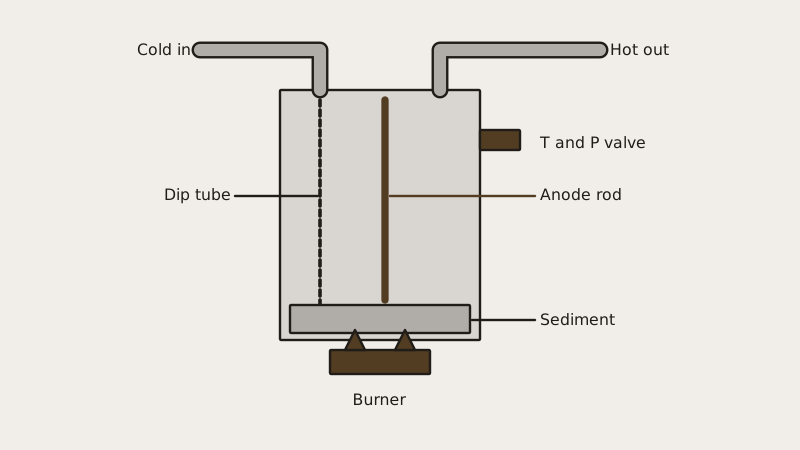
Most storage tank heaters give 10 to 15 years of service, and tankless models can pass 20, according to the US Department of Energy. Pasadena homes sit on the short side of that range more often than the national average would suggest, because the local supply is hard and a lot of heaters live in hot garages. Our water heater replacement hub covers the full process. Here you will learn how to date your unit, what the warning signs look like, and when it makes more sense to fix than to replace.
What is the normal lifespan of a water heater?
A tank heater typically runs 10 to 15 years. A tankless unit commonly lasts more than 20, because it holds no standing water that can rust the shell from inside. Where a tank lands in that window depends on water quality, how often it was drained, and the state of its anode rod.
Start by dating your unit. The data plate on the side carries a serial number, and the maker's website can usually turn it into a month and year. A heater beyond its tenth birthday is in leak territory even if it still makes hot water. Research on used heaters posted by the Department of Energy found the sacrificial anode wearing out after roughly five years of use and internal parts degrading by year seven, so the middle years are when care pays off.
Why do heaters in the San Gabriel Valley wear out early?
Hardness is the biggest local factor. Pasadena Water and Power reported 202 to 256 ppm for 2025, averaging about 13 grains per gallon, and calls it hard water that builds scale and shortens a heater's useful life. Scale blankets the bottom of a tank, insulating the steel and the burner from the water.
Other local stressors stack on top. A heater in an uninsulated garage or a hot attic works through a wide temperature swing. High household pressure from a worn regulator hammers the tank, and a missing expansion tank turns every heating cycle into a pressure spike. Whether your own street gets harder or softer water than the city average is covered in water hardness by ZIP code. The cheapest life extension is a fresh anode, explained in anode rod replacement.
Which signs say replace rather than repair?
Water pooling around the base, rust in the hot stream, a rumble or pop during heating and a heater past roughly 12 years that needs a pricey part all point to replacement. A weeping fitting or a bad valve is a repair. A breach in the tank shell never is.
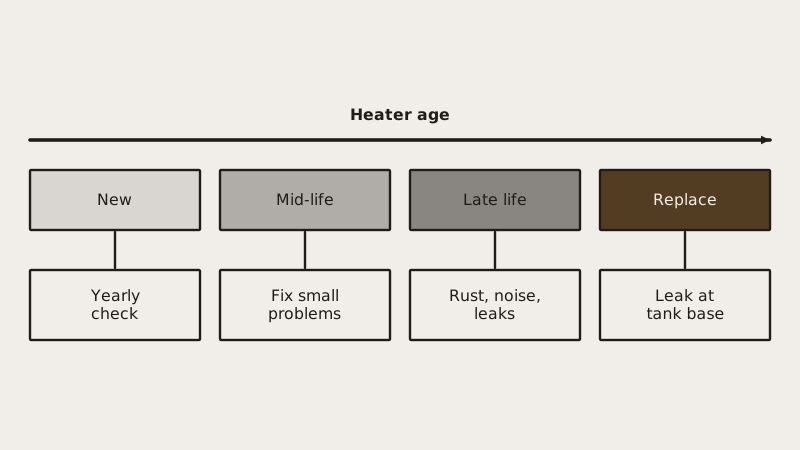
Other clues: hot water that fades quickly, a pilot or element that keeps failing, more than one service call in a year, and creeping energy bills. If something is leaking right now, shut the cold-water valve above the tank, switch off the power or gas control, and read what to do about a leaking water heater. If the only symptom is no hot water, rule out the cheap causes first, since a thermostat or igniter swap costs a fraction of a new tank.
Is it cheaper to fix an older heater or buy a new one?
A heater under roughly 8 to 10 years old with one failed part is worth fixing. One between 10 and 15 that leaks or needs a major component is better replaced, since the repair may only postpone the same bill by a few months.
One test: once a repair nears half the price of a new unit, or the heater is close to the end of its life, spend that money on a new one. New models are also more efficient, which counts in a busy household. Ask the visiting plumber to price both options in writing. Typical replacement figures are in the price of water heater replacement, and emergency water heater replacement covers a heater that fails after hours.
Do tankless heaters really outlast tanks?
Yes, by a good margin. Federal figures put tankless units at 20 years or more against 10 to 15 for a tank. The catch is scale: hard water coats the heat exchanger, so a tankless unit in Pasadena needs a periodic descaling flush to reach that age.
Cost cuts the other way. A tankless heater is usually more expensive to buy and to install, particularly where the gas line, vent or electrical service must be upgraded. The payback hinges on your hot water habits and how long you plan to stay put. Tank vs tankless water heaters in Pasadena works through that comparison.
What can I do to stretch a heater's life?
Once a year, draw off a few gallons to carry sediment out. Test the relief valve by lifting its lever, look at the anode every few years, and hold household pressure near 50 to 60 psi. Leave breathing room around a gas burner and keep garage clutter away.
Earthquake bracing is part of ownership here. California law says new and replacement water heaters must be braced or strapped against shaking, and the rule extends to existing residential heaters; the State Architect's guidance calls for at least two straps. A replacement is also normally permitted work, so find out how it is handled by the City of Pasadena or your own city's building department. A service check or a swap starts on the quote page.
Common questions
How long does the swap itself take?
Straight tank-for-tank replacements often finish in a few hours when access is easy and the connections match. Relocating the unit, switching to tankless, or fixing gas, venting or corroded pipe stretches the job toward a full day or beyond. Arrival windows come with the booking.
What should I check before hiring someone for a replacement?
Get the contractor license number and search it on the state license board's site. Confirm the brand, the maker's warranty terms, and whether strapping, an expansion tank, the permit and haul-away of the old heater are priced in. Also settle who pays if corroded valves or pipe turn up.
Must I be home when it is replaced?
Yes, an adult should be around. The water goes off, gas or power is disconnected, and any change in price needs a yes from you. Before the visit, open a clear path to the heater and shift stored boxes out of the garage or closet.
Can a tank heater really reach 20 years?
Occasionally, if it was drained, kept in a mild spot and fed softer water. Do not plan around it, because a tired tank usually fails as a leak with little warning. If yours is past 12 years, budget for a replacement and choose the time yourself.
For the wider picture, start with plumber pasadena.
Sources
- Energy Saver Guide, US Department of Energy
- Tankless Water Heaters, US Department of Energy EERE fact sheet
- 2026 Annual Drinking Water Quality Report (2025 data), Pasadena Water and Power
- Health and Safety Code 19211, water heater bracing, California Legislative Information
- Guidelines for Earthquake Bracing of Residential Water Heaters, California State Architect
Page updated