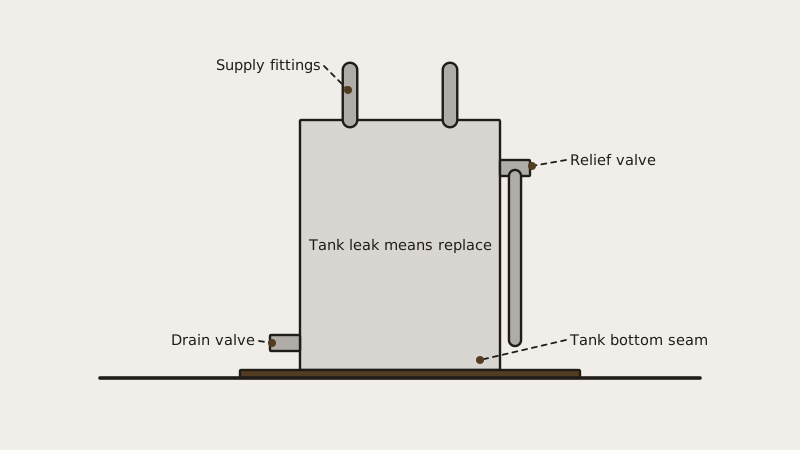
A water heater that drips from a valve, a pipe fitting or the drain spigot can usually be repaired. One that seeps from the tank wall or from underneath the jacket almost never can, because nothing seals a rusted pressure vessel for good. Start by finding the wet spot, and read about the whole range of jobs on our water heater replacement page if the tank turns out to be the culprit.
Sorting it out needs a torch, a rag and ten quiet minutes. The sections that follow cover the first steps, reading the leak, testing the relief valve, whether repair pays, brand differences, and the price range for jobs around Pasadena and the San Gabriel Valley.
What do I do the moment I see water around the water heater?
Kill the electricity or gas supply to the unit, shut the cold inlet valve on the pipe above it, and crack a hot faucet elsewhere in the house to let pressure out. Wipe the floor dry and see where new water appears. Do this first: water that keeps running will ruin flooring and drywall fast.
On an electric model, flip its dedicated breaker in the panel. On a gas model, turn the control dial to off or pilot, and that is as far as you should go: never loosen a gas fitting. Smell gas? Walk out first. Go outside, then phone SoCalGas on its emergency number, 1-800-427-2200. Immediate danger means 911.
Stay well clear of the relief pipe if it is spitting steam. Scalding water can arrive without warning, so nobody small or furry should be in the room.
Which leaks are fixable, and where is mine coming from?
Drips at the inlet and outlet connections, at the relief valve or the pipe running from it, or at the spigot-style drain valve low on the tank are repairable in most cases. Water seeping through the jacket, or pooling under a tank with no fitting above it, means the inner tank has failed, and that calls for replacement.
Check these in order with a dry towel:
- Top connections. Corroded flex lines or loose nipples drip down the shell and look like a tank leak. A fitting change is a modest job.
- Relief valve and the pipe leading from it. A weeping valve often signals pressure that runs too high, not just a worn part.
- Drain valve. Many are plastic and loosen with age. Tightening may stop it; if not, the valve is replaced.
- Anode rod port. A seal leaking where the rod enters the tank top can be fixed if the tank is otherwise sound.
- Tank bottom. If it is wet here and nowhere else, expect a new heater.
Condensation fools many people, especially on gas units with cold water running through them on a warm day. A paper towel left overnight tells the difference: condensation stops when the room warms.
Is the water heater's relief valve bad, and how would I know?
Suspect the valve if it drips, runs steadily, or stays shut when you lift its little test lever. It exists to protect the tank, so a failed one gets replaced. One that drips constantly could simply be answering high pressure in your pipes.
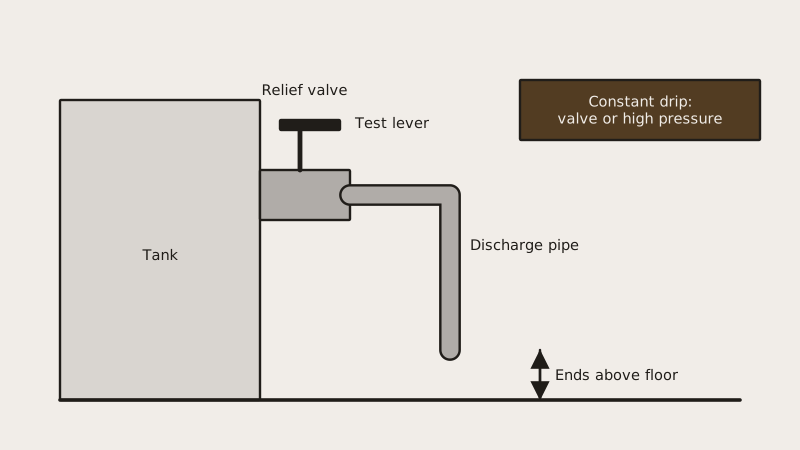
To test, set a bucket beneath the discharge pipe, lift the lever for a second, expect a burst of hot water, and let the lever drop back. A valve that dribbles afterward is worn out, and one that never opens should not be trusted.
Dripping only while the burner or element runs can mean heated water that expands has no place to go inside a sealed plumbing system, where an expansion tank is the cure instead of a new valve. Ask the plumber to read the house pressure with a gauge as well. See relief valve replacement for how that job runs.
Does a hot water heater repair pay off?
Mostly yes if water is getting out through a valve, a fitting or an element and the tank has fewer than ten years behind it. Mostly no if the tank wall leaks or the heater is well past a decade, because one fix on an old tank tends to be followed by another. Compare the repair quote to what a new heater costs fully installed.
One rule of thumb: when a repair would eat up a third or more of a replacement's cost on a heater that is already old, replace it. A young tank deserves repair. Some warranties cover a tank leak early in a unit's life, so read the label before paying for anything and ask the manufacturer.
For an aging heater, our pages on replacement timing and what a new unit costs fill in the rest of the decision.
Can I fix a leaking water heater myself?
Snugging a loose drain valve, drying the area and shutting off supplies are fine for an owner. Gas piping, venting, discharge lines and anything needing a permit are contractor work. Anyone taking a job priced at $1,000 or over, or one needing a permit, must hold a California contractor license, and Pasadena's Building and Safety Division states that replacing a water heater takes a plumbing permit.
Swapping a relief valve badly can strip protection from a tank under pressure. Tenants should notify the landlord first. Plugging or capping a relief discharge to stop a drip is never acceptable.
Strapping matters in earthquake country. Section 19211 of California's Health and Safety Code says every new, replacement and existing residential water heater must be braced or anchored against earthquake motion, so the plumber should glance at your straps.
Is repairing a Rheem different from a Bosch or Whirlpool?
The logic of finding a leak is identical across brands, but parts, anode rod lengths and warranty terms are not. The rating plate on the side shows the model and serial number. Have both at hand when you request a visit so the plumber can bring the correct valve, element or thermostat.
Rheem, Whirlpool, Bosch, A. O. Smith and Bradford White plates all carry a serial number that encodes the build date, so the sticker tells you the age. Brand counts most with tankless water heaters, where error codes and part supply vary; a leaking tankless unit usually has a loose water connection or a failed heat exchanger and deserves a plumber's diagnosis. Solar hot water adds a storage tank, collectors and a pump, so the leak could be anywhere in the loop.
Local water plays a part. Hard water is common across the San Gabriel Valley, and the scale and sediment it leaves inside a tank shorten the tank's life and use up the anode rod. Flushing the tank and inspecting that rod do the most good.
What does fixing a water heater leak cost, even at night?
Use these as a guide: 2026 price surveys show tank heater repairs landing between roughly $150 and $1,000, a relief valve swap near $50 to $300, and a thermostat or element around $100 to $350. Night and weekend calls often carry a premium, and a whole new installed tank costs more than any of these.
These are national figures; a real quote depends on the part, on where the heater is installed (garage, closet, attic), and on the hour you call. A written price arrives before work starts. Send the leak details and the model number via the quote page, and the plumber can judge whether repair makes sense.
An urgent call buys speed, not a different repair. If the tank wall is the source, ask about same-day replacement, since a failed tank cannot be patched.
Common questions
Why is there water under my water heater?
Common culprits are the drain valve, plain condensation, or a tank on its way out. Dry everything and watch. A damp drain valve may stop with a tighter turn or a new valve. Water creeping out from the jacket with nothing wet above it means the tank has rusted through.
Can epoxy or sealant stop a tank leak?
No. Putty on a tank wall might slow a seep briefly, but it cannot restore a pressure vessel, and the tank can fail further with no warning. Treat a wall leak as the end of that heater, shut off its water, and plan a replacement.
How many years should a tank heater last around here?
A tank heater often runs ten to fifteen years; hard water and skipped flushing can shave that down. The serial number on the label reveals age. Beyond about ten years, a leak is more likely tank wear than a failed part.
Does a drip count as an emergency?
A slow weep at a fitting may hold until an appointment once the supply is off and the power or gas is shut down. A steady flow, a stained ceiling below, or a hissing relief valve needs attention the same day, since water damage and scalding both grow fast.
Does repairing a water heater need a permit?
Small jobs like a thermostat or element usually do not, though replacing the whole heater is, per Pasadena's Building and Safety Division. Each nearby city has a separate building office and separate rules, so the plumber checks with whichever one covers your street.
For the wider picture, start with plumber pasadena.
Sources
- California Health and Safety Code section 19211, water heater strapping
- California State Architect, guidelines for earthquake bracing of residential water heaters
- City of Pasadena Building and Safety Division, water heater standard
- Water heater repair cost guides (Angi, HomeGuide and others), checked November 2026
Page updated