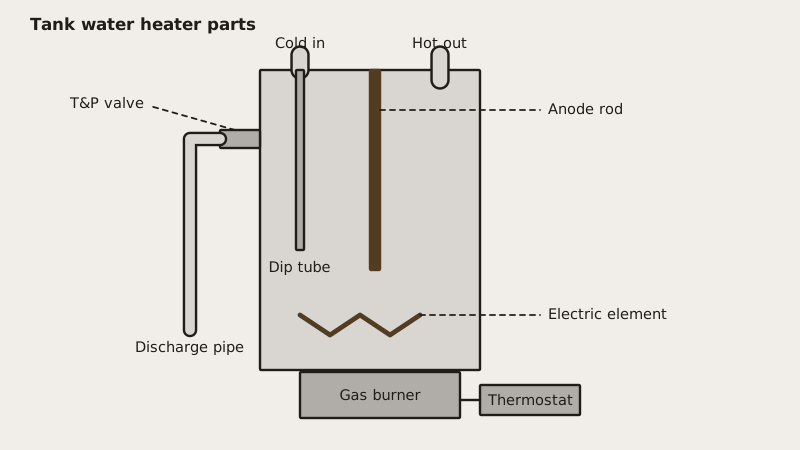
Begin at the source of heat: the breaker, the on switch, the gas knob, the pilot window. A heater with power and fuel but cold taps has a failed part, a trip or a mixing fault somewhere between tank and faucet. A tank that feels stone cold means no heat is being made at all. Whether a repair is worth it is a question for water heaters in general, and the answers below narrow it down.
What are the signs that your water heater is going out?
Hot water that fades in minutes, a tank that rumbles or pops, rust in the hot tap only, damp patches around the base and a heater past its tenth birthday: these are the classic warnings. One alone proves nothing. Two or three together, or any leak at all, usually tilt the decision toward a new unit.
Details that help you read the signs:
- Popping and rumbling. Scale and sediment sit on the tank floor and trap steam bubbles. Pasadena Water and Power calls local water very hard, around 12.9 grains per gallon, so mineral crust builds faster here than in soft-water cities.
- Rust only in the hot tap. Clear cold water with brown hot water points inside the tank, where the anode rod sacrifices itself to protect the steel. See anode rod replacement.
- Moisture at the base. A tank cannot be patched. Shut the cold-water valve feeding the heater, then read water heater leak repair to tell a loose fitting from a failed shell.
- Age. Ten-plus years is common for a tank, shorter when scale is heavy and nobody has flushed it.
Before you start, what can you safely check?
Look at the breaker panel or the heater's own switch if it is electric, and at the gas control knob and pilot window if it is gas, then at the temperature dial. Stop there. No opening gas fittings, no lighting anything you do not understand, no touching wiring while it is live. A gas odor means you walk out first and phone later.
Reach the gas company's leak line at 1-800-427-2200, but only from outdoors. Call 911 if people are at risk, and keep every switch and flame out of it.
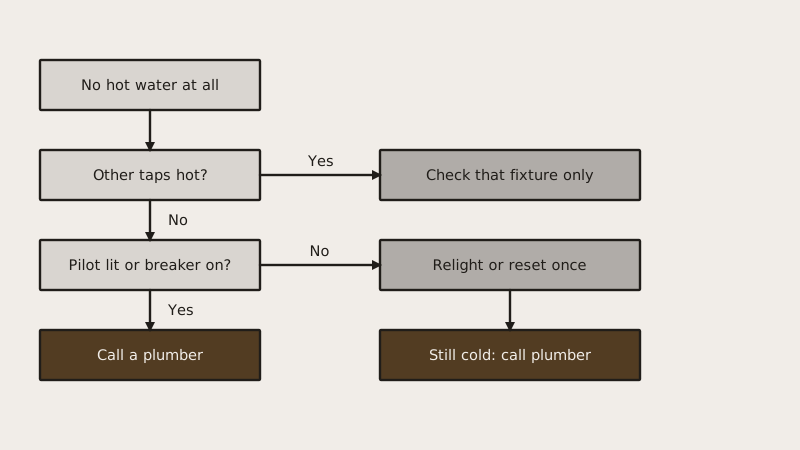
Otherwise, a ten-minute sequence rules out the easy causes:
- Test several taps. One cold faucet while the rest run hot means a faulty cartridge or crossed lines at that fixture.
- Confirm the heater has energy. Electric needs the breaker and disconnect on. Gas needs the knob at "on" or "pilot" and a flame you can see through the window.
- Read the temperature dial. Someone may have turned it to the lowest mark.
- Put a hand on the tank wall. Warm tank with cold taps suggests a valve, a cracked dip tube or mixing. A cold tank suggests no heat.
Which faults leave a house with no hot water?
They follow the fuel. On a gas tank, the usual culprits are a pilot that went out, a tired thermocouple, a burner choked with soot, or a gas valve someone closed. Electric ones lose it through a tripped breaker, the overheat cutout or a burnt element. A tankless unit throws an error code or clogs with scale. A cracked dip tube spoils either kind of tank.
Gas tank. If the pilot keeps blowing out, suspect the thermocouple, the little probe that proves to the gas control that a flame exists. Rheem's service bulletin for its power-vent line lists a leaking pilot tube, soot on the grounding strap and low gas pressure as reasons ignition locks out. Read the pilot light repair notes and the guide to hot water gone while the pilot burns. The relighting steps printed on your heater's label are the only ones to follow, and one failed try means stop.
Electric tank. Two heating elements warm the water, and a safety cutout called the ECO shuts power when the tank overheats. Rheem's instructions are to switch power off, open the access panel, press the red reset and close it up before power returns, and they say a service technician must find out why it overheated. A second trip means stop and call. The page on electric heaters with no hot water goes into thermostats and elements.
Tankless. A display code names the fault in the manual. Blocked venting, interrupted gas or power and scale inside the heat exchanger lead the list. Scale is a Pasadena problem, so descaling flushes recur. Weighing one up? Tank against tankless compares them.
Dip tube. This plastic pipe sends incoming cold water to the tank bottom. Once it cracks, cold water mixes high in the tank and the hot supply goes lukewarm quickly.
Does a cold tap count as an emergency, and what about renters?
Mostly it is a nuisance. It becomes an emergency with a gas smell, spreading water, or a tank that hisses, bulges or shakes. Close the water to the heater if it is leaking and make the call. When a replacement cannot wait, emergency water heater replacement explains what same-day work involves.
Apartment dwellers should find out first whether the building has one central heater. If it does, the landlord or manager owns the repair, and apartment building hot water outages points to the right person. Some older multi-unit buildings in the San Gabriel Valley heat with a boiler, which also warms radiators. Boiler pressure and relief faults leave no room for guesses, so leave those to a plumber or heating contractor.
Which symptoms mean the job needs a plumber?
Any leak, a breaker that trips twice, a gas smell, a flame that will not stay lit, an error code that refuses to clear, or a repair estimate that creeps toward what a new heater costs. Gas piping and any permitted water heater swap fall under California contractor rules, and replacements need seismic strapping.
Health and Safety Code 19211 requires bracing, anchors or straps on new and replacement tanks so an earthquake cannot throw them over. A heater put in without a permit or straps can surface as a problem at resale.
Use the quote page to send the fuel type, the heater's age and anything you have tried. Then a local plumber arrives, finds the fault and prices either a repair or a replacement. Other work across Pasadena and the San Gabriel Valley starts from Pasadena Pipe Works.
Common questions
Why is the water cold with the pilot still burning?
The pilot is only the ignition source. The main burner may not be firing, the gas valve could have failed, the thermostat may be set too low, or heat could be lost to a cracked dip tube. A main burner that never lights points at the gas control. That repair is a plumber's.
Can Pasadena's hard water leave me without hot water?
Indirectly. Mineral scale coats elements and burner surfaces, so heat cannot pass into the tank properly and elements fail early. Tanks get noisy and tankless units clog. With water this hard, ask a plumber about periodic flushing and a softener or scale prevention.
How quickly can a no-hot-water problem be fixed?
A reset or a relit pilot takes minutes. Swapping an element, thermocouple or gas valve can be one visit if the plumber carries the part. A full replacement tends to occupy a few hours, with permit, strapping and venting checks folded in.
Which items should a repair quote include?
Look for diagnosis time and parts, the permit and strapping when a heater is swapped, how venting gets checked on gas units, and what happens if the repair fails. The contractor license number belongs on it too, and the state can confirm it.
Should I repair or replace an old heater?
A leaking tank gets replaced. A single dead part in a heater not yet ten is often worth fixing. In the middle, put the repair price next to a new unit, bearing in mind that a ten-year-old tank may fail again soon. A plumber can supply both figures.
Sources
- Rheem use and care manual for electric residential water heaters (no hot water, fuse, breaker, ECO reset)
- Rheem technical bulletin TB 1627 (gas power-vent ignition checks)
- SoCalGas, earthquake and excess flow valves (gas leak steps, emergency line)
- Pasadena Water and Power, water quality FAQs (hardness)
- California Health and Safety Code section 19211, water heater bracing
Page updated