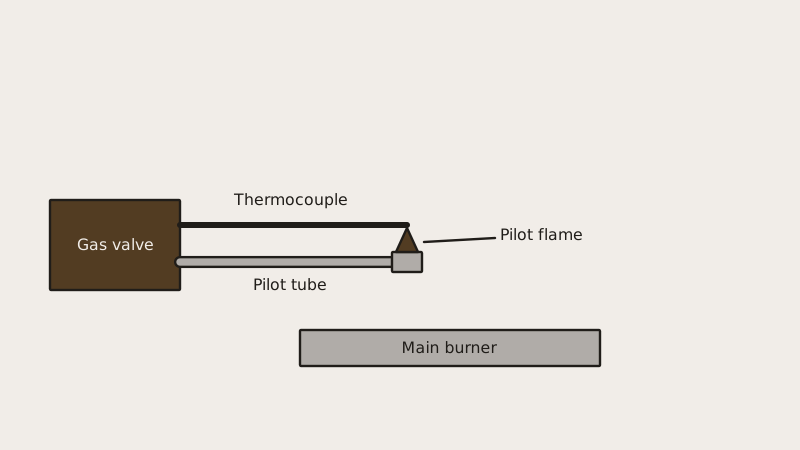
A pilot that keeps dying most often has a worn thermocouple, which stops reporting the flame and lets the gas valve close. Then come a clogged pilot tube, a draft and, less commonly, the gas control valve itself. Relighting steps appear on the tank's data label, while any job that opens a gas connection belongs with a plumber. For the larger repair-or-replace question, see water heater replacement, and the quote form arranges a visit.
What makes a pilot flame die over and over?
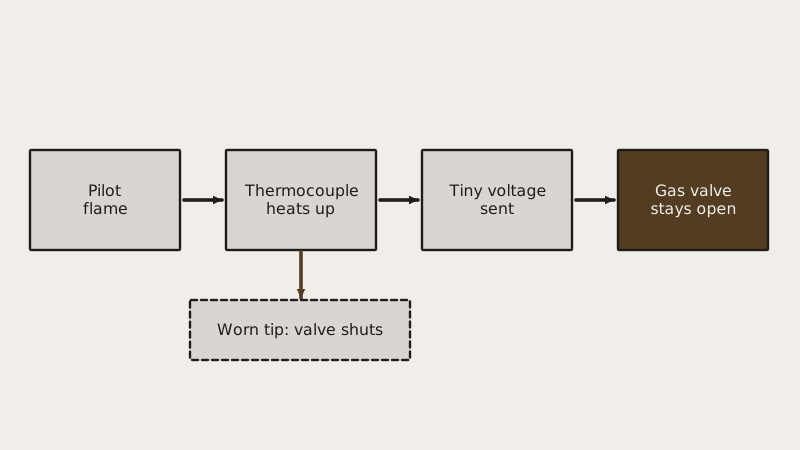
Four causes cover most cases, listed roughly by likelihood. A worn thermocouple stops making the tiny current that holds the gas valve open. A pilot tube plugged with soot or dust starves the flame. A downdraft, even a slamming garage door, pushes it out. And a failing control valve can cut gas when everything else is fine.
You can narrow it down by watching. If the flame is small, yellow and flickering, the pilot is dirty or the gas supply is weak. A steady blue flame that still drops out a minute after the knob is released points to the thermocouple. If it vanishes when a door slams or the furnace starts, the draft is the problem. Newer heaters with electronic ignition have no standing pilot, and a fault there shows up as an error light, not a dead flame.
Can I relight the pilot on my own?
On many heaters, owners follow the lighting instructions printed on the tank. Smell gas, and you do not try at all: go outside, and from there use the SoCalGas hotline (1-800-427-2200). Where people could be hurt, use 911. Gas that was shut off at the meter is not yours to relight, because SoCalGas does that. After one careful attempt that fails, stop.
Relighting again and again is not a repair. Every failed attempt says a part is faulty, and persisting can let unburned gas collect in a closet or garage. Flames that roll out of the burner opening, or sooty marks near the base, are also a signal to stop and call. Carbon monoxide has no smell, so a working CO alarm near any gas appliance is cheap protection.
What is a thermocouple, and what will replacing it cost?
The thermocouple is a slim copper probe held in the pilot flame, generating a trickle of electricity while hot. The gas valve needs that trickle to stay open. Once the probe wears, the valve closes the moment the knob is released. The part runs roughly $5 to $25, and published repair prices come to about $100 to $325 including labor.
Several guides place a plain pilot relight or adjustment at $50 to $200. Swapping one is a brief visit that ends by testing joints for gas and checking the flame. The thermocouple replacement page shows the steps. Prices here are a rough guide, with your written quote as the real figure.
Why is the water cold when the pilot is burning?
Then the pilot itself is fine. The thermocouple may sense flame while the control valve or its thermostat fails to open the main burner, or the burner ports are blocked, or gas pressure is low. A lit pilot above a cold tank is a warning sign for the gas valve, and a plumber tests before swapping parts.
A symptom checklist is in no hot water with the pilot lit, and gas valve replacement if the valve is the suspect. A valve swap costs more than a thermocouple, around $300 to $550 installed in published guides. On a heater past ten to twelve years, get a replacement price beside the repair price.
Does Pasadena's water or housing affect pilot trouble?
Partly, through the house more than the water. Older homes often tuck the heater into a tight closet, garage corner or alcove with little combustion air. The water matters too: Pasadena Water and Power measured hardness at 202 to 256 parts per million for 2025, and scale in a gas tank makes the burner work harder.
Heater closets in older houses sometimes have louvered doors meant to let air in. Boxes stacked against them can starve the flame. Keep the space clear of storage, paint and anything flammable. Flushing the tank each year removes sediment that causes rumbling, and the plumber can show where the drain valve sits.
At what point is this a plumber's job?
Book a plumber if the pilot dies again after one relight, the flame is yellow and sooty, rust or water shows at the base, or the gas valve or burner needs replacing. Gas piping and valves are contractor work in California, and replacing the heater also brings a permit, strapping and venting checks.
California's contractor license line sits at $1,000 of labor and materials, which a pilot repair seldom reaches, yet gas connections are a safety matter at any price. Pasadena's Permit Center handles plumbing permits and names water heater replacement among jobs where plans are not always needed. We arrange for a plumber to test, explain the fault and quote in writing before parts are replaced. If hot water vanishes suddenly and completely, see emergency water heater replacement.
Common questions
How long is the plumber on site?
Relighting or changing a thermocouple is brief, often finished within the hour. A stubborn pilot takes longer to diagnose, and a gas valve swap can need a couple of hours. A part on order adds a second trip, and hot water stays off until it arrives.
What color should a healthy pilot flame be?
Mostly blue, steady and short, wrapping the thermocouple tip. A flame that is yellow, lazy or sooty suggests blocked airflow, dirt or a gas problem. Leave adjustment to a plumber, who can clean the pilot tube and set it safely.
Can wind or a draft put out the pilot?
Yes. Open windows, a nearby door, an exhaust fan or a downdraft in the flue can blow it out. If the pilot dies at the same moment each time, note what else is running. That detail helps a plumber, because a draft problem can also mean the flue is not carrying exhaust out properly.
Do modern water heaters still have a standing pilot at all?
Many gas heaters sold now use electronic ignition and have no standing pilot. They need power and show a fault light. Standing pilots are common on older tanks. Whichever you have, an aging tank is worth a repair-versus-replace quote, so ask the plumber for both.
Is an out pilot light dangerous?
A pilot that goes out and stays out is a safety feature working, since the valve shuts the gas. Danger comes from escaping gas, relighting after a leak, or poor venting. With a gas smell, leave first. Otherwise, treat repeated outages as a fault to fix, never to override.
Browse every plumbing service we arrange on the Pasadena Pipe Works home page.
Sources
- SoCalGas, emergency information (gas odor, shut-off and relight guidance)
- City of Pasadena Permit Center, apply for a permit
- California Contractors State License Board, handyperson exemption
- Published pilot light, thermocouple and gas valve repair prices from national cost guides, checked November 2026
Page updated