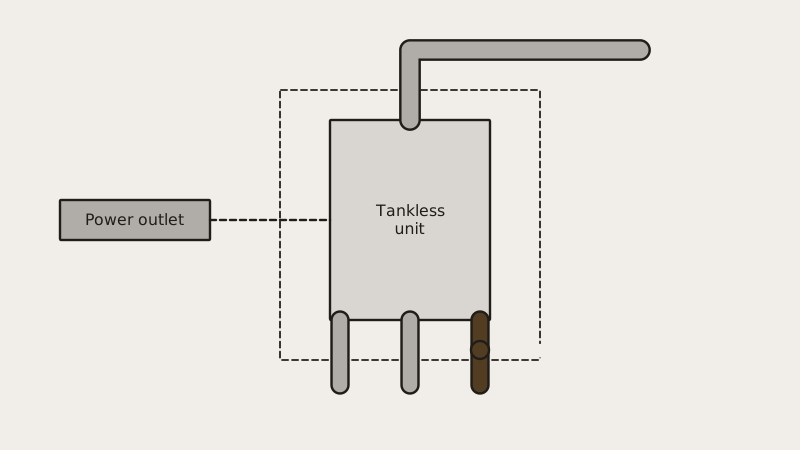
A good tankless installation starts with a site check, not a box. The plumber sizes the gas line to the unit's burner, plans the vent and condensate drain, confirms there is a power outlet, applies for the permit and sets up valves that let the heat exchanger be flushed later. Gas tankless units in California commonly cost $4,000 to $5,500 installed, and more where the gas line must be upsized. See tank versus tankless to decide whether it suits your home, and use the quote form to book a visit. If you are still deciding between a tank and a tankless unit, start with the water heater replacement overview.
What does a tankless installation actually involve?
The job has five parts: removing the old tank, running a gas line big enough for the burner, venting the exhaust through the wall or roof, adding a drain for condensate on high-efficiency models, then hooking up water, power and isolation valves. Then the plumber tests for gas leaks, fires the unit and sets the temperature. Expect a full day for a straightforward replacement.
Mounting is on a wall, indoors or outside, so the old tank's footprint is not the issue. The vent is. A condensing unit uses plastic vent pipe through a sidewall, while non-condensing models use stainless venting. The gas line is the usual surprise: a tankless burner pulls a lot more gas at the same moment than a tank burner does, which is why a half-inch line that fed a tank can need upsizing to three-quarter inch. The page on natural gas pipe explains sizing.
Why do gas line and venting change the price so much?
Because they are the labor. The heater itself is a known cost, while a gas line upgrade of $400 to $1,100 for resizing, or $600 to $1,500 and more for a longer run from the meter, depends on your house. Venting through an exterior wall is the cheap case, and routing it through a roof or around obstacles adds several hundred dollars.
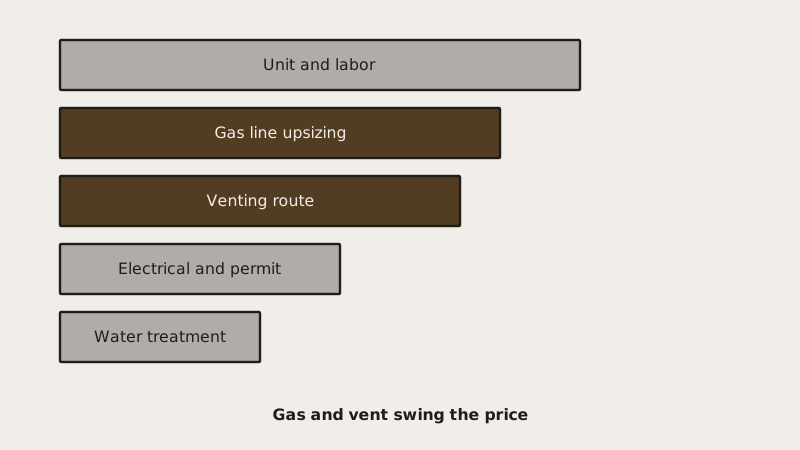
Older Pasadena houses, whether Craftsman bungalows or 1950s ranch homes, often feed the water heater through one small gas line, with the heater tucked in a garage or closet beside old flues and little wall space. That is where an install moves from $4,500 to the high end, or past $6,500 in some Southern California estimates. The plumber should measure the run, count the appliances on the line and quote the line work separately from the unit.
How much should a Pasadena tankless install run?
Published prices for a gas tankless installed in California run about $2,500 to $6,500, with most sources centering on $4,000 to $5,500, and Southern California estimates of $4,500 to $5,500 for a condensing unit. Older homes needing gas line and venting work can reach $6,500 to $8,500. Read these as a guide; what you pay follows the plumber's own quote.
| Item | Published range (a guide) |
|---|---|
| Typical gas tankless, installed | $4,000 to $5,500 |
| Low and high ends, California | $2,500 to $6,500 |
| Gas line resize, half inch up to three-quarter | $400 to $1,100 |
| Gas line run from the meter | $600 to $1,500 and up |
| Venting, standard wall run | $200 to $600 |
| Permit | $50 to $500, by city |
Prices run above national averages in California for a few reasons: high plumber wages, air-quality rules that limit emissions from new gas heaters in Southern California, and venting requirements. Pricing by brand sits on tankless hot water heater installation cost, and there are brand pages for Rinnai installation and Navien installation.
What rebates exist, and do I need a permit?
SoCalGas lists residential rebates for qualifying gas tankless heaters, with 2026 amounts tied to efficiency and running from about $80 up to $1,500 while funds last. The federal tax credit that once applied to these units expired on December 31, 2025. A plumbing permit is the norm for installing a water heater in Pasadena, and the plumber should pull it and schedule inspection.
Rebate rules change, so read the current SoCalGas application before you buy: a qualifying unit usually has to replace a gas tank heater at an existing home in SoCalGas's service area, and the unit's efficiency rating decides the amount. Pasadena's Permit Center lists water heater replacement as work where plans are not always required, and the plumber handles the permit side. As for licensing, California reserves work that totals $1,000 or more, labor and parts together, for someone holding a state contractor license. Permit and inspection fees vary by city across the San Gabriel Valley, since each has its own building department.
Will Pasadena's hard water hurt a tankless heater?
Yes, if the unit is not flushed. Pasadena Water and Power measured hardness at 202 to 256 parts per million for 2025, which counts as very hard water, and the scale it leaves builds on the heat exchanger and cuts flow and efficiency. Plan on a yearly descaling flush, and ask the plumber to fit isolation valves so the flush is simple.
Descaling by a professional commonly costs $150 to $350 in published prices. A softener or scale-prevention cartridge ahead of the heater can lower the frequency, and you can read about softener installation for that option. The Department of Energy says most tankless heaters are built to last more than 20 years, with replaceable parts, versus 10 to 15 for a storage tank, and that is true only if scale and filters get attention.
What questions separate a careful installer from a rushed one?
Press on which model and why, how the gas line was sized, where the vent exits and where condensate drains. Then confirm the quote names the permit, isolation valves, a wall mount and hauling off the old tank, with gas and vent work priced apart from the unit, all on paper before anyone starts.
You should also ask about capacity. The Department of Energy says tankless heaters typically deliver 2 to 5 gallons per minute, so a house with two showers running while the dishwasher cycles may need a larger unit or two. A plumber who never asks how many bathrooms you have, how many people live there or which appliances use hot water deserves caution.
Common questions
How long does installation take?
A straightforward replacement usually takes a full day, and a job with new gas line, new venting or a relocated heater can take longer or span two visits. The gas and hot water are off while the work proceeds. The plumber then tests, fires the unit and walks you through the controls.
Must I stay home for the whole job?
For part of it, yes. Someone has to open the door, approve extras such as a gas line upsize, and be around if an inspector is scheduled to visit. Hovering is not required. Do clear a route to the heater and the gas meter.
Is tankless worth it in a Pasadena home?
For many households, yes, if hot water use is moderate and the home has gas. The Department of Energy reports demand heaters beating storage tanks on efficiency by 24 to 34 percent in light-use homes (under about 41 gallons daily), and by 8 to 14 percent at about 86 gallons a day. You pay more at the start.
Can a tankless heater run during a power outage?
A gas tankless heater needs electricity for the fan, igniter and controls, so it quits in an outage unless it has battery backup. Ask about that option if outages concern you. Tank heaters with a standing pilot may keep making hot water without power.
What happens if I choose the cheapest quote?
A low quote often leaves out the gas line upgrade, venting, permit or condensate drain, and you pay for them later. Compare quotes line by line. The lowest total is only the best value if every item you need is in it, with the same model and the same scope.
See our other services on the Pasadena Pipe Works home page.
Sources
- U.S. Department of Energy, tankless or demand-type water heaters (lifespan, flow rate, efficiency)
- SoCalGas, 2026 residential efficiency rebate application
- Pasadena Water and Power, 2026 annual drinking water quality report
- City of Pasadena Permit Center, apply for a permit
- California Contractors State License Board, handyperson exemption
- Published gas tankless installation prices for California and the Southern California area, checked November 2026
Page updated