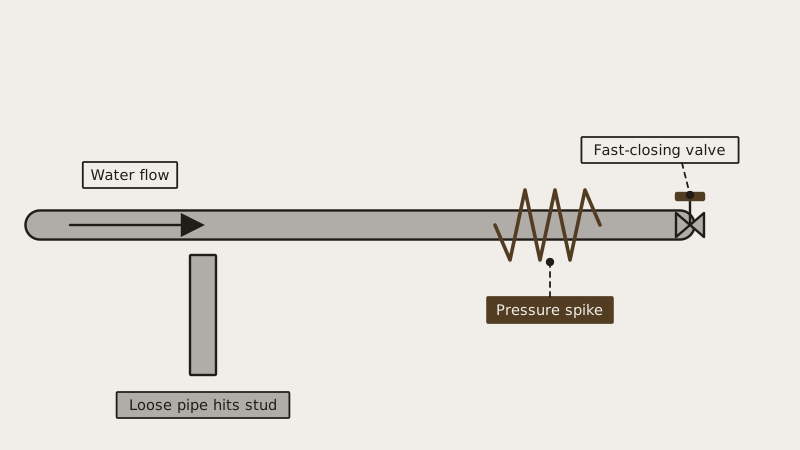
Water hammer is the bang, thump or shudder that follows when running water is halted abruptly. A washer valve, a dishwasher or a single-lever faucet snaps shut, the moving column of water hits the closed valve, and the jolt races down the pipes. At Pasadena Pipe Works we hear about it most from people with older homes and high street pressure, and it responds well to a few specific fixes.
Ahead: what the sound means, usual causes in a Pasadena house, fixes ordered by cost, and what to leave to a plumber.
What causes the water hammer sound?
Moving water carries momentum. A quick-closing valve stops the flow almost instantly, so the energy has nowhere to go; pressure spikes and the pipes rattle. The valves most likely to cause it are on washing machines, dishwashers, icemakers, toilets and single-lever faucets, and the effect gets worse at higher pressure.
Four conditions make the bang louder:
- High water pressure. More pressure means more force behind the stopped water. Static pressure beyond 80 psi is where the state code expects a regulator.
- No cushion in the lines. Many houses have vertical air chambers behind fixtures that absorb the shock. When they fill with water, the cushion is gone and the bang returns.
- Loose pipes. Pipes that aren't strapped down knock against framing when the shock arrives.
- Long straight runs and a fast valve at the end of them.
The Wikipedia entry on water hammer explains the physics, in case you want the engineering side.
How do I find which valve is causing it?
Walk through the house and run each fixture, then shut it off briskly. Note which one produces the thud. Noise only as the laundry or dishwasher cycle ends implicates that appliance's solenoid valve. If it comes with a kitchen faucet, check the cartridge. If it appears when a toilet finishes filling, the fill valve may be at fault.
Also notice the location. A thud in the wall behind one fixture suggests that branch. A bang that seems to come from everywhere, or from the basement or crawlspace, suggests the main supply and pressure. Pipes in the attic or crawlspace that knock against joists point to loose straps, covered in our notes on attic and crawlspace plumbing.
Keep a short list: fixture, how loud, and whether it also knocks when the water comes on. A plumber can use that list. A constant tick or a knocking that starts on opening a tap, not closing, is not classic water hammer and may be thermal expansion or loose pipe.
Is water hammer harmful?
Over time, yes. The pressure spikes strain joints, valves, appliance hoses and the water heater connections, and can loosen fittings until they leak. A single bang won't wreck anything, but years of it shorten the life of plumbing. Treat persistent banging as a repair item, not a quirk of an old house.
The bigger risk is the cause underneath. High pressure stresses everything, and a worn pressure regulator or none at all is common in older homes. If you also see a rising bill, a damp spot or a failing fixture, the meter test in our guide to a jumping water bill checks for that.
Can I fix water hammer myself?
Often, partly. Begin with safe checks: make sure the main is open all the way, strap or pad exposed pipes you can reach, and put a gauge on an exterior hose bib for the pressure. If pressure is above about 80 psi, the regulator is the real fix. Draining the system to refill air chambers is a known trick that works for some houses.
The air chamber reset: close the main, open the highest faucet and the lowest one so the pipes empty, shut those faucets, then bring the main back on slowly. Air refills the chambers and the cushion returns. It is free and sometimes lasts only months. If your house has no air chambers, it won't help.
A few boundaries. Don't adjust or replace a pressure regulator unless you know how; see adjusting a pressure regulator valve first. Anything involving gas piping, cutting pipe or soldering belongs with a pro. Noise at a gas line or appliance connection deserves caution: leave the area, and if gas is detectable, step outside and call the gas utility, SoCalGas, at 1-800-427-2200.
What does a plumber do to stop water hammer?
A plumber measures pressure, adds or replaces a pressure regulator if pressure is too high, and installs water hammer arrestors on the offending lines, typically at the washing machine, dishwasher or other quick-closing valves. Arrestors are small sealed devices with a spring or air cushion that absorb the shock. A plumber can also strap loose pipes and reset air chambers.
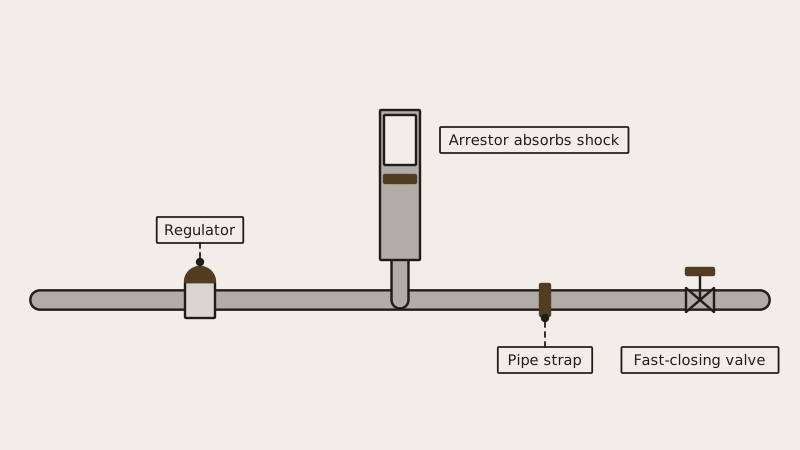
Typical work, from least to most involved:
- Gauge the pressure and record it. Static pressure above 80 psi needs a regulator under California code. See water pressure regulators.
- Strap and cushion loose pipe, especially in an attic or crawlspace.
- Fit arrestors to the appliance supply lines or to the branch where the noise starts. A sealed arrestor connects to the line like a short tee.
- Replace a worn fixture valve, such as a failing fill valve in a toilet. See fixing a running toilet if that fits.
- Replace or add the regulator, which also protects fixtures and appliances. Cost information is in regulator installation cost.
One contractor guide we read said the code provision on arrestors isn't adopted across the board for housing, so whether one is required varies with the job and the city. That is a reason to put the question to the plumber and the city building office, not a reason to skip the fix.
Why is the noise worse in some Pasadena homes?
A mix of local reasons. Older houses may have rigid copper or galvanized pipes with no remaining air chambers, and low-lying neighborhoods can see high static pressure while hillside homes can see low pressure, since elevation changes pressure. Pasadena Water and Power notes that a home's position relative to booster stations and pressure-reducing stations can change what you get at the tap.
We can't tell you your pressure from your address, only a gauge can. If the reading is high, the regulator, usually a bell-shaped brass valve near where the main enters the house, may have failed or be missing. If pressure is normal and the noise persists, arrestors and strapping are the likelier cures.
Other systems can add noise. A heating or air conditioning system with a water line, such as a boiler, humidifier or water-fed unit, can make its own knocking, so have a specialist in that equipment check it if the sound follows the system.
Banging pipes often travel through a house, so the source may not be where you hear it. Ask the plumber to find the source with a pressure gauge and a fixture-by-fixture test, not guess. For a price, begin at the quote page. Once labor and materials pass $1,000, California expects a contractor with a license.
Common questions
What makes pipes thump the moment a tap closes?
Flowing water stops suddenly when the valve closes, and the shock wave rattles pipes against their supports. Fast valves, high pressure, waterlogged air chambers and loose straps make it louder. Identify which fixture does it and measure pressure. A regulator, arrestors, strapping or a repaired valve usually quiets it. Persistent banging deserves a plumber's visit.
Is a banging pipe dangerous?
Seldom an emergency, though not harmless. The surges stress joints and fittings and can eventually cause a leak. If banging arrives with leaks, a damp wall or a sudden pressure drop, turn the main off and phone a plumber. A gas smell is a separate emergency: leave and call SoCalGas.
What exactly is a hammer arrestor?
It is a small sealed device that connects to a supply line near a quick-closing valve. Inside is a cushion, air or a spring behind a piston, that absorbs the pressure surge instead of the pipes. Plumbers fit them at washing machines and dishwashers. Check the maker's literature for upkeep, and expect a failed one to be replaced.
Does low water pressure cause water hammer?
Not usually. Hammer is associated with high pressure and fast valves. But a failing regulator can swing between high and low, and a clogged line can make banging seem odd. If you have both weak flow and banging, start with the low water pressure causes and measure before guessing.
Can I just live with the noise?
You can for a while, but the noise is a message. It means pressure spikes are hitting your fittings. A cheap fix such as strapping or draining the air chambers may be all you need, while a regulator is a bigger but worthwhile repair. Fix the cause before a leak does it for you.
Sources
- Pasadena Water and Power, water quality FAQs (water pressure and who to call)
- California Plumbing Code, 80 psi pressure regulator rule, as summarized by Southern California plumbing contractors, checked November 2026
- Published plumbing guides on water hammer arresters and air chambers, checked November 2026
- SoCalGas, natural gas safety
Page updated