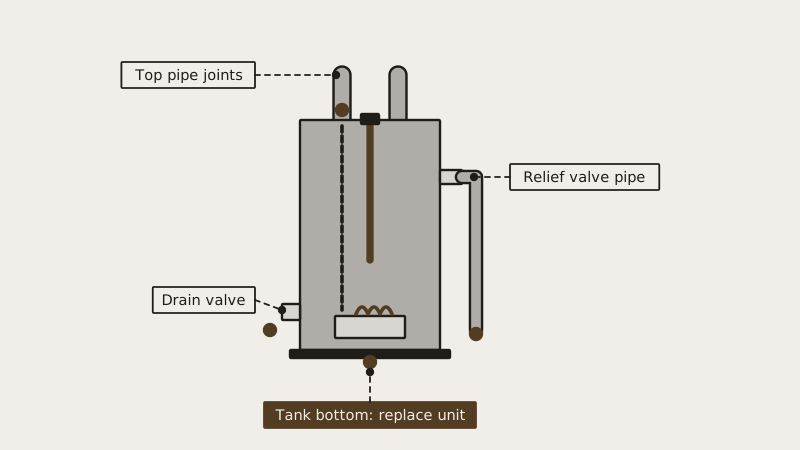
First close the cold supply valve on the heater, kill its electricity or set the gas knob to pilot, then trace the wet spot. Drips at a pipe fitting or the relief valve are frequently repairable. Water leaving the tank wall or the bottom seam nearly always means the steel liner has corroded away, and the unit has to come out. Choosing a new one is covered under water heater replacement.
Pasadena Pipe Works arranges plumber visits to homes in Pasadena and across the San Gabriel Valley. What follows sorts the leaks by location, lists what a plumber inspects, and sets out the city's rules for a swap.
Why does the location of the wet spot matter?
Very much, because the spot separates a cheap repair from a finished tank. Wetness at the pipe joints on top, at the T&P relief valve or at the drain valve is often curable. Moisture weeping through the outer jacket, or a puddle that keeps coming back after you dry it, signals a failed tank.
A simple way to read the puddle:
- Wet up top. Loose inlet or outlet fittings, or a corroded nipple. Water can crawl down the jacket and surface at the base, so look at the top before blaming the bottom.
- Water at the end of the relief valve's pipe. Either the valve is protecting the tank from pressure, or it is worn out. Thermal expansion without an expansion tank is a classic trigger. Read about replacing the relief valve and the expansion tank.
- A drip at the drain valve low on the tank. May be nothing more than a loose cap or a tired valve, so rule that out before condemning the tank.
- Water coming from beneath, with a damp tank wall. Corrosion from the inside out. Time to replace.
What do I do right after I spot the leak?
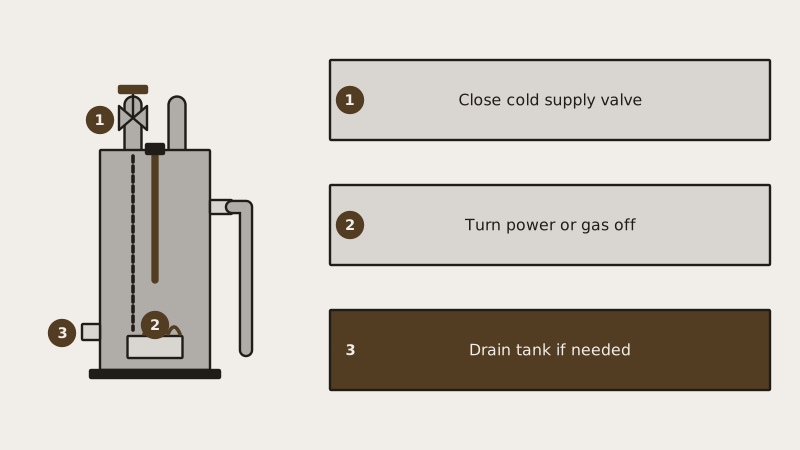
Remove the energy source, then the water, then protect the floor. A gas unit goes to pilot or off. An electric one gets its breaker flipped. Close the cold valve above the heater, and leave one hot tap running somewhere in the house until the dripping slows. After that you mop up and photograph the damage.
In order:
- Energy off. An element left powered in a draining tank burns out quickly.
- Cold water off at the valve on the line feeding the heater. If it is seized, use the main for the house.
- One hot tap open, upstairs if you can, to ease the pressure.
- Contain the spill. Lift rugs, lay towels, run a wet vacuum.
- Smell gas? Leave, and use 1-800-427-2200 (SoCalGas) once you are outside.
- Take photos for your own records and for your insurer.
For anything bigger than a drip, read how emergency water heater replacement works on the same day.
Repair a leaking heater, or retire it?
If the tank is sound, water heater repair is realistic for a leaking fitting, valve or drain. A hole in the tank cannot, since the steel has rusted through. Age is the second test: Rheem lists 8 to 12 years as the point where a professional's opinion is wise, because a cheap part is a poor bet on a tank that may fail next.
Consider replacement when:
- Water is escaping from the tank wall or the bottom seam.
- The heater is old, rusted at the fittings, or has been leaking on and off.
- Rust-colored hot water appears alongside the leak.
- A repair would eat much of what a new unit costs. Compare with the price of water heater replacement, and age is the topic of how long a water heater lasts.
Pasadena's hard water is part of this. Pasadena Water and Power measured 202 to 256 ppm hardness in 2025, around 13 grains per gallon, and notes that it causes buildup in water heaters and shortens their effective life. Rheem recommends flushing a tank every six months in hard water, instead of yearly. A spent anode rod, easy to forget about, leaves the tank steel unprotected, as the anode rod guide explains.
What does the plumber inspect on arrival?
The plumber pins down where the water leaves, then checks the usual culprits: supply and outlet joints, the relief valve and the pipe it drains through, the drain valve, any expansion tank and your house pressure. You are then offered a repair or a replacement, each with a price on paper.
A typical visit covers:
- The leak source, traced with a dry rag, not guesswork.
- House water pressure. High pressure makes relief valves open and shortens fixture life.
- Any expansion tank. The city's handout cites the code section that requires an approved one wherever a device stops pressure from easing back into the main.
- The gas or electrical connections, where relevant, since a heater changed on a gas line must pass inspection.
- A decision, repair or replace, with the reasons and the cost.
Fix-side detail lives on our page about repairing water heater leakage.
Which Pasadena rules govern a replacement?
Pasadena's Building and Safety Division states that every water heater replacement needs a plumbing permit. Its handout also calls for prior approval, anchoring against earthquakes, a relief-valve drain that ends outdoors and, in a garage, a raised stand and sometimes a crash post. Permits come from the Permit Center on North Garfield Avenue.
The details in the city's gas-fired water heater handout:
- Strapping: at least two restraints, one around the tank's upper section and a second low down, screwed into a wall stud with fasteners of at least 1/4 inch diameter reaching 1-1/2 inches in. The state requires this for earthquakes.
- Relief valve drain: no smaller than the valve outlet, hard-piped to the outside, ending 6 to 24 inches above grade, pointed downward, not trapped, not threaded at the end. Discharging into a pan under the heater is prohibited.
- Garage installs: the flame must be at least 18 inches above the floor, with a stand built to the handout's spec, and a crash post where a vehicle could strike the heater. The 20-by-20-foot garage dimension must be kept clear.
- Venting and clearances: per the manufacturer's listing and the city's vent rules.
These come from the city's published standards. The contractor with a California license on the job usually takes care of the permit and the inspection. Other valley cities have separate building departments, reached through where we work.
Who do I call, and how do I begin?
Phone immediately for water from the tank body, any gas smell, or a leak the valves will not stop. Water heaters bring gas or heavy electrical loads together with permits and strapping, which makes this contractor work, not a weekend repair. Through the quote form, a local plumber comes out and writes up the price.
Common questions
How many hours is a water heater leak repair?
Repairing a fitting or valve can be finished in about two hours. A full tank swap tends to take half a day to a full one: draining, setting and strapping the new unit, piping, venting and testing. The permit and inspection add steps, and the quote should state the timing.
What should I ask first?
Get the contractor license number from whoever quotes, then search it on the state's licensing site. Learn who pulls the Pasadena permit, and whether the price includes strapping, a fresh relief valve and drain run, an expansion tank where needed, and taking the old tank away. Also ask about written warranty terms from the maker and the installer.
Is every leak an emergency?
Act promptly. A slow leak still ruins flooring and drywall, and a damaged heater on a gas line raises a safety question. Stop its water and energy, then book a visit. A small weep at a fitting is less pressing than water running out of the tank body.
Must someone stay home during the work?
Somebody over eighteen must unlock the heater area and show where the water and gas shutoffs are, and you will have no hot water for a while. A replacement also brings a permit inspection, so plan to be around for that window or to let the inspector in.
Sources
- City of Pasadena Building and Safety Division, typical residential gas-fired water heater requirements
- City of Pasadena Building and Safety Division, work exempt from permit
- Rheem, how often to flush your water heater
- Pasadena Water and Power, 2026 Annual Drinking Water Quality Report
- SoCalGas, natural gas leaks
Page updated