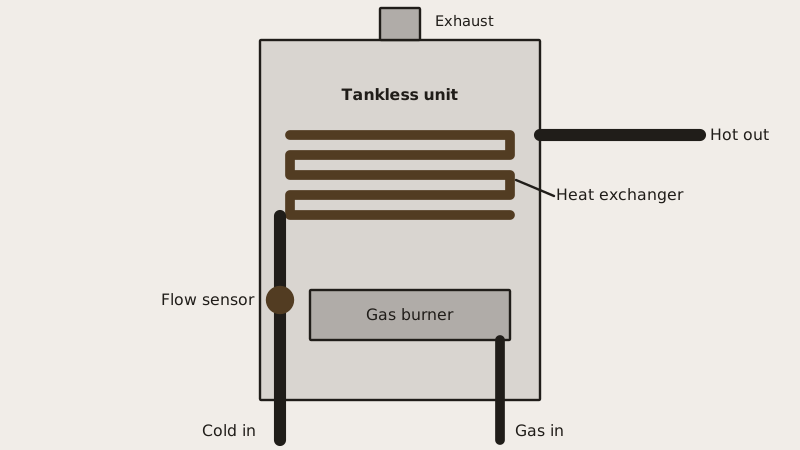
When people search for an instant water heater repair, they usually have a tankless, on-demand unit that warms water on the move rather than storing it. Typical faults: limescale in the heat exchanger, a grimy or loose flame rod, a plugged inlet screen, a vent problem or a dead control board. Cleaning the screen is about all an owner should try. The larger decision sits on our water heater replacement page.
Below: how instant heaters fail, which codes matter, what you can check without tools, what repair costs, and when a new unit is the smarter spend.
What does an instant heater repair cover?
It is the diagnosis and fix of a tankless heater that has stopped heating, or a fast repair on any water heater. Most searches mean the first. A tankless unit fires its burner or powers its elements only while water flows, so faults appear as cold water, lukewarm water, a blinking code or hot water that cuts out mid-shower.
Some people use the phrase to mean speed, a repair today. We cannot promise a time, because a visit depends on the plumber's schedule, but the emergency water heater page explains which situations are urgent and what to shut off in the meantime.
Tankless units come in gas and electric forms. A gas unit depends on gas flow, combustion air, a vent and a flame sensor, which gives it more ways to fail. An electric unit relies on heavy elements, a control board and a high-amperage circuit. Brand-specific fault patterns appear in our pages on Rinnai, Navien, Rheem and Noritz units.
Why would an instant heater go cold?
Gas models most often fail on ignition, flame sensing, venting or scale. A unit that clicks and never lights suggests a gas supply issue, a dirty flame rod or igniter, or clogged burner orifices. One that lights and then quits may have a flame rod fault, a vent that recirculates exhaust, or a heat exchanger choked with scale.
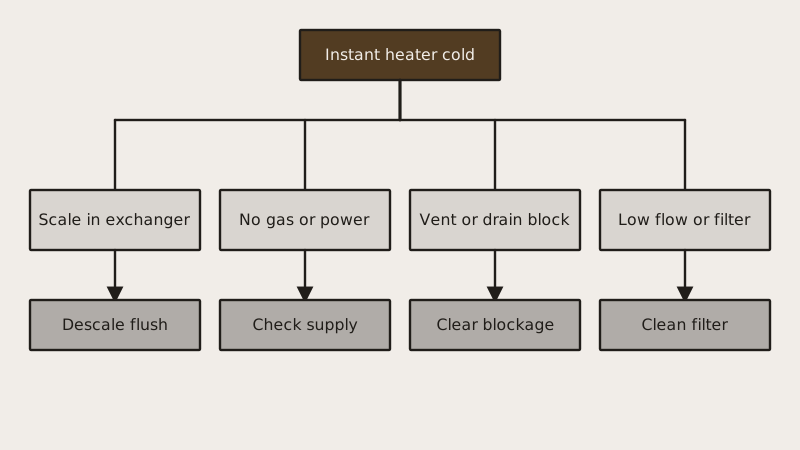
Rinnai's own diagnostic notes tie code 11 (no ignition) and code 12 (flame failure) to checks such as gas being on at the meter, correct gas type and pressure, air in the gas line, a loose flame rod or electrode, carbon or a white deposit on the igniter, and blocked burner orifices. A vent terminal that fails clearance rules can also feed exhaust back in and trigger code 12. Other brands use different codes, so read your manual.
Hard water adds a regular culprit. The 2025 Pasadena Water and Power report shows hardness of 202 to 256 ppm, about 13 grains per gallon at the average, and water that hard coats a heat exchanger. Rinnai's manual says that in hard water the supply must be treated or the exchanger flushed regularly, with scale flagged by LC-series codes or a service-soon indicator, and it notes that scale damage falls outside its warranty.
Flow matters as well. Instant heaters need a minimum flow to fire, so a clogged aerator, a nearly closed valve or weak supply pressure can make the unit shut off. Low hot water pressure lists causes, and no hot water covers tank types too.
Which checks are safe for an owner?
Start simple: power reaching the unit, gas valve open, water valves open, inlet screen clean and the display code written down. Then try a reset as the manual describes. If the code comes back, or gas is in the air, stop there, and never open the gas side or the combustion chamber.
A short checklist:
- Read the display. Write the code down and match it to your model's manual.
- Confirm power. A tripped breaker or loose plug silences the controls, and electric units have their own breaker.
- Confirm valves. The gas valve and both water isolation valves should be wide open.
- Clean the inlet screen. Close the cold valve, unscrew the filter, rinse out grit, refit it.
- Test flow. Open one tap; some units need a minimum flow to start. Clean aerators too.
- Eyeball the vent. A blocked or disconnected vent is a safety fault, so do not run the heater with it damaged.
If you smell gas, leave without touching a switch, then use the SoCalGas leak line from the street (it answers at 1-800-427-2200). Gas fittings are never a DIY job.
Some manuals describe a vinegar flush that needs isolation valves and a small pump, and a slip can harm the unit. Rinnai says to flush when scale codes appear and to have the appliance inspected every year by a qualified professional, so most owners are better off booking this one.
What does the repair cost?
Published 2026 guides put most tank water heater repairs between $100 and $500, with tankless repairs running up to about $1,300. A descale is often a fraction of that, while a new heat exchanger or control board can near the price of a fresh unit. Treat the numbers as a guide, because only the quote sets the figure.
What decides the bill:
- The part. Flame rods and filters are cheap. Heat exchangers and boards are not.
- Gas or electric. Gas faults involve more parts and safety checks.
- Scale. A heavily scaled exchanger may be past saving.
- Isolation valves. If none were fitted, adding them costs extra but makes later flushes easy.
- Access. Outdoor wall units are easy. Attic installs take longer.
Age counts. The Department of Energy credits tankless units with more than 20 years when cared for, so a failed board on a 12-year-old unit is a closer call than on a 4-year-old one. See what a new heater costs and the tankless install cost article for the gas and vent work behind it.
Is repair or replacement the better call?
Repair if the fault is an inexpensive part on a unit under a decade old. Replace if the heat exchanger is scaled through, an old unit's board has died, or the estimate edges toward the cost of buying a new one. If your household has outgrown the unit's flow rate, replacing it also lets you resize.
A few points specific to this area:
- Permits. Replacing a tankless heater is permitted work in Pasadena. The City's handout notes that these installs generally need gas line sizing calculations, a listed vent, combustion air and, for new electrical work, an electrical permit. Simple permits can be issued over the counter.
- Gas load. Tankless units usually draw far more gas than a storage tank, so the house's gas line and meter may cap what fits.
- Softening. In hard water, a water softener or scale inhibitor can protect the heat exchanger. Our softener installation page explains the options.
- Tank option. If a tankless conversion has been trouble, the tank versus tankless comparison helps you decide whether to switch back.
Older Pasadena houses with limited gas supply or tight closets can make tankless a poor fit, and a plumber should check gas sizing before any swap.
How do I get a repair booked?
Send the model, the display code and what the heater is doing. A local plumber, arranged by us, inspects gas, vent, water flow and controls and puts a price in writing first. Requests are read Monday through Friday, nine to five. Begin with the quote page. How it works shows what follows, and the home page has our other plumbing help.
Common questions
Will this eat up my whole day?
Cleaning a filter or swapping a flame rod may take a little over an hour. A flush takes longer, and a new board or heat exchanger may mean ordering a part and returning. Expect a time estimate once the fault is found.
What should I put to the plumber before saying yes?
Find out whether your brand is familiar to them, whether the price includes diagnosis and parts, whether a descale is needed and isolation valves are fitted, and what the repair warranty covers. Also get the contractor's license number and run a lookup through the state's contractor board.
Must I stay home during the repair?
An adult must unlock the door for the plumber and agree to the quote. Once the work begins you can often stay close by. Keep the unit and its vent reachable; an outdoor model may only need a gate unlocked.
Can an owner flush a tankless heater?
Some owners flush with vinegar where isolation valves exist, and manuals describe the steps. Errors can damage the unit or affect a warranty, and without valves a clean flush is impractical. Many owners book a plumber for the yearly service, particularly in hard water like Pasadena's.
Why does my tankless heater give lukewarm water?
Scale, low flow or a mismatch between demand and capacity. If two fixtures run at once, a unit sized for one may deliver lukewarm water. A clogged filter or aerator reduces flow, and a scaled heat exchanger cannot transfer heat well. A plumber can test flow and read the unit's history.
Sources
- Rinnai, Direct Vent Tankless Water Heater installation and operation manual (hard water, flushing, scale codes)
- City of Pasadena Building and Safety Division, tankless water heaters
- Pasadena Water and Power, 2026 water quality report (2025 data)
- SoCalGas, natural gas leaks
- U.S. Department of Energy, Energy Saver guide (water heater lifespans)
- Angi, cost to repair a hot water heater (2026)
Page updated