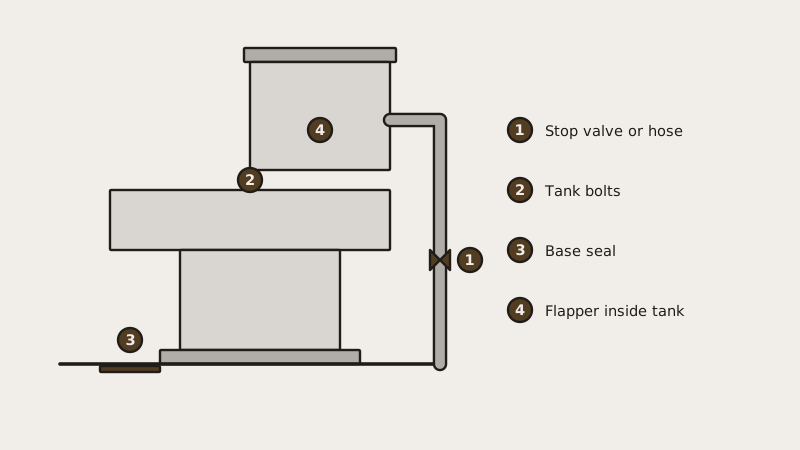
Five spots account for nearly every puddle beside a toilet: the wax seal under the bowl, the bolts that hold tank to bowl, the braided hose, the little wall valve, and hairline cracks in the china itself. Which one you have decides whether this is a ten-dollar Saturday job or a call to a plumber. Our general toilet repair guide covers the wider picture. This page is for the wet floor in front of you, and the quote form is there when you want a plumber arranged with a written price.
How do I figure out which part is leaking?
Dry everything, then use tissue as a detector. Press a fresh piece against the hose, the valve body, each tank bolt and the rim where the bowl meets the floor. The first tissue to go dark names the culprit. Water that shows up only after a flush leans toward the seal or bolts, while a steady drip leans toward the supply side.
| Wet spot | Probable cause | Usual fix |
|---|---|---|
| Floor at the base, worse after flushing | Seal gave up or bolts slackened | Plumber lifts the toilet |
| Drip under the tank | Rubber washers on tank bolts | Small repair, often DIY |
| Wall valve or hose | Packing nut, worn hose | DIY or plumber |
| Sweaty tank, damp floor | Condensation | Liner or humidity control |
| Visible crack | Split tank or bowl | New toilet |
Condensation fools many people. On a humid day a cold tank grows beads of water on the outside that run to the floor, with nothing broken at all. If the dampness comes and goes with the weather and the dye test further down stays clean, that is your answer.
What stops the water right now?
Reach behind the toilet, find the small oval handle on the wall pipe and keep rotating the handle in the closing direction until it stops. Flush once to empty the tank, then mop up. If that valve spins uselessly or keeps weeping, go to the whole house's main shut-off and close it instead.
Treat a base leak as a no-flush situation, since every flush shoves more water out under the bowl and into the floor beneath. If the toilet must be used, pour a bucket into the bowl to make it go. Keep clear of cords and outlets while the floor is wet, and photograph the damage in case of an insurance claim. When the bathroom sits above a room, water leaking through a ceiling explains the next steps.
A valve that will not behave is a repair in itself. Why toilet shut-off valves fail explains what replacing one involves.
Could the tank be leaking into the bowl without any puddle?
Yes, and it is the sneakiest kind. A worn flapper lets water creep past into the bowl all day and night, so the floor stays dry while the meter spins. Add a few drops of dye to the tank water, skip the flush for ten minutes, and watch the bowl. Colored water there confirms the leak.
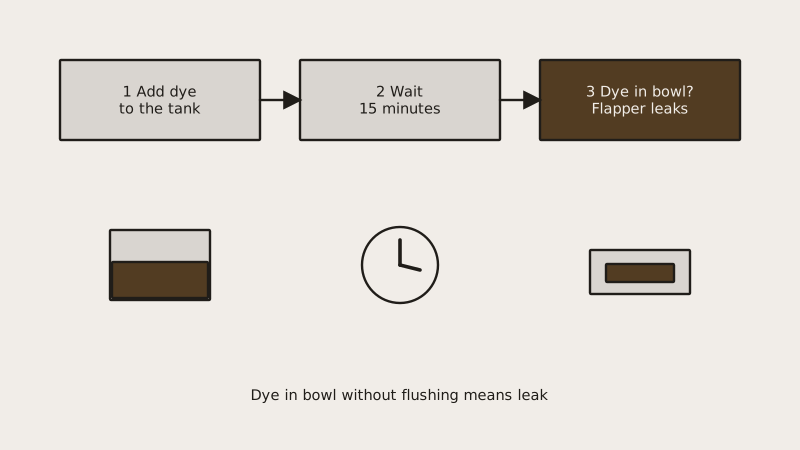
EPA's WaterSense program puts the typical household's yearly leak loss at over 9,300 gallons, with toilets among the usual sources. The dye test also sorts your problem into two bins. A clean bowl with a wet floor means the water is escaping outside the china. Color in the bowl with a dry floor means the flapper, covered by toilet flapper repair and the guide to a toilet that runs. Both faults can coexist.
Sometimes the first clue is financial. Should the water bill leap while nothing looks damp, the guide on a bill that suddenly climbs says where to look, and the dye test is step one.
Which toilet leaks should go to a plumber?
Hand it over when water seeps out where the bowl meets the floor, when the floor feels spongy or stained, when china is cracked, or when you cannot get the water to stop at the valve. A seal replacement means lifting the whole toilet, inspecting the flange and setting it back, and a rotten floor or broken flange is carpentry and plumbing in one visit.
Bathrooms in Pasadena's older neighborhoods stack the odds. Bungalows from the early to mid twentieth century often drain through iron or clay, and the flange bolted to that pipe may have rusted or dropped below the tile line. A floor that has seeped for months hides rot worth far more than a wax ring. One plumber on one visit can lift the toilet, probe the subfloor, mend the flange and reset on a new seal.
Mind the legal line too. A leak that has ruined a floor and a drain can outgrow handyman work fast, because California asks for a contractor license when labor plus parts reach $1,000, or sooner if a permit is needed.
What do toilet leak repairs cost?
Cost guides put most toilet repairs between about $150 and $400. A wax seal reset lands near $150 to $350, a damaged flange adds $250 to $500, and cheaper repairs such as a flapper or fill valve sit lower, near $50 to $200. Cracked china starts a different conversation about a new toilet. Take these figures as orientation, with the real number in your written quote.
| Leak source | Typical plumber range |
|---|---|
| Flapper or fill valve | $50 to $200 |
| Wax seal reset | $150 to $350 |
| Flange repair | $250 to $500 |
| New toilet, installed | see toilet installation cost |
Parts barely register, usually under $50 for a seal, bolt set or hose, so most of the figure is labor and the plumber's minimum. Ask the quote to state the condition of the flange, because that is where surprises live.
How do I keep it from leaking again?
Fit a fresh seal whenever the toilet comes up, make sure the flange sits level with the finished floor, and bring the bolts down evenly without cranking. Swap rubber hoses and old valves while the bowl is off. Look at them again each year. And replace the flapper on EPA's schedule of at least every five years.
Local water adds a twist. In its latest report Pasadena Water and Power lists hardness near 12 to 15 grains per gallon, so scale builds up under washers and valve seats until they stop sealing. Wipe the bolt heads and valve joints and run a dry finger over them every few months; a slow drip is easy to catch early. If water has already reached a neighboring wall or the room below, a toilet-related burst pipe lists the shut-off order.
Common questions
Can a toilet leak lead to mold or rotten flooring?
It can when water keeps reaching the floor. Grout darkens, the subfloor softens, vinyl lifts and a musty smell appears. Dry the area, stop the leak and have a plumber press on the floor around the base. A spongy spot means the damage goes deeper than the surface.
Is it fine to keep using a leaky toilet?
Not if it leaks at the base, because each flush spreads water into the floor. If only the tank sweats or a hose drips and the valve is closed, you can refill the tank by hand and flush with a bucket. When unsure, leave the valve closed and call someone.
Why does the floor get wet right after I flush?
A flush sends a surge through the joint beneath the bowl, so timing like that blames the wax seal or the closet bolts. A rocking toilet makes it worse. Resist tightening bolts hard, since a cracked base is the penalty. The seal and flange need an inspection.
Will my water utility or insurer pay for it?
A leak inside the house is generally the owner's responsibility, though asking the water utility about any adjustment costs nothing. Insurance may pay for sudden damage and often excludes slow leaks. Read the policy, speak to your agent and keep photos, the plumber's invoice and the date you first noticed.
What if the water smells foul or looks dark?
That suggests the drain side, usually the seal or flange, not clean supply water. Children and pets should stay clear, and surfaces need disinfecting once the repair is done. An odor with no visible leak may have another origin; the page on sewer smell lists the candidates.
Our other plumbing services sit on the Pasadena Pipe Works home page.
Sources
- U.S. EPA WaterSense, Fix a Leak Week
- California Contractors State License Board, what kind of contractor do you need
- Published toilet repair prices from several plumbing cost guides, checked November 2026
Page updated