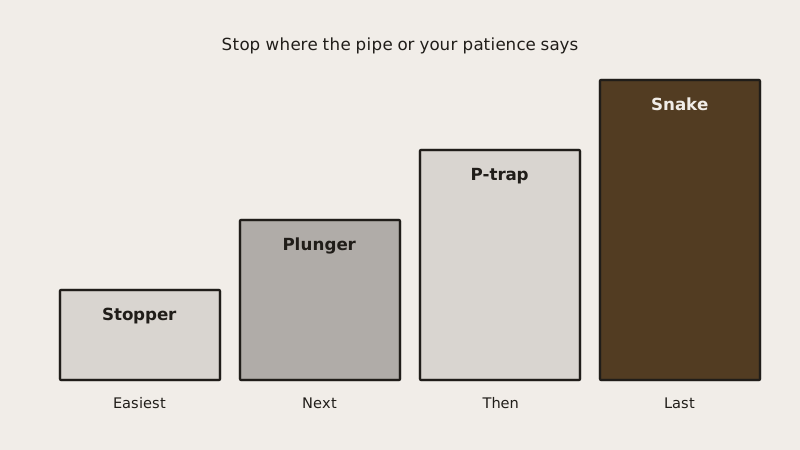
Most bathroom sinks that drain slowly have the same culprit: a hairy, soapy plug sitting on the stopper or in the first few inches of pipe. Lift the stopper out, clean it, and the basin often runs freely again within minutes. If it does not, a cup plunger, the curved trap under the basin, and a hand tool come next. A drain that fails along with a tub or toilet is a plumber's job. For a blocked toilet, go to clogged toilet help.
The ladder below runs from the gentlest fix to the most involved, along with the clues that tell you the blockage lies deeper than the sink.
Where should I begin with a sluggish bathroom basin?
Start at the stopper. Take it out, wipe off the slime, and fish out whatever hangs below with a notched plastic strip or a hook bent from a coat hanger. Hair makes up most of the blockage, and it tends to snag close to the opening. Discard the wad, then flush with warm tap water.
Getting the stopper out depends on its design:
- Twist-and-lift type. Turn counterclockwise, then pull straight up.
- Pop-up linked to a lever. Under the basin, locate the horizontal rod where it meets the tailpiece, back off the retaining nut, slide the rod free, and the stopper lifts out.
- Fixed grid. Work the strip or hook through the slots instead.
Spread a towel and set a bowl beneath before you start, because the wad that comes up is gray and greasy. It forms when soap, toothpaste and skin oil act as glue for loose hair. Hard water in Pasadena quickens the process. The utility's 2025 report gives hardness of 202 to 256 ppm, so mineral scale and soap curd stiffen the plug faster than they would in softer supply.
Also look at the overflow slot near the rim of the basin. Residue gathers behind it, and a bottle brush pushed through that slot can cure a stale smell along with the slow flow.
Will a plunger work on a bathroom basin?
Usually, yes. Block the overflow slot with a damp rag, keep a shallow pool in the basin, seat a small cup plunger squarely over the drain, and make twelve or so strokes without breaking the seal. Snap it free on the last stroke. Water spinning away means the plug has shifted.
The rag is not optional. Without it, force leaks out the overflow instead of travelling down the pipe. Pick a compact cup plunger, since the flanged toilet type seals poorly on a flat drain.
On chemical cleaners: skip them. Poison Control cautions that drain products hold strong alkalis or acids capable of burning skin and eyes, that swallowing them is dangerous, and that mixing cleaning products can release poisonous fumes. The EPA's alternative is a plunger or a plumber's snake. A cleaner left sitting in a blocked basin also turns the next person's trap-opening job into a hazard. Anyone hurt needs 911, and Poison Control's line is 1-800-222-1222.
Plunging with no result tells you something too. A sink that stays slow and gurgles while other fixtures run funny may have an air problem, such as a blocked vent. Clogged drain vents explains how to recognize one.
What does cleaning the trap involve?
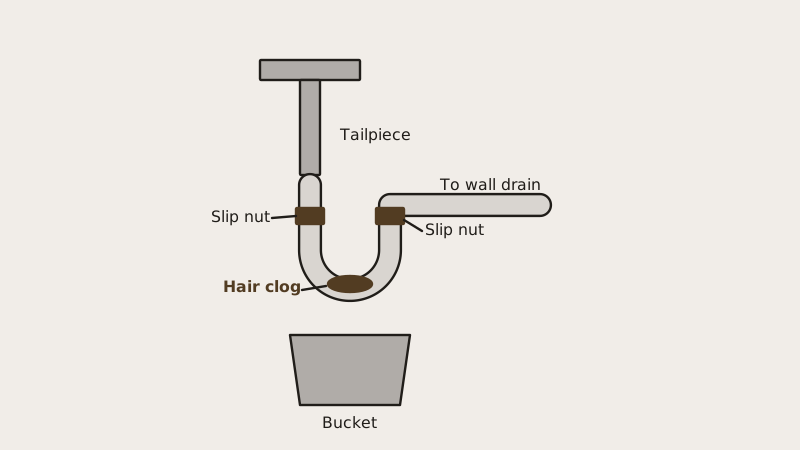
Slide a pail under the U-shaped pipe beneath the basin, loosen the two coupling nuts by hand, drop the trap, tip out the muck, scrub it, and refit it. Snug by hand, then a quarter turn more, is enough. Then run water and check every joint for weeping. This one step defeats many stubborn sink clogs.
In sequence:
- Empty the cabinet floor and position the pail.
- Back off the nut at the tailpiece and the one at the wall-side pipe, then slide each down its pipe.
- Lower the trap. Expect a foul, dark sludge.
- Scrub the bore with a bottle brush. Inspect for hairline cracks and flattened washers.
- Reassemble with the washers facing the way they came out, thread the nuts by hand, add a quarter turn.
- Open the tap and dab each joint with tissue to catch a slow drip.
Treat an old metal trap gently. In a Craftsman-era bathroom the chrome-plated brass or steel pipe may be badly corroded, and a seized nut or a crumbling elbow means stop and phone a plumber. Pipes under a basin can start weeping after being disturbed, a subject taken up in fixing a leak below the sink.
One regulatory note. The Pasadena Building and Safety Division's exemption sheet says clearing a stoppage or stopping a leak needs no plumbing permit, so an owner can do this work. Replacing pipes or fixtures is different and may call for one.
When is a drain snake worth using?
When the plug sits beyond the trap and the plunger has failed, a hand auger or a toothed plastic strip is the next tool. Feed it down with a gentle twist until it stops against something, then jiggle it in and out to snag or break up the clog. Retrieve the tool, flush, and repeat if flow is still poor.
A plastic strip costs very little and grabs hair well. A short metal auger reaches farther but can scratch porcelain and chrome, so shield the fixture and keep the handle rotating rather than shoving. A hard stop, or a cable that returns clean, means the blockage may be past what a sink tool reaches. Never force the cable through a tight bend or a cracked trap arm. Wear gloves.
Read the clues about location:
- Just this basin crawls. The clog is in its trap or the short branch behind the wall.
- The neighboring tub or shower gurgles. The blockage has moved down the shared branch.
- Several fixtures slow, or a toilet bubbles. That implicates the main line, and snaking one sink will not cure it. Related warning signs appear in the guides to sewer smell indoors and clogged shower drains.
- Gurgle plus a sewer odor, no visible clog. Suspect the vent or a dried-out trap. Pour water in to refill it.
When does a plumber take over?
Bring one in when the plunger, trap and hand tool all fail, when more than one fixture runs slow, when water rises in the tub or a toilet, when pipes under the basin are corroded or dripping, or when the clog returns. A repeating clog suggests a sag in the line, roots, scale or old cast iron, and a camera can show which.
Pasadena's older housing is part of why clogs return. Plenty of houses from the Craftsman years through the 1950s drain via cast iron or clay, which scales, cracks and snags hair and grease. If that describes your home and the blockage returns every few months, read about cast iron pipes before spending more on cleaners. In a condo or apartment, a backup touching several units belongs to the building's drain stack, so tell the manager first.
A plumber finds the clog, clears it using a cable or camera-guided equipment, and reports whether the pipe itself needs work. We publish no price for this small job because it depends on access and distance, so the figure arrives in a written quote. Scale is also worth asking about; hard water scale describes what it does to drains and fixtures.
To arrange a visit, send the quote request. How it works explains the steps, requests are read Monday through Friday, nine to five, and the home page has our other plumbing services. For another take on the same drain, see bathroom sink drain clearing.
Common questions
Is boiling water safe for a bathroom drain?
Skip it. Boiling water poured onto a porcelain basin can crack it, and it can soften plastic pipe joints. Hot water straight from the tap is fine and cuts through soap scum. Hair will not melt, so a physical tool is what clears a hair plug.
Will baking soda and vinegar clear the drain?
It can freshen a drain and loosen a light film, but it seldom shifts a hair clog, and the foam may push water back up. It is far milder than commercial cleaners. If you try it, do not follow with a chemical product, and keep other household cleaners out of the mix.
What makes my bathroom sink clog again and again?
Hair, toothpaste, soap film and mineral scale cling to the pipe wall and stack up, especially at a shallow trap or on a pop-up crossbar. Rough or old pipe catches more. Cleaning the stopper monthly helps. A clog that comes back time after time deserves a camera inspection.
Does a gurgling drain mean something bigger is wrong?
Possibly. Gurgling means air is being dragged through the water seal, often by a partial clog or a blocked vent. If one sink does it, clear that drain. If several fixtures gurgle, the main line or vent may be involved and a plumber should look.
Whose job is a clog in a condo?
If only your sink is slow, clearing it is yours. If neighbors have backups or it keeps recurring, the shared stack is probably the cause, and the association or manager is responsible for that line. Tell them, and have them call the plumber so access and responsibility are clear.
Sources
Page updated